On this page
- What Is Trimix Flooring?
- What Types Are Laid in India?
- What Are the Main Benefits?
- Where Is It Used?
- How Is Trimix Flooring Installed?
- How Does It Compare with Regular Concrete and PCC?
- How Much Does Trimix Flooring Cost?
- How Do You Maintain the Floor?
- What Is the Environmental Impact?
- How Do You Choose a Contractor?
- Trimix flooring is a machine-finished concrete floor, vacuum dewatered after pouring.
- "Trimix" comes from Tremix, a Swedish equipment brand; the generic name is VDF.
- Dewatering pulls out about 15–25% of the mixing water, giving a denser, harder top.
- Plain trimix costs about ₹60–110 per sq ft before GST.
- Most failures come from late joint cutting and poor curing, not from the concrete.
Trimix flooring is a concrete floor finished in three machine stages: vibration screeding, vacuum dewatering and power trowelling. The result is a dense, level, hard-wearing slab for warehouses, factories and parking areas.
What Is Trimix Flooring?
Trimix flooring is a cast-in-place concrete floor from which a vacuum pump sucks out surplus water soon after pouring. The slab is then power-floated and trowelled to a smooth, dense finish.
The slab is M20 to M30 concrete over a compacted sub-base and a PCC (plain cement concrete) base. Heavier floors add steel mesh, making the slab RCC (reinforced cement concrete).
VDF (vacuum dewatered flooring) names the process. "Trimix" is a spelling of Tremix, the brand of Tremix AB, Sweden, whose equipment reached India in 1987. Sellers use the names interchangeably. For the dewatering science and VDF vs IPS, read our VDF flooring guide.
What Types Are Laid in India?
Trimix floors in India come in four main types, set by reinforcement and surface hardener. Your engineer picks one from the expected loads.
Trimix flooring types
Rates before 18% GST, June 2026| Type | Thickness | ₹ per sq ft | Best for |
|---|---|---|---|
| Plain (PCC) trimix Budget | 100–150 mm | 60–110 | Godowns, showrooms, parking |
| With non-metallic hardener Default pick | 100–150 mm | 90–150 | Warehouses with forklift traffic |
| With metallic hardener | 100–150 mm | 130–200 | Heavy, dry factory floors |
| Heavy RCC trimix | 150–200 mm+ | 120–200+ | Point loads, racking, trucks |
What Are the Main Benefits?
The main benefits of trimix flooring are a harder, denser surface, a flat finish and fast large-area work. Removing water lowers the water-cement ratio at the top, where wear happens.
- Strength and wear resistance: the dense top layer resists abrasion from wheels and pallets.
- Load capacity: a designed slab carries racking, forklifts and vehicles.
- Less shrinkage and curling: lower water content means fewer surface cracks.
- Low upkeep: no waxing; sweeping and joint care are enough.
Trimix pays off on large, open areas. Contractors often quote a minimum of 1,000–5,000 sq ft, because moving the machines to site costs the same for any size.
Where Is It Used?
Trimix floors suit any site where wheels, machines or heavy goods move daily:
- Warehouses and logistics parks, such as those around Bengaluru's Hoskote and Nelamangala belts
- Factories and workshops in industrial areas like Peenya and Bommasandra
- Basement and stilt car parks in apartments
- Showrooms, supermarkets and cold-storage floors
- Driveways, godowns and service yards at homes
How Is Trimix Flooring Installed?
Trimix flooring is installed in strips about 4 m wide, one panel at a time, so each pour is dewatered and trowelled before it sets. The concrete grade, thickness and timings come from your project specification.
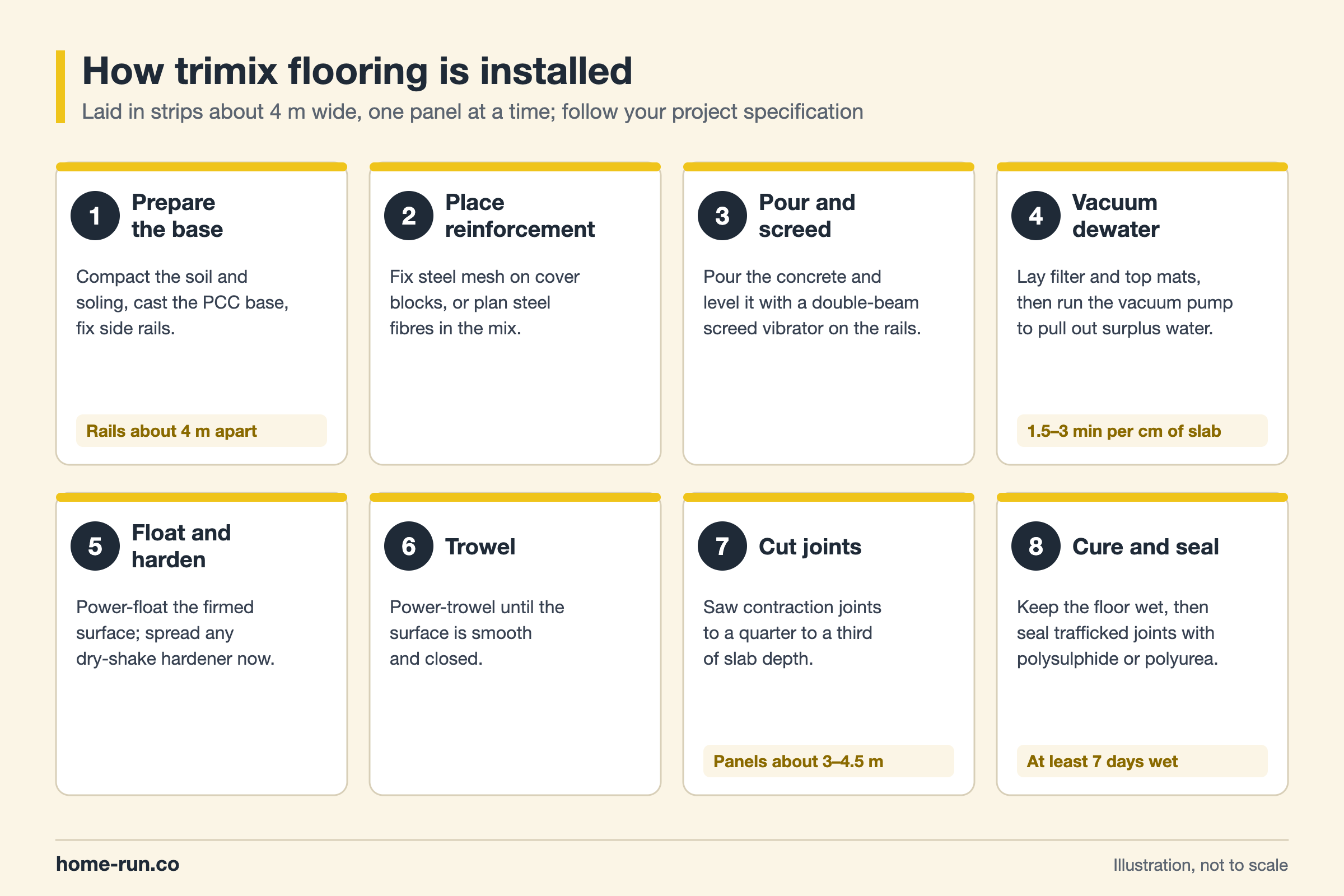
- Prepare the base. Compact the soil and soling, cast the PCC base and fix side rails about 4 m apart.
- Place reinforcement. Fix steel mesh with cover blocks, or plan steel fibres in the mix.
- Pour and screed. Pour the concrete and level it with a double-beam screed vibrator running on the rails.
- Vacuum dewater. Lay the filter and top mats and run the pump for about 1.5–3 minutes per cm of slab thickness.
- Float and harden. Power-float the firmed surface; spread any dry-shake hardener at this stage.
- Trowel. Power-trowel until the surface is smooth and closed.
- Cut joints. Saw contraction joints into panels of about 3–4.5 m each way, to a quarter to a third of slab depth.
- Cure and seal. Keep the floor wet for at least 7 days, then fill trafficked joints with polysulphide or polyurea sealant.
How Does It Compare with Regular Concrete and PCC?
Trimix is harder at the surface and flatter than a hand-laid concrete floor, but needs machines and a trained crew. A PCC base alone is a levelling layer, not a wearing floor.
Trimix (VDF) floor
Heavy trafficPoint
- Dense, dewatered top resists wear and dusting
- Machine-flat finish over large panels
- Needs pumps, trowels and an experienced crew
- Higher cost, with a minimum viable area
Regular concrete floor
Small areasPoint
- More surplus water, so a weaker, dustier top
- Hand-finished, so less flat over big areas
- Any mason can lay it with basic tools
- Lower cost and suits small jobs
For chemical spills or a hygienic finish, trimix is often the base for a coating; see our epoxy flooring guide.
How Much Does Trimix Flooring Cost?
Plain trimix flooring costs about ₹60–110 per sq ft with material, before 18% GST (Studio Matrx, June 2026). On IndiaMART in November 2026, listings ran from about ₹5 to ₹95 per sq ft; the lowest are labour-and-machine rates, with the client supplying concrete.
Many quotes start from the 1:1.5:3 nominal mix explained in our M20 concrete ratio guide.
Preparing the base for a trimix floor?
Cement, aggregates and steel delivered across Bengaluru.
How Do You Maintain the Floor?
A trimix floor needs regular sweeping, damp mopping and joint care.
- Routine cleaning: sweep grit daily and mop with a neutral cleaner.
- Dusting: a powdery surface points to weak curing; a concrete densifier can harden it.
- Cracks: seal hairline cracks before wheels break the edges.
- Joints: replace worn joint sealant so wheels do not chip panel edges.
What Is the Environmental Impact?
Trimix has the footprint of any concrete floor, mostly from cement. Its green point is long life before resurfacing.
Curing uses water for a week, and the water drawn out carries cement fines. Let it settle on site instead of draining it into storm drains.
How Do You Choose a Contractor?
Choose a trimix flooring contractor on proof of similar floors, not the lowest rate. Walk away if you see:
- No site visits: they cannot show a floor of similar size and load.
- Vague rate: the quote does not say whether concrete, hardener and GST are included.
- No joint plan: panel size, cutting time and sealant are not written down.
- No curing plan: who keeps the floor wet for 7 days is left unclear.
Get slab thickness, grade and joint layout from a structural engineer, then compare three itemised quotes on that specification.