On this page
- What Are CPVC Pipes and Why Do Homes Use Them?
- What Does IS 15778 Require From CPVC Pipes?
- Which CPVC Pipe Brands Are Sold in India?
- How Do CPVC Pipe Brands Compare on Specifications?
- How Do You Choose Between CPVC Pipe Brands?
- Should You Buy SDR 11 or SDR 13.5 CPVC Pipes?
- Where Are CPVC Pipes Used and How Are They Installed?
- What Should You Check Before Buying CPVC Pipes?
- Every brand here states its home-plumbing CPVC pipes conform to IS 15778, the BIS standard for CPVC pipes for potable hot and cold water.
- Pick SDR 11 or SDR 13.5 by pressure need. IS 15778 rates SDR 11 at 2.76 MPa and SDR 13.5 at 2.18 MPa at 27°C.
- All six brands sell 15–50 mm (½" to 2") home sizes. They differ in larger sizes, compound source, NSF listings and warranty terms.
- Ashirvad, Apollo and Prince name Lubrizol resin or the FlowGuard Plus brand. Supreme cites Japanese material and technology.
CPVC pipe brands sold widely in India include Apollo Pipes, Ashirvad, Astral, Finolex, Prince and Supreme. Each one states its CPVC pipes for home hot and cold water conform to IS 15778, so the real differences sit in data-sheet details.
This list is alphabetical, not a ranking. Figures come from each maker's product page or manual and the IS 15778 text.
What Are CPVC Pipes and Why Do Homes Use Them?
CPVC pipes are plastic water pipes made from chlorinated polyvinyl chloride, a PVC resin with extra chlorine that lets the pipe carry hot water. Homes use them for both hot and cold supply lines.
- Heat tolerance: IS 15778 covers water service up to and including 82°C.
- No rust or scale from the pipe: CPVC does not corrode the way galvanised iron does.
- Solvent-weld joints: no threading or heat tools.
- Design life: Prince and Astral quote 50 years, a design claim, not a warranty.
uPVC (unplasticised PVC) is meant for cold water. CPVC is the grade for hot and cold water, so never run geyser lines in uPVC.
What Does IS 15778 Require From CPVC Pipes?
IS 15778:2007 is the Bureau of Indian Standards (BIS) specification for CPVC pipes for potable hot and cold water distribution. It sets pipe classes, sizes, lengths, tests and markings.
IS 15778 pipe classes and working pressure
Working pressure in MPa (kg/cm² in brackets)| Class | SDR | At 27°C | At 82°C |
|---|---|---|---|
| Class 1 Common for homes | 11 | 2.76 (28.14) | 0.68 (6.93) |
| Class 2 | 13.5 | 2.18 (22.23) | 0.55 (5.60) |
| Class 3 | 17 | 1.73 | 0.42 |
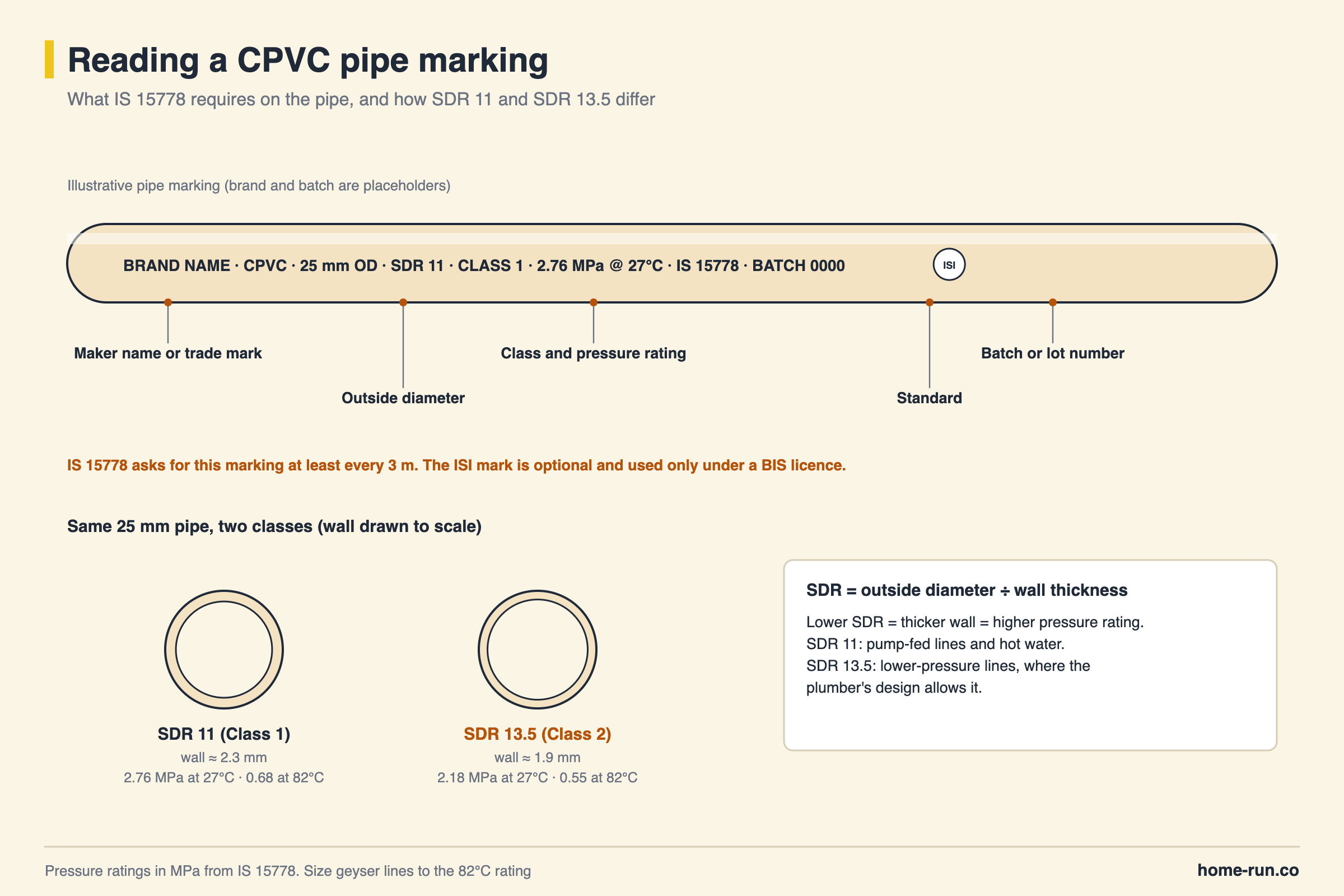
SDR (standard dimension ratio) is the outside diameter divided by wall thickness. A lower SDR means a thicker wall and a higher pressure rating.
IS 15778 also requires each pipe to be marked at least every 3 m with these details:
- Manufacturer's name or trade mark
- Outside diameter
- Class of pipe and pressure rating
- Batch or lot number
- Optional: the BIS Standard Mark (ISI mark), used only under a BIS licence
Which CPVC Pipe Brands Are Sold in India?
The CPVC pipe brands below all make IS 15778 pipes in SDR 11 and SDR 13.5. They are listed alphabetically, with what each maker publishes.
1. Apollo Pipes (CPVC-X)
Apollo Pipes sells its CPVC range as the CPVC-X Extra Strong Plumbing System. Apollo lists ISI certification for pipes to IS 15778 and fittings to IS 17546.
- Classes and sizes: SDR 11 and SDR 13.5 from 15 to 50 mm; Schedule 40 and 80 from 65 to 100 mm.
- Compound: TEMPRITE CPVC resin from Lubrizol.
- Temperature: stated up to 93°C.
2. Ashirvad (FlowGuard Plus)
Ashirvad, part of the Belgian Aliaxis Group since 2018, sells CPVC under the FlowGuard Plus name, a Lubrizol trade mark. Ashirvad states its pipes use Lubrizol raw material.
- Standards: IS 15778:2007 and ASTM D2846, the US standard for CPVC hot and cold water systems.
- Classes and sizes: SDR 11 and SDR 13.5, ½" to 2".
- Certifications listed: NSF/ANSI 61 and IAPMO India on the SDR 13.5 product page.
3. Astral (CPVC Pro)
Astral sells CPVC Pro pipes in copper tube size (CTS) and iron pipe size (IPS).
- Classes and sizes: SDR 11 and SDR 13.5 from 15 to 50 mm; Schedule 40 up to 150 mm and Schedule 80 up to 300 mm.
- Ratings: maximum service temperature 93°C; limiting oxygen index (LOI) of 60.
- Certification and warranty: NSF International certification; a 25-year warranty document is linked.
4. Finolex Industries
Finolex Industries makes CPVC pipes to IS 15778 in 15–50 mm and to ASTM F441 in 65–150 mm, in Schedule 40 and 80.
- Pressure: SDR 11 at 28.14 kg/cm² (27°C) and 6.93 kg/cm² (82°C), in line with the code.
- Temperature: recommended for water up to 82°C.
- Lengths: 3 m and 5 m.
5. Prince Pipes (FlowGuard Plus)
Prince Pipes also sells CPVC under the FlowGuard Plus name. Its technical manual names Lubrizol TEMPRITE compounds certified to NSF/ANSI 14.
- Classes and sizes: SDR 11 and SDR 13.5 from ½" to 2"; Schedule 40 and 80 from 2½" to 10".
- Temperature: suitable for use up to 93°C.
- Warranty: covers manufacturing defects; not valid when mixed with other makers' products.
6. Supreme Industries (Lifeline)
Supreme Industries sells CPVC as the Lifeline hot and cold water system. Supreme cites Japanese material and technology for the range.
- Classes and sizes: SDR 11 and SDR 13.5 from 15 to 50 mm, plus SDR 9 in ¾" and 1" to company standard.
- Larger sizes: Schedule 40 and 80 pipes from 65 to 250 mm.
- Approvals: NSF USA for the system and CFTRI approval for potable water.
How Do CPVC Pipe Brands Compare on Specifications?
CPVC pipe brands match closely on the IS 15778 basics. They differ on stated maximum temperature, large sizes, compound source and published warranty.
CPVC pipe brands compared on published specs
Alphabetical, not ranked| Brand | Home range | Stated max temp | Largest size | Compound named | NSF listed | Warranty online |
|---|---|---|---|---|---|---|
| Apollo CPVC-X | SDR 11, 13.5 | 93°C | 100 mm | Lubrizol TEMPRITE | Not stated | Not stated |
| Ashirvad FlowGuard Plus | SDR 11, 13.5 | Not stated | Schedule 40/80 listed | Lubrizol | NSF/ANSI 61 | Term not given |
| Astral CPVC Pro | SDR 11, 13.5 | 93°C | 300 mm | Imported resin | Yes | 25 years |
| Finolex | SDR 11, 13.5 | 82°C | 150 mm | Lead-free, not named | Not stated | Not stated |
| Prince FlowGuard Plus | SDR 11, 13.5 | 93°C | 250 mm | Lubrizol TEMPRITE | Compound and cement | Defects, terms apply |
| Supreme Lifeline | SDR 11, 13.5 (+ SDR 9) | Not stated | 250 mm | Japanese material | NSF USA | Not stated |
IS 15778 rates pipes for water up to 82°C. Some makers state 93°C as a maximum service temperature, at lower pressure. For a geyser line, size the pipe to the 82°C rating.
How Do You Choose Between CPVC Pipe Brands?
Choose between CPVC pipe brands by checking certification, class, system fit and support, in that order.
- BIS licence: ISI mark and IS 15778 on the pipe; verify the licence on the BIS website.
- Pressure class: SDR 11 for pump-fed lines and hot water; SDR 13.5 where the plumber's design allows it.
- Drinking-water listing: NSF/ANSI 61 or similar, for third-party proof.
- Full system: fittings to IS 17546 or ASTM D2846, and the same brand's solvent cement.
- Written warranty: term, cover and claim process.
Mixing brands of pipe and fitting, using uPVC cement on CPVC, or buying pipes with no class marking. Prince's warranty excludes use with other makers' products.
Should You Buy SDR 11 or SDR 13.5 CPVC Pipes?
SDR 11 is the safer default for most homes because its thicker wall carries more pressure at every temperature. SDR 13.5 is a lighter class for lower-pressure lines.
SDR 11 (Class 1)
Higher pressure- 2.76 MPa at 27°C
- 0.68 MPa at 82°C
- Thicker wall for the same size
- Suits pressure pumps and geyser lines
SDR 13.5 (Class 2)
Lower pressure- 2.18 MPa at 27°C
- 0.55 MPa at 82°C
- Thinner wall, lighter pipe
- Suits gravity-fed lines where designed for it
For a full list of what goes into a home water system, see our plumbing materials list for house construction.
Where Are CPVC Pipes Used and How Are They Installed?
CPVC pipes are used for hot and cold drinking-water lines in homes, apartments and commercial buildings, with Schedule 40 and 80 sizes for larger risers.
In Bengaluru homes, CPVC typically runs from the overhead tank or pressure pump to bathrooms, kitchens, geysers and solar water heaters. The steps below show the basic solvent-weld method:
- Cut the pipe square with a CPVC cutter. Our guide to pipe cutters and cutting wheels covers the tools.
- Deburr, chamfer and dry-fit the pipe to check socket depth.
- Apply CPVC solvent cement to the pipe end and the fitting socket.
- Push in with a quarter turn, then cure for the time on the cement tin before testing.
Leave pressure testing and concealed work to a trained plumber. For layouts, see our bathroom plumbing guide for homeowners.
What Should You Check Before Buying CPVC Pipes?
Check five things before you buy CPVC pipes: marking, class, system match, cement and paperwork.
- IS 15778, ISI mark, size and SDR class printed on every pipe
- One class across the job, usually SDR 11
- Fittings and valves from the same brand and size series (CTS or IPS)
- CPVC solvent cement from the same brand, within its use-by date
- Written warranty terms and a GST invoice kept on file
Planning a plumbing job?
CPVC pipes, fittings and solvent cement delivered across Bengaluru.