On this page
- What Are the Different Types of Hammer and Their Uses?
- How Do the Types of Hammer Compare on Weight and Handle?
- How Do You Choose the Right Type of Hammer?
- How Do You Use a Hammer Safely and Effectively?
- How Do You Maintain and Store Hammers?
- Where Can You Buy Hammers in India?
- The common types of hammer are claw, sledge, ball peen, cross pein, club, mallet, tack and dead blow hammers.
- A claw hammer drives and pulls nails; a sledgehammer breaks concrete and drives stakes.
- Ball peen and cross pein hammers shape metal; mallets strike without marking the surface.
- Match head weight to the job and to your arm, and pick a face about 12 mm wider than any tool you strike.
- Wear eye protection and retire any hammer with a chipped face or loose handle.
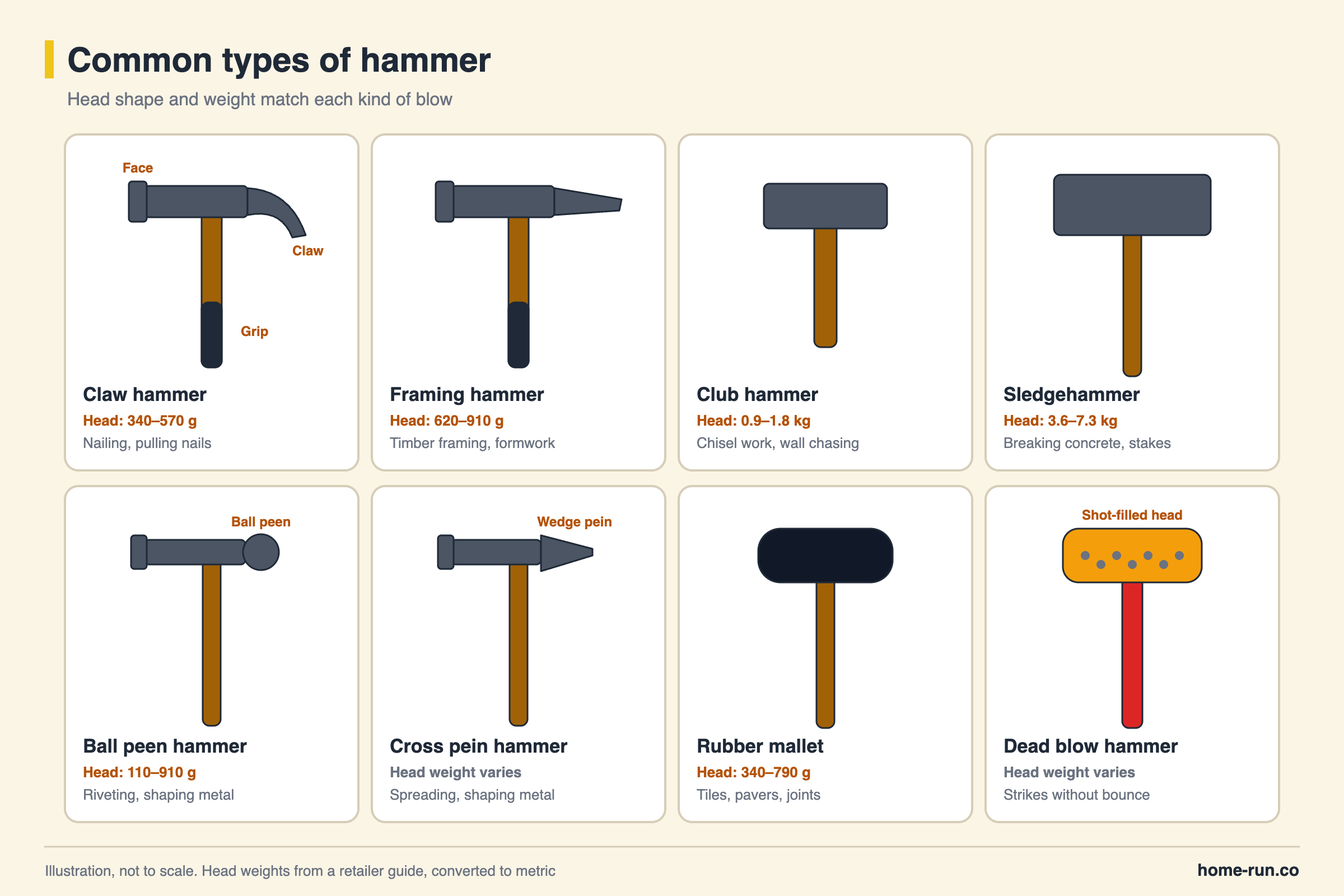
The main types of hammer are the claw hammer, sledgehammer, ball peen hammer, cross pein hammer, club hammer, mallet, tack hammer and dead blow hammer. Each one has a head shape and weight built for one kind of blow.
On a house site in Bengaluru you will see most of them in one week. Carpenters use claw hammers, masons use club and brick hammers, and demolition crews use sledgehammers.
What Are the Different Types of Hammer and Their Uses?
A hammer is a hand tool with a weighted head on a handle, used to deliver a blow. The types of hammer differ in head shape, head weight and face material.
IS 841:1983, the Bureau of Indian Standards (BIS) specification for steel hammers, lists 12 steel types. These include engineer's ball pein and cross pein hammers, three sledge patterns and stone breaker's hammers.
- Claw hammer: a flat striking face with a split, curved claw on the back for pulling nails.
- Framing hammer: a heavier claw hammer with a straighter claw, used for timber framing and formwork.
- Sledgehammer: a heavy head on a long handle, swung with two hands to break concrete or drive stakes.
- Club hammer: a short-handled, two-faced hammer used one-handed with chisels and for light demolition.
- Ball peen hammer: a flat face plus a rounded peen (the back end of the head) for riveting and shaping metal.
- Cross pein hammer: a wedge-shaped pein set across the handle, used to spread and shape metal.
- Mallet: a large head of wood or rubber that strikes without denting the work.
- Tack hammer: a light hammer for small nails and tacks, often with a magnetic face.
- Dead blow hammer: a hollow head filled with steel shot or sand, so the hammer does not bounce back.
Powered tools such as breakers are a separate family. Our jackhammer guide covers powered demolition hammers.
How Do the Types of Hammer Compare on Weight and Handle?
Hammer head weights range from about 110 g for a light ball peen to over 7 kg for a large sledgehammer. The table gives typical head weights from a US retailer's buying guide, converted to metric.
Types of hammer compared
Typical head weight, handle and main use| Hammer | Head weight | Handle | Main use |
|---|---|---|---|
| Claw hammer Default pick | 340–570 g (12–20 oz) | Wood, fibreglass or steel | Nailing and pulling nails |
| Rip claw hammer | 450–710 g (16–25 oz) | Wood, fibreglass or steel | Prising boards, demolition of timber |
| Framing hammer | 620–910 g (22–32 oz) | Wood, fibreglass or steel | Formwork, roof and timber framing |
| Ball peen hammer | 110–910 g (4–32 oz) | Wood, steel or graphite | Riveting, shaping metal, striking punches |
| Brick hammer | 430–680 g (15–24 oz) | Wood, fibreglass or steel | Cutting and trimming bricks and blocks |
| Club hammer Masonry | 0.9–1.8 kg (2–4 lb) | Wood, fibreglass or steel | Chisel work, chasing walls, light breaking |
| Sledgehammer Heavy | 3.6–7.3 kg (8–16 lb) | Wood or fibreglass | Breaking concrete, driving stakes |
| Rubber mallet | 340–790 g (12–28 oz) | Wood | Setting tiles and pavers, assembling joints |
Weight and balance
A heavier head drives a nail or chisel with fewer blows but tires the arm sooner. Most of the hammer's weight should sit in the head, so the tool swings and lands squarely.
Handle material and grip
Wooden handles absorb some shock and are easy to replace; IS 4953:2023 is the BIS standard for wooden handles for hand hammers. Fibreglass and steel handles resist breakage, and a cushioned grip cuts vibration over a long day.
Hammer names on Indian sites
In Hindi, a hammer is a hathoda and a small one a hathodi; in Kannada, it is a suttige. Village blacksmiths still forge iron with sledge and cross pein hammers.
A club hammer is a short, one-handed sledge of about 1–2 kg; a sledgehammer is two-handed and much heavier. A mallet has a fixed soft head, while a soft-face hammer takes replaceable faces of different hardness.
Traditional hammer
Wooden handlePoints
- Forged steel head wedged onto a wooden handle
- Handle absorbs some shock
- Head can loosen as the wood dries
- Cheap to rehandle when the wood breaks
Modern hammer
Daily site usePoints
- One-piece steel or a fibreglass handle bonded to the head
- Rubber or cushioned grip cuts vibration
- Head stays tight for longer
- Whole hammer is replaced if the handle fails
How Do You Choose the Right Type of Hammer?
Choose a hammer by the job first, then by weight and grip. A claw hammer of about 450 g suits most home nailing, while chisel and breaking work needs a club hammer or sledgehammer.
- Nailing timber or formwork: a claw hammer, or a framing hammer for all-day framing.
- Chiselling, wall chasing or breaking tiles: a club hammer with a cold chisel.
- Breaking concrete or driving stakes: a sledgehammer, or a breaker for large areas.
- Metal, rivets and punches: a ball peen or cross pein hammer.
- Tiles, pavers and furniture joints: a rubber mallet or dead blow hammer.
- Frequency of use: for daily use, pay for a forged head and a cushioned grip.
- Your comfort: hold it before you buy; you should control the swing without wrist strain.
Pick a hammer whose striking face is about 12 mm wider than the head of the chisel, punch or wedge you will hit. This guidance comes from the Canadian Centre for Occupational Health and Safety (CCOHS).
Drilling and chasing often go together on site. Our drill bit set guide explains which bits suit masonry, wood and metal.
How Do You Use a Hammer Safely and Effectively?
You use a hammer safely by gripping it near the end of the handle, striking squarely with the face parallel to the work and wearing eye protection. Glancing blows and damaged faces are the main risks to avoid.
- Grip: hold the handle near its end, not just below the head, for more control and power.
- Start the nail: tap it lightly while holding it, then move your fingers away before full blows.
- Swing: let the elbow and wrist drive the swing and keep your eye on the nail head.
- Strike square: land the face flat on the work; never strike with the side (cheek) of the head.
- Check around you: look behind and above you before swinging a long-handled hammer.
- Strike one hammer against another, or hit stone and concrete with a nail hammer
- Use a hammer with a mushroomed or chipped face, or a cracked claw
- Regrind, weld or reheat a hammer head
- Work near live wiring without an insulated handle and an isolated circuit
How Do You Maintain and Store Hammers?
Hammers last longest when you keep the head clean and dry, check the handle often and store them away from damp. Bengaluru's monsoon months can rust a steel head left in a wet site shed.
- Wipe after use. Remove cement, mortar and moisture with a dry cloth.
- Oil the head. Apply a thin coat of light machine oil to bare steel to prevent rust.
- Check the handle. Replace any handle that is loose, cracked or splintered before the next use.
- Inspect the face. Retire the hammer if the face is chipped or mushroomed.
- Store dry. Hang hammers on a rack or keep them in a toolbox, away from wet floors.
Keep rubber mallets out of direct sun, which hardens and cracks rubber over time. Store hammers with other site tools, such as your spirit level, so heavy heads do not knock delicate tools.
Where Can You Buy Hammers in India?
You can buy hammers at local hardware stores, building material suppliers and online platforms across India. In Bengaluru, HomeRun delivers hand tools and hardware with construction materials.
- Local hardware stores: you can feel the weight, grip and balance before you buy.
- Online platforms: compare head weight, length and handle material in the listing.
- Check the marking: a good steel hammer carries the maker's name and head weight, and may state conformity to IS 841.
Need a hammer on site today?
Hand tools, hardware and building materials delivered across Bengaluru.