On this page
- What Is Conduit Wiring and How Does It Work?
- What Are the Main Types of Conduit Wiring by Installation Method?
- What Types of Conduit Material Are Used in India?
- What Fittings Go Into a Conduit Wiring System?
- Surface vs Concealed Conduit Wiring: Which Is Better?
- How Do You Choose the Right Conduit?
- How Is Concealed Conduit Wiring Installed?
- What Mistakes and Safety Issues Should You Watch For?
- Conduit wiring runs insulated wires inside PVC or metal pipes laid from the distribution board to each point.
- Concealed conduit is hidden in walls and slabs; surface conduit is clamped on top.
- Rigid PVC is the default for Indian homes; metal conduit suits factories and must be earthed.
- Indian specifications use a 20 mm minimum size and limit how many wires go in each pipe.
- Buy ISI-marked conduit to IS 9537 and use a licensed electrician.
Conduit wiring is a method of running insulated electrical wires inside a protective pipe, called a conduit, instead of fixing bare cables to or inside a wall. With conduit wiring explained in one line: you lay the pipe first and pull the wires through later.
What Is Conduit Wiring and How Does It Work?
Conduit wiring works by creating a closed pipe path from the distribution board to junction boxes, then on to switch and socket points. The electrician fixes the pipes and boxes, and then draws the wires through using a steel fish tape or draw spring.
The conduit protects the wires from four things:
- Impact: nails, drills and knocks.
- Moisture and chemicals: damp walls, wet plaster and cement.
- Fire spread: the pipe contains a fault better than bare cable.
- Touch: people cannot reach live insulation.
Wires sit loose inside the pipe, so you can pull old wires out and draw new ones in. You do not have to break plaster, as you would with cable buried directly in the wall.
What Are the Main Types of Conduit Wiring by Installation Method?
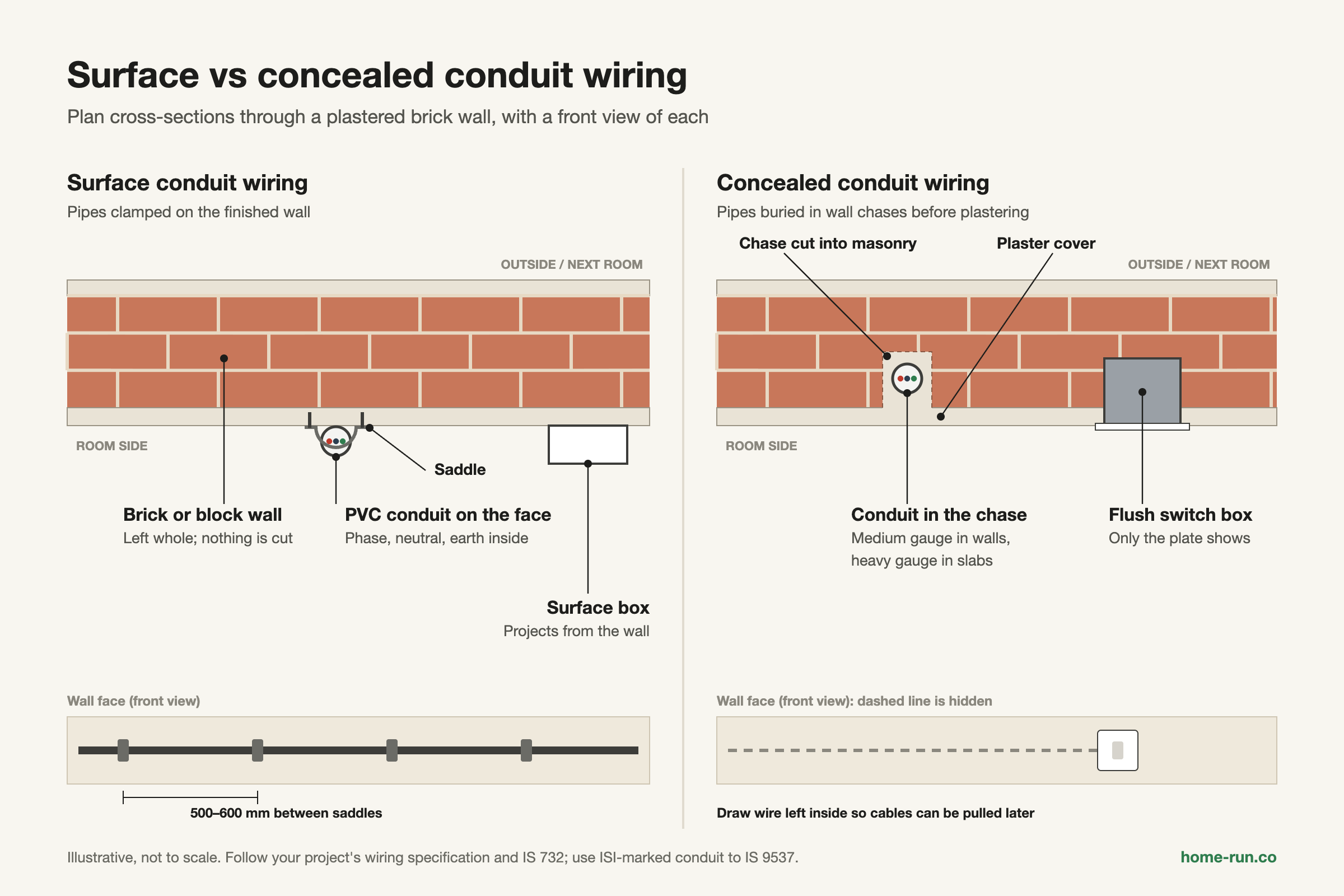
Conduit wiring has two installation methods: surface conduit wiring and concealed conduit wiring.
Surface conduit wiring
RetrofitsPipes clamped on the wall or ceiling with saddles.
- Visible on the wall face
- Quick to install and alter
- Faults are easy to trace
- Suits garages, workshops and rentals
Concealed conduit wiring
New buildsPipes buried in wall chases or cast into slabs.
- Only switch plates show
- Laid before plastering or casting
- Changes need wall cutting
- Suits homes, offices and shops
In most new RCC homes, conduits for ceiling lights and fans go into the slab before the concrete is poured. Wall conduits go into chases, grooves cut into the masonry, before plastering.
Some electricians use a half-concealed layout: concealed in finished rooms, surface in utility areas or above a false ceiling.
What Types of Conduit Material Are Used in India?
Conduit in India comes in three main families: rigid PVC, rigid metal and flexible conduit.
Conduit materials compared
Pick by location and risk| Conduit type | Best use | Strengths | Limits |
|---|---|---|---|
| Rigid PVC Default pick | Concealed and surface wiring in homes | Light, rust-free, non-conducting, low cost | Softens with heat; not for explosive areas |
| Rigid steel or GI Industrial | Factories, exposed runs, high-impact areas | Strong, fire resistant | Costlier, can corrode, must be earthed |
| Flexible PVC or metal | Short links to motors, machines, fixtures | Bends around obstacles, absorbs vibration | Short runs only; less protection |
| EMT and IMC Rare locally | US-style commercial work | Thin-wall or medium-wall steel | Uncommon on Indian sites |
PVC conduit is also sold in light, medium and heavy gauge. Gauge means wall thickness, not diameter. Manufacturers recommend light gauge for surface and false-ceiling runs, medium for wall chases and heavy for slabs.
Steel conduit conducts electricity, so it must be earthed along its whole length. PVC does not provide an earth path, so a separate earth wire runs inside it.
What Fittings Go Into a Conduit Wiring System?
A conduit wiring system uses pipes plus fittings that join, turn and end each run. Fittings for rigid PVC conduit are covered by IS 3419.
- Conduit pipes: straight lengths, usually 20 mm and 25 mm in homes.
- Couplers: join two pipe lengths end to end.
- Bends and elbows: turn a run by 90°.
- Junction boxes: round or square boxes where runs meet and split. See our guide to electrical junction boxes.
- Switch (gang) boxes: recessed metal or PVC boxes that hold switches and sockets.
- Saddles and clamps: fix surface conduit to the wall.
- Bushes and locknuts: protect wire insulation where pipes enter boxes.
Surface vs Concealed Conduit Wiring: Which Is Better?
Concealed conduit wiring is better for new construction and finished interiors. Surface conduit wiring is better for retrofits, exposed industrial areas and temporary setups.
Conduit wiring compared with other wiring methods
Relative, not priced| Method | Looks | Cost | Repair or change | Best for |
|---|---|---|---|---|
| Concealed conduit New homes | Neatest | Highest | Rewire easily; moving points needs wall cutting | New builds, finished interiors |
| Surface conduit | Pipes visible | Medium | Easy | Retrofits, workshops, rentals |
| Casing-capping or trunking | Flat channel visible | Low | Easy | Quick additions in existing rooms |
| Cable buried without conduit Avoid | Hidden | Low | Wall must be broken | Not recommended |
Disadvantages of concealed conduit wiring: higher labour and material cost, wall chasing, and harder fault tracing. Concealed systems use flush-mounted switches and sockets fixed in recessed boxes.
Disadvantages of surface conduit wiring: visible pipes, dust on ledges and more exposure to knocks.
If the walls are not yet plastered, go concealed. If they are finished and painted, go surface or plan a chase-and-patch job.
How Do You Choose the Right Conduit?
Choose conduit by location first, then by the number and size of wires.
- Walls and slabs: rigid PVC, medium gauge in chases and heavy gauge in slabs.
- Exposed industrial areas: rigid steel or GI, earthed.
- Near machines or vibration: short flexible conduit.
- Underground: armoured cable or heavy-gauge conduit, never bare house wire.
- Near heat: metal, as PVC softens above about 60°C.
Wire in Indian homes is usually FRLS (flame retardant, low smoke) PVC-insulated copper to IS 694. A typical circuit has phase, neutral and earth wires.
Wire-count tables are easier on site. This one comes from an Indian conduit wiring specification for PVC-insulated wire:
Maximum wires per conduit
Single-core PVC-insulated wire| Wire size | 20 mm | 25 mm | 32 mm |
|---|---|---|---|
| 1.5 sq mm | 3 | 6 | 9 |
| 2.5 sq mm | 2 | 4 | 8 |
| 4 sq mm | 2 | 3 | 6 |
Indian specifications put power and lighting wiring in separate conduits. Data, TV and telephone cables need their own conduits too, and one specification asks for at least 300 mm separation.
Planning your home's wiring?
Order conduit, fittings and wires with a GST invoice, delivered across Bengaluru.
How Is Concealed Conduit Wiring Installed?
Concealed conduit wiring is installed in stages that fit between masonry, slab casting and plastering.
Mark the layout
Mark every switch, socket, light and fan point on the walls and shuttering.
Lay slab conduits
Tie pipes and fan boxes to the reinforcement before the concrete pour.
Chase the walls
Cut grooves in the brick or block deep enough for the pipe and plaster cover.
Fix pipes and boxes
Fix conduit, bends, junction boxes and switch boxes level, with a draw wire left inside.
Inspect, then plaster
Check routes and joints before plaster hides them.
Draw wires and test
Pull the wires, connect fittings, and test insulation and earth continuity.
Bends and pull points: every bend adds friction when wires are pulled. Indian specifications add an inspection or junction box after a set run length or number of bends. One tender spec says every 12 m or after two 90° bends. The US code's "360 rule" limits bends to 360° in total between pull points.
PVC conduit up to 25 mm can be bent cold with a bending spring. Larger sizes need ready-made bends.
What Mistakes and Safety Issues Should You Watch For?
Most conduit wiring failures come from undersized pipes, too many bends and joints that cannot be reached later.
- Conduit smaller than 20 mm, or packed past its wire limit
- Several sharp bends with no inspection box
- Junction boxes plastered over or left uncovered
- Non-ISI pipe that cracks or crushes in a slab
- Power, data and TV cables in one pipe
- Metal conduit with no earth continuity
Check these Indian rules and standards:
- IS 9537: the BIS standard for conduits. Part 2 covers rigid steel and Part 3 rigid plain PVC conduit.
- IS 732: the BIS code of practice for electrical wiring installations.
- National Electrical Code of India 2023: the BIS code for safe installation practice.
- CEA Safety Regulations, 2023: the Central Electricity Authority rules on electrical safety.
Hire a licensed electrical contractor for design, final connections and testing. In Bengaluru, BESCOM supplies power to the finished installation.
If you are also fixing a gypsum board false ceiling, lay its light conduits before the boards go up.