On this page
- Why Does Jaw Shape Decide What a Cutter Can Cut?
- What Are the Main Wire Cutter Jaw Types?
- What Are Side Cutters Used For?
- Flush Cutters vs Side Cutters: Which Gives a Cleaner Cut?
- When Should You Use End Cutters or Nippers?
- Which Cutters Handle Thick Cable, Bolts and Wire Rope?
- What Makes a Wire Cutter Safe for Electrical Work?
- How Do You Choose the Right Wire Cutter?
- How Do You Use and Look After Your Cutters?
- Which Cutters Should a Home Toolbox Have?
- A wire cutter's jaw shape, not its handle, decides what it cuts cleanly and how the cut end looks.
- Side (diagonal) cutters are the default pick for house wiring, cable ties and soft wire.
- Flush cutters leave a flat end on fine electronics leads but chip on hard steel wire.
- Use cable shears, bolt cutters or wire rope cutters for thick cable, rod and steel rope.
A wire cutter is a hand tool with two hardened jaws that meet to cut wire. The shape of those jaws decides what it can cut and how clean the cut is.
Wire cutter jaw types range from angled side cutters for house wiring to flush cutters for circuit boards and long-handled bolt cutters for rod and chain. Pick the wrong jaw and you crush the wire, leave a sharp burr or nick the blade.
Why Does Jaw Shape Decide What a Cutter Can Cut?
Jaw shape decides what a cutter can cut because it sets the bevel, the edge position and the cutting action.
- Bevel: the sharpened, angled face of each jaw. A steeper bevel is stronger; a finer bevel cuts cleaner.
- Edge position: along the side of the jaw (side cutters) or across the tip (end cutters).
- Cutting action: centre-cut blades meet edge to edge and pinch the wire. Shear-cut blades slide past each other like scissors.
So one tool cannot cover fine copper and hardened steel. Knipex rates its 160 mm diagonal cutter (70 01 160) at about 4 mm for soft wire but only about 2 mm for hard steel wire.
Side cutters, diagonal cutters, diagonal pliers, "dikes" and "cutting plier" in Indian catalogues usually mean the same tool. "Side cutting pliers" can also mean combination pliers with a cutting notch, so check the picture before you order.
What Are the Main Wire Cutter Jaw Types?
The main wire cutter jaw types are side (diagonal), flush, end-cutting, cable, bolt and wire rope cutters. Carpenter's pincers are a close relative.
Wire cutter jaw types at a glance
Qualitative guide; check each tool's rated capacity| Jaw type | Jaw and cut | Typical use | Do not use for |
|---|---|---|---|
| Side (diagonal) cutter Default pick | Angled head, bevelled edges, leaves a small point | House wiring, cable ties, soft wire | Steel rope, thick armoured cable |
| Flush cutter Electronics | One flat face, leaves a flat end | PCB leads, craft wire, plastic sprues | Steel binding wire, nails |
| End cutter (nipper) | Edges across the tip, cuts face-on | Nails, rivets, wire flush to a surface | Reaching into tight boxes |
| Carpenter's pincers | Rounded head, blunter edges | Pulling and trimming nails | Neat electrical cuts |
| Cable cutter (shears) | Curved shear blades that wrap the cable | Thick stranded copper or aluminium cable | Steel wire, hard-drawn copper |
| Bolt cutter Heavy duty | Short, thick centre-cut jaws, compound leverage | Padlock shackles, chain, rod | Wire rope, fine wire |
| Wire rope cutter | Shear blades that hold the strands | Braided steel rope | Solid bolts and rod |
What Are Side Cutters Used For?
Side cutters are used for cutting copper and aluminium wire, cable ties and soft wire in tight spaces. The angled head reaches into a switch box and cuts close to a surface.
- House wiring: trimming 1.5, 2.5 and 4 mm² conductors, the usual sizes for lights, sockets and AC points in Bengaluru homes.
- Boxes and conduit: cutting tails to length when fitting an electrical junction box or pulling wire through conduit wiring.
- General jobs: cable ties and soft binding wire.
Diagonal cutters vs side cutters is a naming difference, not a tool difference. For stripping insulation, a wire stripper is kinder to the copper.
Flush Cutters vs Side Cutters: Which Gives a Cleaner Cut?
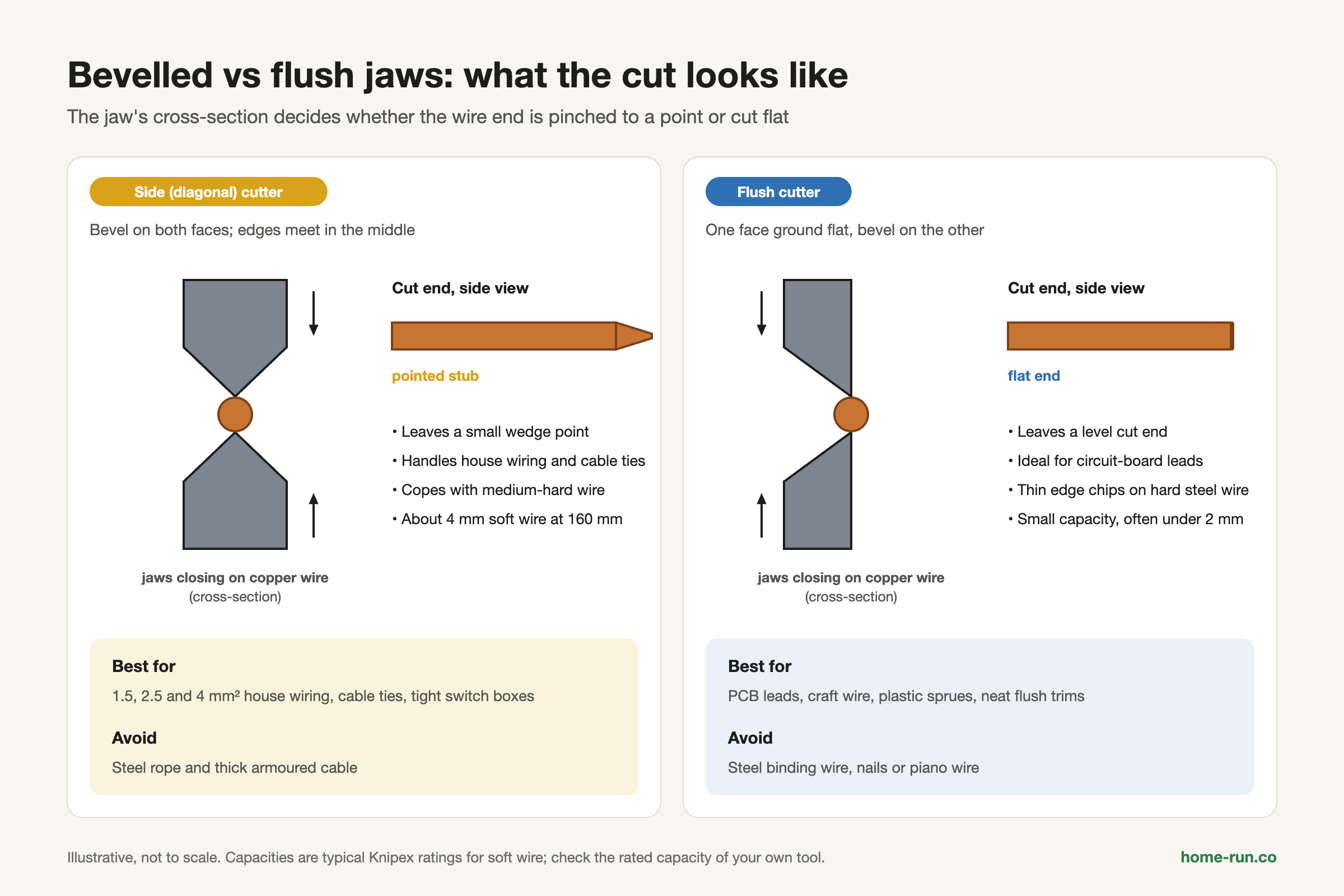
A flush cutter gives the cleaner cut. One face of its jaw is ground flat, so the cut end sits almost level, with no pointed stub.
Flush cutter
Clean finishPoints
- Flat face leaves a level cut end
- Ideal for trimming leads on a circuit board
- Thin edge chips on hard steel wire
- Small capacity, often under 2 mm
Side (diagonal) cutter
All-rounderPoints
- Bevelled faces leave a small wedge point
- Handles house wiring and cable ties
- Stronger edge copes with medium-hard wire
- Larger capacity, about 4 mm soft wire at 160 mm
Knipex rates its 125 mm electronics flush cutter (78 61 125) for soft wire from about 0.4 to 1.6 mm. A semi-flush cutter sits in between: a slightly steeper bevel leaves a tiny tip but holds its edge longer.
Never use a flush or precision cutter on steel binding wire, nails or piano wire. The thin edge chips, and that chip marks every cut after it.
When Should You Use End Cutters or Nippers?
Use end cutters when you need to cut nails, rivets or wire flat against a surface. Their edges run across the tip at right angles to the handles, like a beak.
Carpenter's pincers look similar but have a rounded head that also pulls nails. Both are common in Indian carpentry and shuttering work. In shops, "nipper" can mean an end cutter or a side cutter, so check the jaw.
Which Cutters Handle Thick Cable, Bolts and Wire Rope?
Thick cable, bolts and wire rope each need their own heavy-duty cutter.
- Cable cutters (cable shears): curved shear blades wrap stranded cable so it cuts instead of flattening. Knipex rates its 165 mm cable shears (95 11 165) up to 15 mm diameter or 50 mm², and says they are not for steel wire or hard-drawn copper.
- Bolt cutters: long handles and compound-lever jaws (an extra linkage that multiplies hand force) for padlock shackles, chain and rod.
- Wire rope cutters: shear-type blades that cut braided steel rope cleanly. Knipex notes that bolt cutters only crush wire rope.
Stop and switch tools if you see any of these signs:
- The jaws spring apart or the edge dents
- Stranded cable flattens instead of cutting
- Rope ends fray and unravel after the cut
What Makes a Wire Cutter Safe for Electrical Work?
A wire cutter is safe for electrical work when it is insulated and tested to IEC 60900, the international standard for live-working hand tools up to 1000 V AC and 1500 V DC. In India, BIS publishes this as IS 13772:2021, identical to IEC 60900:2018.
- Marking: look for the 1000 V symbol and "IEC 60900" on the handle. Klein Tools notes the symbol requires testing up to 10,000 V.
- Comfort grips are not insulation: Knipex lists its plastic-coated 70 01 160 as not 1000 V insulated.
- Indian option: Taparia's 160 mm VDE side cutting plier (VDESC-6) is listed as conforming to IEC 60900:2018. One Indian store priced it at ₹1,398 including GST (checked November 2026).
Switch off the MCB and test the circuit dead before cutting any wire. An insulated cutter protects you from accidental contact. It does not make cutting live cable safe.
How Do You Choose the Right Wire Cutter?
Choose a wire cutter by answering three questions: what the wire is made of, how thick it is, and where you are cutting.
- Material: soft copper and aluminium suit side or flush cutters; steel wire needs a cutter rated for hard wire.
- Thickness: read the capacity for that wire hardness, not the biggest number on the pack.
- Space and finish: tight box, side cutter; flat finish, flush cutter; flush to a surface, end cutter.
- Size: about 125 mm for electronics, 160 mm for house wiring, 200 mm or high-leverage for heavier wire.
- Quality: jaws that meet along the full edge with no light showing, a smooth pivot and induction-hardened edges.
A stranded bundle is slightly thicker than the solid figure.
Wires and fittings for your electrical job
Order electrical supplies and hardware with a GST invoice and delivery across Bengaluru.
How Do You Use and Look After Your Cutters?
Use cutters by isolating the circuit, setting the wire deep in the jaw and squeezing straight through.
- Switch off the circuit and test it dead.
- Wear eye protection when cutting hard or spring wire, and hold the offcut.
- Set the wire close to the pivot, where leverage is highest.
- Cut square with one firm squeeze. Do not twist or rock the tool.
Bengaluru's humid monsoon months rust bare steel:
- Wipe the cutter dry after use and put a drop of light oil on the pivot.
- Store it in a dry box, away from damp walls and cement bags, with other site tools like your pipe wrench.
- Replace it when the edges show a gap, a nick or a rolled edge that leaves strands uncut.
Which Cutters Should a Home Toolbox Have?
A home toolbox needs one good 160 mm side cutter, ideally insulated to 1000 V. It covers most household wiring and soft wire.
- Add a flush cutter if you solder or build electronics.
- Add end cutters or pincers for carpentry and nail work.