On this page
- What Is a Concrete Mixer and How Does It Work?
- What Are the Types of Concrete Mixers?
- How Is Mixer Capacity Measured Under IS 1791?
- How Many Batches Does a Slab Need?
- How Do Portable and Stationary Mixers Differ?
- Which Mixer Brands Are Common in India?
- How Do You Mix Concrete Correctly by Machine?
- How Do You Run a Mixer Safely?
- How Do You Maintain a Drum Mixer?
- How Do You Choose the Right Concrete Mixer?
- What Should You Arrange Before Mixing Day?
- A concrete mixer rotates a drum or pan to blend cement, sand, aggregate and water into a uniform mix.
- IS 1791:1985 covers tilting, non-tilting and reversing drum mixers and names each size by its mixed batch in litres.
- The dry load a mixer takes is about 1.5 times its rated mixed batch, so a 200 L mixer takes roughly 300 L of loose material.
- Mix each batch for at least 2 minutes after all materials are in, as IS 456:2000 advises.
- Small home sites use a one-bag drum mixer; big pours use ready-mix concrete in transit mixers.
A concrete mixer is a machine that combines cement, sand, coarse aggregate and water into concrete of even colour and consistency. On Indian home sites, the concrete mixer is usually a diesel or electric drum mixer sized to take one 50 kg bag of cement per batch.
Machine mixing gives stronger, more consistent concrete than hand mixing on a platform. This guide explains mixer types, capacity ratings, batch maths and safe mixing practice.
What Is a Concrete Mixer and How Does It Work?
A concrete mixer works by lifting and dropping, or forcing, the ingredients against each other until every stone is coated with cement paste. Drum mixers use blades fixed inside a rotating drum. Pan mixers use paddles that turn inside a fixed or rotating pan.
Every site concrete mixer has the same basic parts:
- Drum or pan: the steel vessel that holds the batch, with mixing blades welded inside.
- Power unit: a diesel engine or electric motor that turns the drum through a gear or chain drive.
- Loading hopper: a skip that lifts dry materials into the drum. Mixers "with lift" raise this hopper by winch.
- Water tank or meter: measures water for each batch. IS 456:2000, the Indian code for plain and reinforced concrete, asks for mixers fitted with water measuring devices.
- Chassis and wheels: let a portable mixer be towed between sites.
A site concrete mixer makes concrete batch by batch where you pour it. Ready-mix concrete (RMC) is batched at a plant to a set recipe and delivered in a truck. RMC suits large, continuous pours; a site mixer suits small, staggered work like lintels, sunshades and short slabs.
What Are the Types of Concrete Mixers?
Concrete mixers fall into two groups: batch mixers, which make one load at a time, and continuous mixers, which feed and discharge without stopping. Almost all home construction in India uses batch drum mixers.
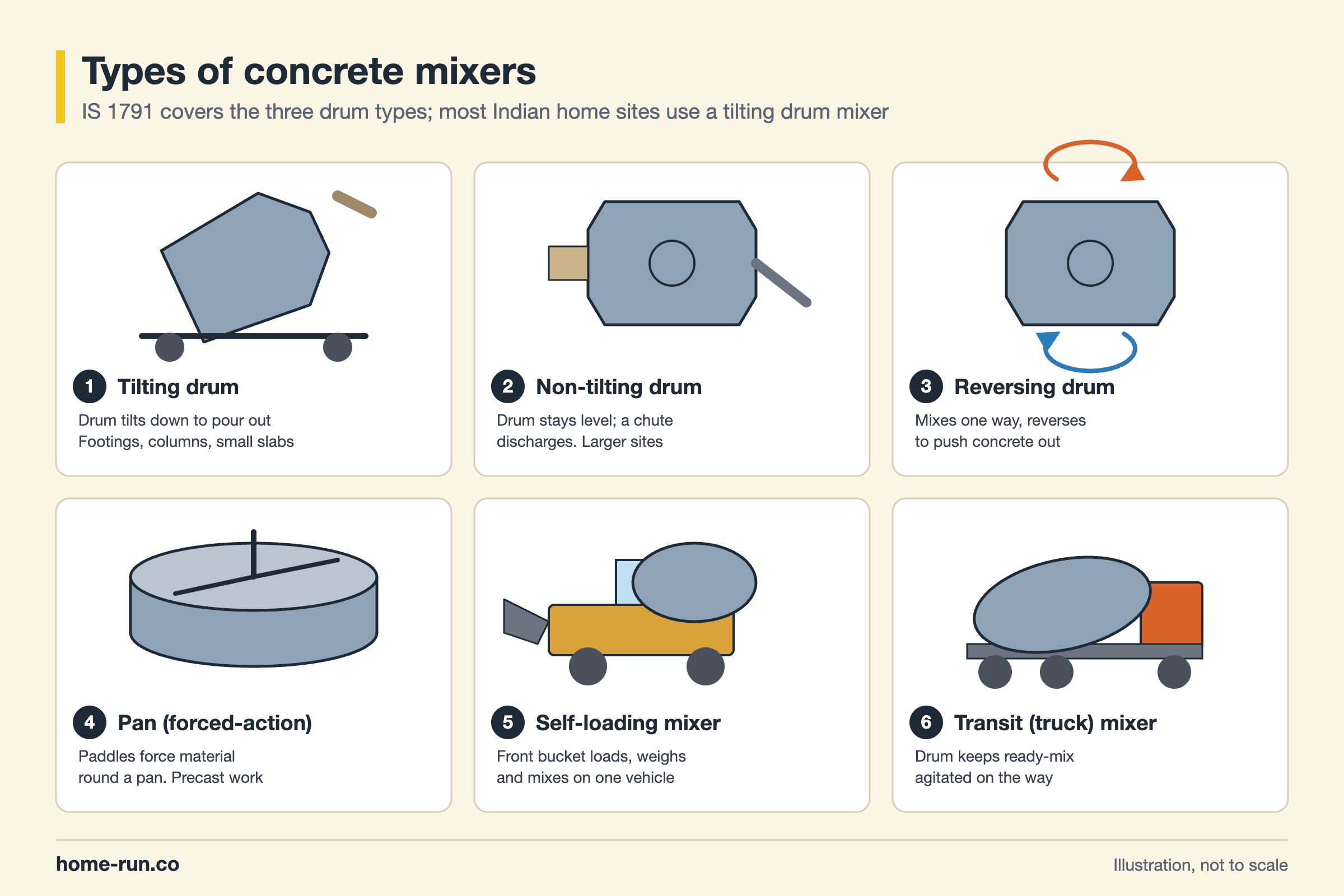
Types of concrete mixer and where each fits
Batch mixers unless noted| Mixer type | How it mixes and discharges | Typical use |
|---|---|---|
| Tilting drum Home sites | Drum tilts down to pour out the batch | Footings, columns, slabs on small plots |
| Non-tilting drum | Drum stays level; a chute swings in to discharge | Larger sites with steady output |
| Reversing drum | Mixes one way, reverses to push concrete out | Medium sites, stiff or wet mixes |
| Pan (forced-action) Precast | Paddles force material around a pan | Precast units, paver blocks, batching plants |
| Self-loading mixer | Front bucket loads, weighs and mixes on one vehicle | Roads, remote and rural sites |
| Transit (truck) mixer | Drum on a truck keeps RMC agitated on the way | Ready-mix delivery to large pours |
A transit mixer, or concrete mixer truck, turns its drum at 4–18 rpm to mix and at not less than 2 rpm to agitate, under IS 5892, the Indian standard for transit mixers. Ready-mix plants send these trucks; site crews rarely own them.
How Is Mixer Capacity Measured Under IS 1791?
Concrete mixer capacity is measured as the nominal mixed batch in litres, the volume of wet concrete one batch yields. IS 1791:1985 writes the size as that number plus a letter, so "200 NT" is a 200 litre non-tilting mixer.
The dry load is bigger than the mixed batch because loose sand and stone shrink once water fills the gaps. IS 1791 sets the maximum unmixed load at 50% above the nominal mixed capacity.
Standard concrete mixer sizes as per IS 1791:1985
Nominal mixed batch, litres| Mixer type | Standard sizes | Max dry load of smallest size (L) |
|---|---|---|
| Tilting (T) | 100 T, 140 T, 200 T | 150 |
| Non-tilting (NT) | 200 NT, 280 NT, 375 NT, 500 NT, 1000 NT | 300 |
| Reversing (R) | 200 R, 280 R, 375 R, 500 R, 1000 R | 300 |
Sellers in India often quote capacity in cubic feet or bags instead. A "10/7" mixer takes 10 cft (about 283 L) of dry material and gives 7 cft (about 198 L) of concrete. That makes it roughly a 200 litre mixer in IS 1791 terms, and it takes one 50 kg cement bag per batch. A "half bag" mixer is the 100–140 L class.
Never overfill a concrete mixer to save a few batches. An overloaded drum spills, leaves dry pockets and strains the gearbox. One bag of cement plus its sand and aggregate is the right load for a 10/7 mixer at common nominal mixes.
How Many Batches Does a Slab Need?
A one-bag concrete mixer gives about 0.124 m³ of M20 concrete per batch at a nominal 1:1.5:3 mix, so 1 m³ needs about 8 batches. The method uses two common site assumptions: dry volume is 1.54 times wet volume, and a 50 kg cement bag is 0.0347 m³.
Round batches up, and keep one spare bag on site for wastage. The same answer comes from the dry-volume method in our concrete mix ratio guide: 1.5 × 1.54 ÷ 5.5 ÷ 0.0347 = 12.1 bags.
How Do Portable and Stationary Mixers Differ?
Portable concrete mixers are small, wheeled and towed between sites, while stationary mixers stay in one place and feed a large, continuous pour. Most homebuilders need a portable mixer.
Portable drum mixer
Home defaultPoint
- Size: half bag to one bag (100–200 L mixed)
- Power: small diesel engine or single-phase motor
- Moves: towed by hand or tractor, fits narrow plots
- Best for: houses, extensions, repairs
Stationary mixer or plant
Large sitesPoint
- Size: 375 L to 1000 L and above per batch
- Power: three-phase motor, often with weigh batching
- Moves: fixed on a foundation for the project
- Best for: apartments, precast yards, RMC plants
Which Mixer Brands Are Common in India?
The concrete mixer market in India splits in two: local fabricators build most one-bag drum mixers, while a few large brands make self-loading mixers, transit mixers and pumps. Compare service support near you before comparing brand names.
Concrete mixer brands seen on Indian sites
Main product focus| Brand | Main concrete products | Note |
|---|---|---|
| AJAX Engineering Bengaluru | Self-loading concrete mixers, pumps, batching plants | Founded 1992, plants at Doddaballapur and Gowribidanur |
| Schwing Stetter India | Concrete pumps, self-loading mixers, transit mixers | Factories in Sriperumbudur and Cheyyar, Tamil Nadu |
| Fiori | Self-loading mixers | Italian maker; linked to the AJAX Fiori name in India |
| Putzmeister | Concrete pumps and truck mixers | German brand, pump specialist |
| KYB Conmat, Macons | Batching plants, transit and self-loading mixers | Indian makers for plant-scale work |
| Local fabricators | Half-bag, one-bag and lift mixers | Ask for IS 1791 conformity and spares |
How Do You Mix Concrete Correctly by Machine?
You mix concrete correctly by loading a measured batch in a set order and turning it for at least 2 minutes after the last material goes in. IS 456:2000 says mixing must continue until the mass is uniform in colour and consistency, and asks for remixing if the concrete segregates after discharge.
- Start the drum empty. Run the concrete mixer and add part of the measured water to wet the drum.
- Add coarse aggregate. Stone first scrubs the blades and stops cement sticking to the drum.
- Add sand, then cement. Use full 50 kg bags and gauge boxes for sand and stone, never loose shovels.
- Add the rest of the water. Get all the water in early in the cycle. IS 4925, the code for batching plants, asks for it within the first quarter of the mixing time.
- Mix for at least 2 minutes. Count from the moment the last material enters the drum.
- Check, then discharge. Look for even colour and no dry lumps. Pour into clean pans or a wheelbarrow and place within minutes.
Fix the water per batch from the mix design, not by eye. Our water-cement ratio guide shows why one extra bucket weakens the concrete. Check consistency with a quick slump test on the first batch.
How Do You Run a Mixer Safely?
You operate a concrete mixer safely by keeping hands and tools out of the turning drum, guarding moving parts and following the maker's manual. Wet cement also burns skin, so protect the crew as well as the machine.
- Guards on: keep chain, gear and belt guards fitted at all times.
- Stop before reaching in: switch off and wait for the drum to stop before scraping or clearing it.
- Electrical safety: use an earthed supply with an RCCB for electric mixers, and keep cables out of water.
- Protective gear: gloves, boots, goggles and a dust mask when tipping cement.
- Stable base: chock the wheels and set the mixer on level, firm ground.
The Noise Pollution (Regulation and Control) Rules, 2000 set 55 dB(A) by day and 45 dB(A) at night (10 pm to 6 am) in residential areas. In dense Bengaluru layouts, run a diesel mixer in daytime only, wet the stockpiles to cut dust, and never wash mixer slurry into storm drains.
How Do You Maintain a Drum Mixer?
You maintain a concrete mixer mainly by cleaning the drum after every use and greasing moving parts on schedule. Hardened concrete inside the drum adds weight, unbalances the drum and cuts usable capacity.
- Run a few buckets of water and coarse aggregate through the drum at the end of every pour.
- Wash the outside, hopper and chute before concrete sets on them.
- Grease the drum bearings, pinion and tilting gear as the manual specifies.
- Check engine oil, air filter and fuel on diesel mixers before each day's work.
- Inspect blades, drum ring gear and the hopper wire rope for wear every week.
- Check tyre pressure and tow hitch before moving the mixer.
Red flags when buying a used mixer
- Thick hardened concrete inside the drum or worn-flat blades.
- Drum wobble, or a grinding noise from the ring gear.
- Frayed hopper rope or a lift winch that slips under load.
- Engine smoke, hard starting or no service records.
- Cracked welds on the chassis or the drum frame.
How Do You Choose the Right Concrete Mixer?
You choose the right concrete mixer by matching its batch size to your largest pour, then checking power, lift, price and local service. Follow these steps in order.
- Size the pour. Work out the biggest single pour in m³, usually the roof slab, and the batches it needs.
- Pick the batch size. A one-bag 10/7 mixer suits most G+1 and G+2 houses. Go larger only for repeat slab work.
- Choose power. Diesel works anywhere; electric is quieter but needs a steady supply on site.
- Decide on a lift. A hydraulic or winch hopper saves labour when loading 10 or more batches a day.
- Compare prices. Get quotes with GST, freight and the first service included.
- Check support. Ask for a warranty, IS 1791 conformity and spares stocked in your city.
Indicative concrete mixer machine prices in India
One maker's online listings, Nov 2026| Mixer listed | Capacity as listed | Listed price (₹) |
|---|---|---|
| Mini concrete mixer | 130 L drum, 0.75 HP motor | 32,000 |
| Half bag mixer Small jobs | 140 L dry, 100 L mixed | 49,000 |
| Diesel concrete mixer | 6 HP diesel | 75,000 |
| Lift concrete mixer Less labour | 480 L output, diesel | 1,50,000 |
| Self-loading mixer | Vehicle-mounted, diesel | 39,90,000 |
For a one-off house, renting a concrete mixer by the day often costs less than buying. Ask local hire firms whether the rate includes the operator, fuel and transport. For a large slab, compare the cost of RMC delivered by a transit mixer and placed with a concrete pump.
Mixing concrete on site?
Cement, sand, aggregates and steel delivered across Bengaluru.
What Should You Arrange Before Mixing Day?
Before mixing day, have the materials, water and crew ready so the drum never waits. A one-bag mixer working all day needs a steady supply of every ingredient.
- Stock all cement bags, sand and 20 mm aggregate for the full pour, plus one spare bag.
- Make gauge boxes for sand and stone sized to one bag of cement.
- Arrange a water drum and a marked measuring bucket.
- Book the mixer operator, diesel and a backup for long slabs.
- Keep the hire firm's or dealer's service number handy for breakdowns.