On this page
- What Is a Concrete Pump and When Does a Site Need One?
- How Does a Concrete Pump Work?
- Which Machine Variants Are Used in India?
- Is Pumping Better Than Pouring by Hand?
- How Far Can Concrete Be Pumped, and Which Specs Matter?
- How Do You Choose the Right Pump for Your Job?
- What Does Pump Hire Cost in Bengaluru?
- What Should You Do Before Booking a Pump?
- A concrete pump places concrete through pipes or a boom; a transit mixer only delivers it.
- Most site pumps are twin-cylinder hydraulic piston pumps with an S-valve.
- Boom pumps suit open sites and fast slab pours; line pumps suit tight plots, long runs and high-rise work.
- Check output (m³/h) and pressure (bar) separately; rated output is a maximum.
- Ask whether a hire quote is per hour, per day or per m³ before you compare offers.
A concrete pump is a machine that pushes fresh concrete through a pipeline or a folding boom to the exact spot where it is placed. On Indian sites, a concrete pump usually takes ready-mix concrete (RMC) from a transit mixer and delivers it to slabs, columns and raft foundations that wheelbarrows or chutes cannot reach quickly.
What Is a Concrete Pump and When Does a Site Need One?
A concrete pump is the placing machine; a transit mixer is the delivery truck. The mixer discharges RMC into the pump's hopper, and the pump supplies the pressure to move it.
A site usually needs a pump when:
- The pour is on an upper floor or roof slab
- The truck cannot park close to the pour point
- The pour is large and continuous, such as a raft foundation
If the truck chute reaches the formwork, or the pour is a few cubic metres at ground level, manual placing is often cheaper.
How Does a Concrete Pump Work?
A concrete pump works by pushing concrete with two hydraulic pistons that stroke in turn: one fills while the other pushes.
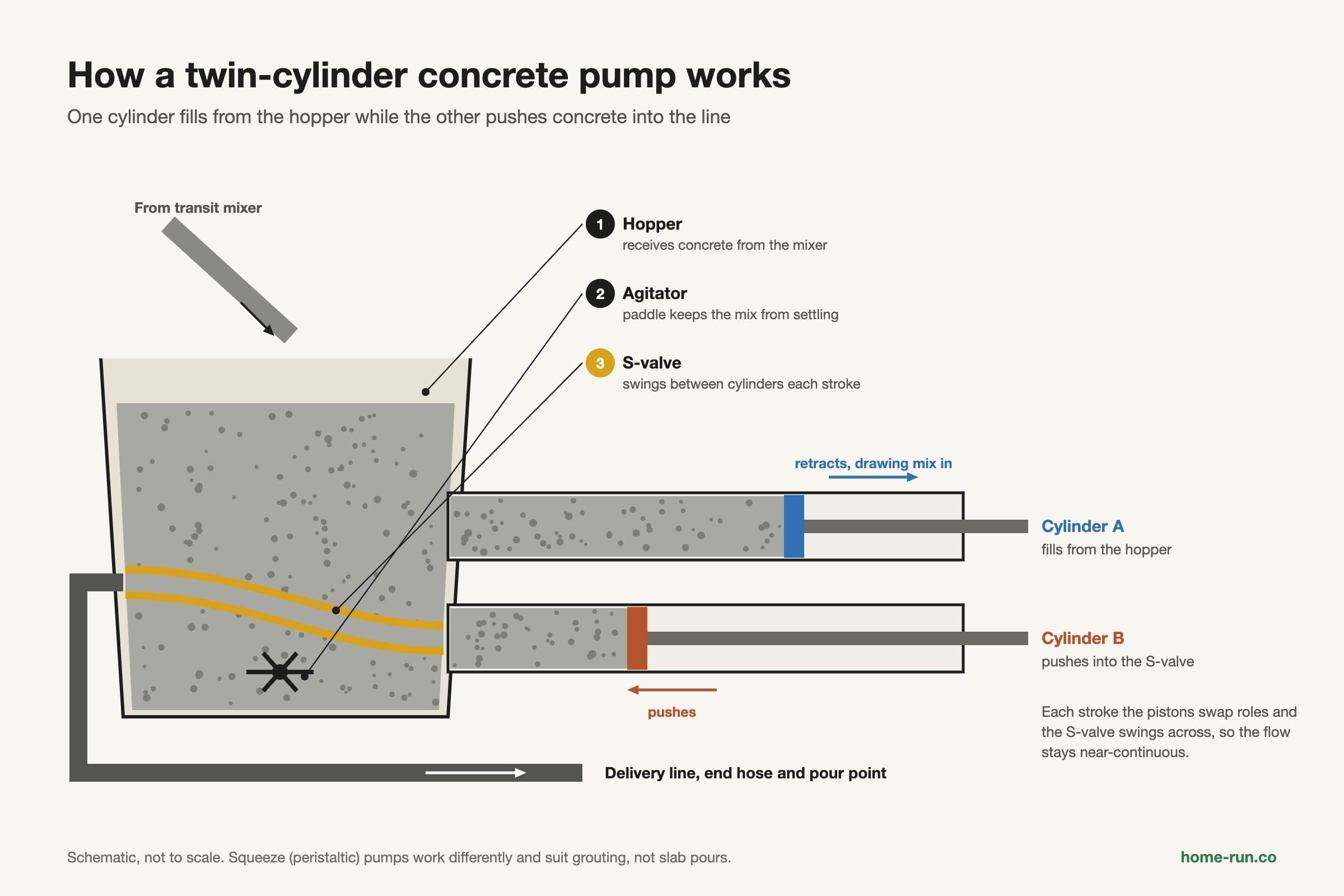
- The transit mixer discharges concrete into the hopper.
- An agitator (rotating paddle) keeps the concrete moving so it does not settle.
- One cylinder draws concrete in as its piston retracts.
- The other piston pushes its load forward into the delivery line.
- An S-valve (or rock valve) swings to connect the pushing cylinder to the line at each stroke.
- Concrete travels through steel pipe and an end hose to the pour point.
A squeeze (peristaltic) pump instead rolls along a flexible tube. Squeeze pumps run at lower pressure and volume, so they suit grouting and repairs, not slab pours.
Slump measures how stiff or runny fresh concrete is. A pumpable mix usually sits around 100–150 mm slump at the point of placement. Adding water on site to ease pumping weakens the finished concrete.
Which Machine Variants Are Used in India?
The main concrete pump variants in India are truck-mounted boom pumps, stationary or trailer line pumps, truck-mounted line pumps and mini pumps. Shotcrete pumps form a smaller, specialist group.
Concrete pump variants compared
Check output on the current spec sheet| Variant | How it places concrete | Typical Indian job | Site need |
|---|---|---|---|
| Boom pump (truck-mounted) Fastest set-up | Folding hydraulic arm carries the pipe | Slabs on G+3 to mid-rise buildings, large open pours | Wide road, firm level ground, outrigger space |
| Stationary or trailer line pump Most flexible | Pipes laid by hand across the site and up the building | Tight plots, long runs, high-rise towers | Small parking spot; crew to lay pipes |
| Truck-mounted line pump | Pump on a truck, feeding a laid pipeline | Contractors moving between many small jobs | Truck access, but no boom space |
| Mini or mixer pump | Small pump, often with a built-in mixer | House roof slabs, columns, narrow lanes | Minimal space; lower output |
| Shotcrete pump Specialist | Sprays concrete through a nozzle | Tunnels, slopes, retaining walls, repairs | Trained nozzle operator |
Schwing Stetter, Putzmeister, Aquarius, Sany and Ajax all sell concrete pumps in India. Compare full datasheets, not model numbers.
Is Pumping Better Than Pouring by Hand?
Pumping is better for height, distance and large continuous pours. Manual or crane-and-bucket placing can win on small, ground-level jobs.
Concrete pump
AdvantagesWhere pumping pays for itself.
- Places concrete far faster than head-pans or wheelbarrows
- Reaches upper floors without a hoist
- Needs a smaller placing crew
- Keeps a large pour continuous, so fewer cold joints form
Manual or bucket placing
Where it still winsAnd what pumping costs you.
- No set-up charge or minimum hire for tiny pours
- Works with stiffer mixes that a pump cannot push
- No pipe priming or washout waste
- Fits sites with no truck access at all
An idle pump waiting for late trucks still bills waiting time.
How Far Can Concrete Be Pumped, and Which Specs Matter?
Pumping distance depends on pump pressure, pipe diameter, the mix and the pipeline layout. A boom is limited by its length, so a laid pipeline can carry concrete much farther.
Concrete pump specifications that drive selection
Example figures from manufacturer data| Specification | What it tells you | Example figure |
|---|---|---|
| Output (m³/h) | Rated maximum volume per hour; site rate is lower | 22–121 m³/h across one maker's stationary range |
| Concrete pressure (bar) | How hard the pump pushes; sets reach and height | 43–243 bar across the same range |
| Outlet diameter (mm) | Pipe bore, which caps aggregate size | 150 mm on a BSA 1407 D |
| Power source | Diesel for most sites; electric where power is reliable | 74 kW diesel on a BSA 1407 D |
| Boom reach (m) | Vertical and horizontal reach without laying pipe | 30 m+ up, about 27 m out on an S-36 |
Vertical rise, 90° bends and the flexible end hose all cut effective reach. Sources put one bend at about 3 m or about 5 m of straight pipe, so rely on the datasheet and the operator's line calculation.
Keep the largest aggregate to no more than one-third of the smallest pipe bore. For mix design, see our concrete mix ratio guide.
How Do You Choose the Right Pump for Your Job?
You choose a pump by matching pour volume, height, site access and pour duration to a pump variant. Work through these steps:
- Volume and height: large upper-floor slabs need a boom or line pump.
- Road width: a narrow lane rules out a boom; use a line or mini pump.
- Distance from truck to pour point: beyond boom reach, lay a pipeline.
- Mix design: confirm slump and aggregate size with the RMC supplier.
- Truck schedule: match mixer arrivals to realistic site output.
For an M20 slab, our M20 concrete ratio guide covers the mix. Higher grades such as M30 concrete are usually ordered as RMC and pumped.
Pump day, stage by stage
Arrive and set up
Park, set outriggers on firm ground, connect the pipeline.
Prime the line
Push cement-sand slurry through to coat the pipe.
Pump continuously
Never let the hopper run empty.
Clear the line
Push a sponge cleaning ball through the pipe.
Wash out
Wash hopper and pipes away from drains.
What Does Pump Hire Cost in Bengaluru?
Pumped RMC delivery in Bengaluru adds about ₹200–400 per m³ over direct chute discharge, according to the InfraLens Bengaluru RMC price page (updated 22 May 2026). The same page lists a separate ₹300–500 per m³ premium for a pumpable mix.
How concrete pump hire is priced
Ask which basis a quote uses| Charge basis | How it works | What to ask |
|---|---|---|
| Per m³ pumped Common with RMC | Rate added to each cubic metre of concrete | Minimum volume and set-up charge |
| Per hour or per day | Pump and operator hired for time | Minimum hours and waiting charges |
| Extras | Mobilisation, extra pipe length, shifting, cleaning | A written list of every extra |
Purchase price depends on variant, output, brand and age. Contractors who pour weekly may buy; homeowners hire. Concrete pumps fall under HSN code 8413 40 00, at 18% GST under the September 2025 rate notification.
Getting ready for a slab pour?
Get cement, steel and site materials delivered across Bengaluru with a GST invoice.
What Should You Do Before Booking a Pump?
Before booking a concrete pump, confirm the volume, the access and the truck schedule. Use this list:
- Confirm the pour volume and start time with your engineer
- Check road width, overhead cables and ground for outriggers
- Book the pump together with the RMC delivery
- Get written quotes and compare them on the same basis
- Brief the crew on hose handling, vibration and finishing
Red flags when hiring an operator or buying a used pump
- Operator plans to skip priming or add water at the hopper
- Worn pistons or leaks around the hopper and S-valve
- Pipes with dents, thin walls or loose clamps
- No service records for a used pump