On this page
- What Is the Difference Between Tiles and Marble?
- How Do Tiles and Marble Compare on Looks?
- Which Is More Durable, Tiles or Marble?
- What Is the Tiles vs Marble Price Difference in India?
- Are Tiles or Marble Safer in Wet Areas?
- Which Has the Lower Environmental Impact, Tiles or Marble?
- Tiles or Marble: Which Suits Each Room?
- Tiles vs Marble: Which Should You Choose?
- Tiles are made in a factory from fired clay; marble is a natural stone cut from quarries.
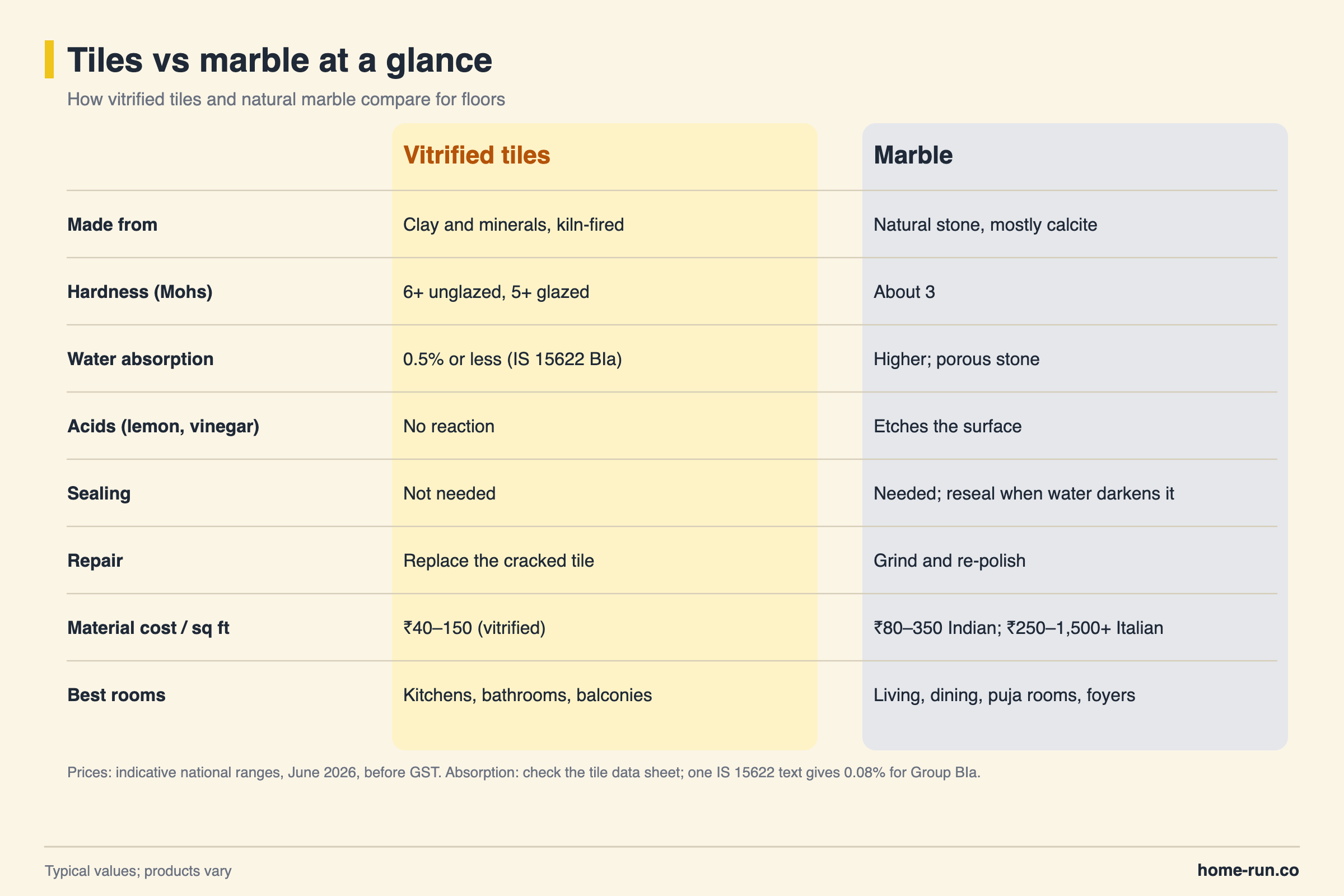
- Vitrified tiles absorb almost no water and resist scratches better than marble, so they suit kitchens and bathrooms.
- Marble gives unique veining and can be re-polished, but it etches with acids and needs sealing.
- Vitrified tiles cost about ₹40–150 per sq ft; Indian marble about ₹80–350 and Italian marble ₹250–1,500+.
- For wet floors, choose a matt tile with a wet DCOF of 0.42 or more.
Tiles vs marble comes down to one trade-off: tiles are cheaper, harder and easier to maintain, while marble offers natural stone character that no two slabs share. Both are common floors in Indian homes.
This guide compares them on looks, durability, upkeep, slip safety, environmental impact and cost per sq ft, then matches each to the right room.
What Is the Difference Between Tiles and Marble?
The main difference between tiles and marble is how they are made. Tiles are pressed from clay and minerals and fired in a kiln. Marble is a metamorphic rock, mostly calcite, cut into slabs or tiles.
- Ceramic tiles: red or white clay body, usually glazed; more porous and softer than vitrified tiles. Read more in our ceramic tiles guide.
- Vitrified and porcelain tiles: denser bodies fired at higher temperatures until glass-like, so they absorb very little water. See our porcelain tiles guide.
- Indian marble: quarried mainly in Rajasthan, which produced about 89% of India's marble by value in 2014-15. Makrana white is the best-known variety.
- Italian marble: imported stone such as Statuario and Carrara, with a finer grain, higher price and more upkeep.
- Marble tiles: natural marble cut into tile sizes, still stone and still porous.
Many vitrified tiles, including Marbonite-style polished tiles, print a marble pattern on the surface. They look like marble but behave like tiles: low water absorption, no etching and no re-polishing. Real marble is the only option with veins running through its full thickness.
How Do Tiles and Marble Compare on Looks?
Marble looks more natural because each slab has its own veining and colour shifts, while tiles look more uniform and come in far more designs. The right look depends on whether you want character or consistency.
- Colour and pattern: marble ranges from Makrana white to green, pink and black stone. Tiles copy wood, stone, cement and solid colours.
- Finish: marble is usually mirror-polished; tiles come in glossy, matt, satin and textured finishes.
- Joints: marble slabs can be laid with near-invisible joints. Tiles need grout lines, though large-format tiles reduce them.
- Cultural preference: white marble has long been the choice for puja rooms and grand living rooms in many Indian homes, and Italian marble signals a premium finish.
For patterns and layouts that work in common rooms, see our guide to living room tiles.
Which Is More Durable, Tiles or Marble?
Vitrified tiles are more durable than marble on day-to-day wear. They are harder, absorb less water and do not react with acids. Marble scratches and stains more easily, but its surface can be ground and re-polished.
Durability and maintenance: tiles vs marble
Typical values| Property | Vitrified tiles | Marble |
|---|---|---|
| Scratch hardness (Mohs) | 6+ unglazed, 5+ glazed | About 3 (calcite) |
| Water absorption | 0.5% or less (Group BIa) | Higher; porous stone |
| Reaction to acids | None | Etches: lemon, vinegar, tomato |
| Sealing | Not needed | Needed; reseal when water darkens it |
| Repair | Replace the cracked tile | Grind and re-polish the surface |
What Is the Tiles vs Marble Price Difference in India?
Tiles cost less than marble at every quality level. Vitrified tiles run about ₹40–150 per sq ft for material, against ₹80–350 for Indian marble and ₹250–1,500 or more for Italian marble (indicative June 2026 ranges, before GST).
Tiles vs marble cost per sq ft in India, 2026
₹ per sq ft, before 18% GST| Flooring | Material (₹/sq ft) | Installed (₹/sq ft) |
|---|---|---|
| Ceramic floor tiles Budget | 30–80 | 70–150 |
| Vitrified tiles (GVT/PGVT) Default pick | 40–150 | 90–220 |
| Granite | 50–250 | 120–350 |
| Indian marble | 80–350 | 180–450 |
| Italian marble Premium | 250–1,500+ | 450–1,800+ |
Long-term cost also differs. Tiles need little beyond cleaning and the odd grout repair. Marble needs sealing and periodic re-polishing, and the stone must travel far to reach Bengaluru, since most Indian marble comes from Rajasthan.
Are Tiles or Marble Safer in Wet Areas?
Matt or textured tiles are safer than marble in wet areas. Polished marble turns slippery once water or oil sits on it. For tiles, ANSI A137.1 asks for a wet DCOF (dynamic coefficient of friction) of 0.42 or more on level indoor floors that get wet.
- Polished marble or glossy tiles in a bathroom or near a shower.
- No slip rating, DCOF or R-value on the tile box or data sheet.
- Glossy tiles on stair treads, ramps or the sit-out during the monsoon.
- Marble in the kitchen, where oil and spills make it slippery and acids etch it.
Comfort underfoot is similar. Both feel cool, which suits Bengaluru's mild climate.
Which Has the Lower Environmental Impact, Tiles or Marble?
Neither is clearly greener; the impact sits at different stages. Tiles use energy in kiln firing at the factory. Marble needs quarrying, cutting and long-distance transport, which matters in Karnataka, a state with little marble of its own.
- Production: tile plants burn fuel to fire clay; marble quarries produce large volumes of cutting waste and slurry.
- Transport: a large share of Indian tiles comes from the Morbi cluster in Gujarat, which made 80–90% of India's ceramic exports in 2024-25. Most marble comes from Rajasthan, and Italian marble adds sea freight.
- Lifespan: marble can be re-polished for decades, while tiles are usually replaced when the surface wears.
If the environmental footprint matters to you, ask the brand for an environmental product declaration (EPD). It is the most reliable way to compare products, since claims like "eco tile" are not standardised.
Tiles or Marble: Which Suits Each Room?
Tiles suit wet, busy and budget-sensitive rooms, while marble suits dry, low-spill rooms where looks matter most. Many Bengaluru homes mix both.
Choose tiles
Most roomsPoints
- Kitchens, where oil and acids hit the floor
- Bathrooms, with matt anti-skid tiles
- Balconies, sit-outs and utility areas
- Rentals and tight budgets
Choose marble
Feature roomsPoints
- Living and dining rooms with few spills
- Puja rooms, often in white marble
- Foyers and staircases where veining shows
- Homes with budget for sealing and polishing
For a broader view of tile families, from ceramic to GVT, read our guide to types of tiles.
Tiles vs Marble: Which Should You Choose?
Choose tiles if you want the lowest cost and upkeep; choose marble if you want natural stone and accept the care it needs. Your budget, rooms and tolerance for maintenance decide it, not one material being better.
If a floor sees water, oil, lemon or vinegar every day, use tiles. If it stays dry and you want it to be the room's centrepiece, consider marble.
Pre-installation checklist
- Buy all tiles or marble from one batch, plus 5–10% extra for cuts and future repairs.
- Check the slab or screed is level before laying.
- Confirm the adhesive suits the material; large tiles and stone need polymer adhesive.
- Seal marble before grouting so grout does not stain it.
- Ask for the tile data sheet: water absorption, Mohs hardness and slip rating.
Skipping expansion gaps at the walls, mixing batches with slight shade differences, and cleaning marble with acidic or bleach cleaners are common causes of trouble. Use a pH-neutral stone cleaner on marble.
Laying a new floor?
Tiles, adhesive, grout and cement delivered across Bengaluru.