On this page
- What Are Porcelain Tiles?
- What Are Porcelain Tiles Made Of?
- Porcelain vs Ceramic vs Vitrified Tiles: What Is the Difference?
- Which Porcelain Types and Finishes Can You Buy?
- What Are the Pros and Cons of Porcelain Flooring?
- Which Rooms and Outdoor Areas Suit Porcelain?
- What Tile Size Should You Choose?
- How Much Does Porcelain Flooring Cost in Bengaluru?
- How Is Porcelain Installed and Maintained?
- Porcelain tiles are fine clay tiles fired until almost glass-like.
- The real test is water absorption of 0.5% or less, not shine or price.
- In India, porcelain is the densest end of the vitrified family.
- Use matt or anti-skid finishes in wet areas; polished ones get slippery.
- Fix them with a polymer-modified tile adhesive, not plain cement mortar.
Porcelain tiles are dense ceramic tiles made from refined clay, feldspar and quartz, pressed and fired at about 1,200°C. The heat turns the body almost glass-like, so a porcelain tile soaks up 0.5% of its weight in water or less.
That low absorption makes porcelain tiles hard and stain-resistant. They work on floors, walls, wet areas and outdoor spaces.
What Are Porcelain Tiles?
A porcelain tile is a ceramic tile with a water absorption of 0.5% or less. That figure places it in group BIa of ISO 13006, the international standard for ceramic tiles.
In India, IS 15622:2017 is the Bureau of Indian Standards (BIS) specification for pressed ceramic tiles. IS 15622 uses the same absorption-based groups.
- Water absorption: the share of its own weight a tile soaks up. Lower means denser and stronger.
- Vitrification: the stage of firing where the clay body fuses and turns glass-like.
- Body: the fired clay under any print or glaze.
Many shops call any glossy floor tile "porcelain". Ask for the water absorption figure on the box or datasheet. If it reads 0.5% or less, the tile is porcelain-grade.
What Are Porcelain Tiles Made Of?
Porcelain tiles are made of three main raw materials: clay, feldspar and quartz. Each one has a job in the fired tile.
Typical porcelain tile body, by dry weight
Proportions vary by maker| Raw material | Share | What it does |
|---|---|---|
| Kaolin and ball clay | 40–50% | Makes the powder plastic enough to press |
| Feldspar | 35–45% | Melts in the kiln and fills pores, cutting absorption |
| Quartz (silica) | 10–15% | Forms a stable skeleton and limits shrinkage |
The making process follows six broad steps:
- Raw materials are ground with water into a fine slurry.
- The slurry is spray-dried into a free-flowing powder.
- Hydraulic presses compact the powder into tiles.
- The tiles are dried, then printed or glazed if the design needs it.
- A roller kiln fires the tiles at about 1,200°C until the body vitrifies.
- Some tiles are polished, rectified (edges ground square) or textured.
Full-body porcelain carries its colour through the whole thickness. Glazed porcelain carries the design in a thin top layer, so a deep chip can show a different colour below.
Porcelain vs Ceramic vs Vitrified Tiles: What Is the Difference?
The main difference is water absorption. Porcelain tiles absorb 0.5% or less, vitrified tiles up to 3%, and ceramic tiles more than 3%.
"Vitrified" is a broad Indian trade term. Many tiles sold as GVT, PGVT, double charge or full body have porcelain-type bodies. Porcelain is the densest end of that family.
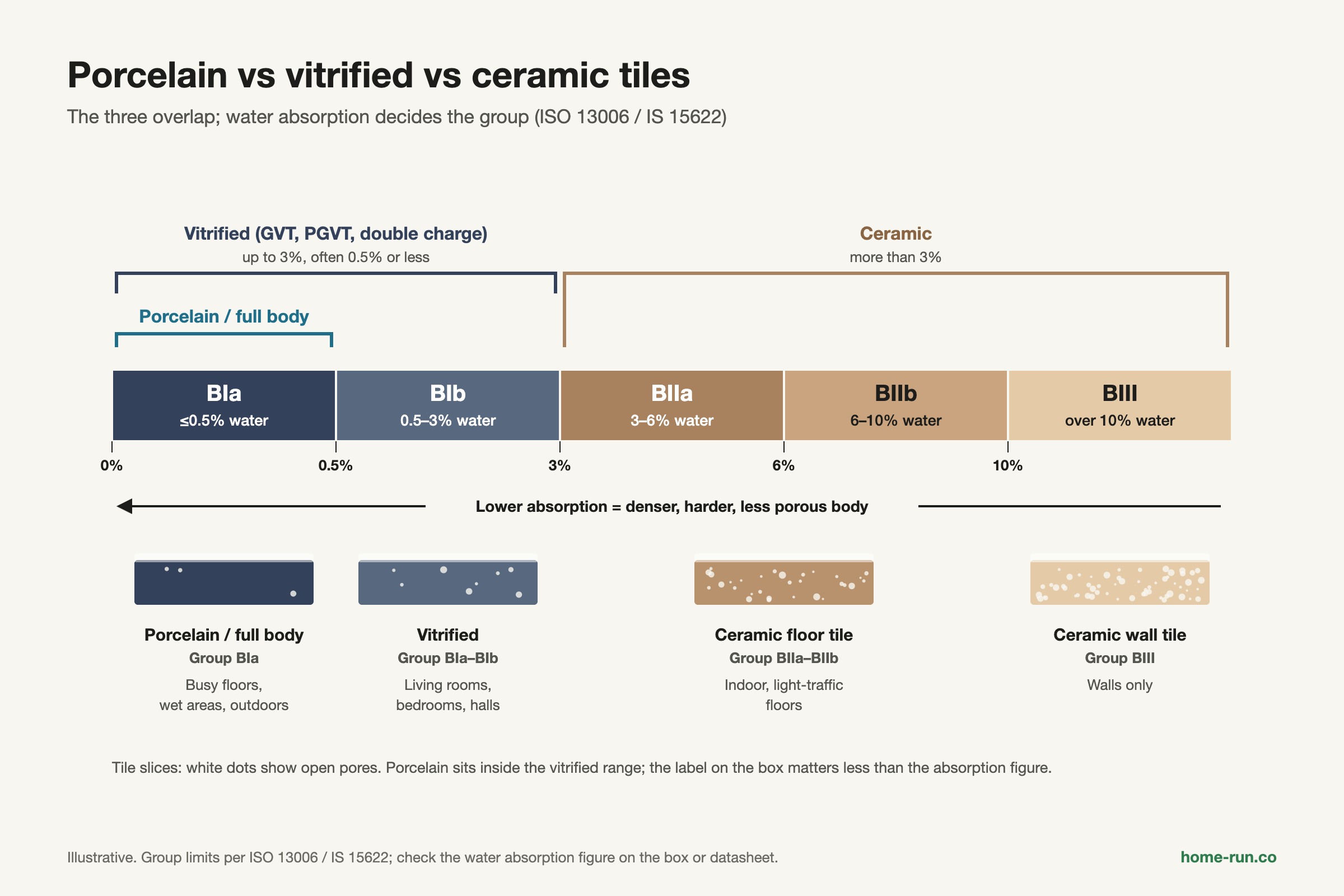
Ceramic, vitrified and porcelain tiles compared
Groups as defined in ISO 13006 / IS 15622| Tile type | Group | Water absorption | Best for |
|---|---|---|---|
| Ceramic wall tile Budget | BIII | Over 10% | Walls only |
| Ceramic floor tile | BIIa–BIIb | 3–10% | Indoor, light-traffic floors |
| Vitrified (GVT, PGVT, double charge) | BIa–BIb | Up to 3%, often 0.5% or less | Living rooms, bedrooms, halls |
| Porcelain / full body Default pick | BIa | 0.5% or less | Busy floors, wet areas, outdoors |
Ceramic for walls and dry, low-traffic rooms. Porcelain-grade vitrified for floors you walk on daily. Full-body porcelain where chips must not show, such as entrances and stairs.
For walls and light-traffic rooms, see our explainer on ceramic tiles and where they suit.
Which Porcelain Types and Finishes Can You Buy?
Porcelain tiles come in three body types and five common finishes.
- Glazed porcelain (GVT, PGVT): a printed design under a glaze. Allows marble, wood and stone looks.
- Double charge: a thick decorative top layer pressed over a plain base.
- Full body: one colour and pattern through the whole tile, so wear shows less.
Porcelain tile finishes and where they suit
Check the slip rating for wet areas| Finish | Look | Where it suits |
|---|---|---|
| Polished | Mirror shine | Dry living and dining rooms |
| Glossy glazed | Shiny print | Walls, low-traffic dry floors |
| Satin | Soft sheen | Living rooms, kitchens |
| Matt | Low sheen | Bedrooms, kitchens, bathroom walls |
| Anti-skid / structured Wet areas | Textured, grippy | Bathroom floors, balconies, ramps |
Popular porcelain tile designs include marble-look, wood-look, stone-look, terrazzo and concrete-look. Whites and beiges make small rooms feel larger; greys and darker tones hide dirt better.
The PEI rating (Porcelain Enamel Institute scale) grades how well a glazed surface resists wear, from class 0 to 5. Class 3 suits all home floors. PEI applies to glazed tiles, not full-body porcelain.
What Are the Pros and Cons of Porcelain Flooring?
The main advantage of porcelain tiles is very low water absorption, which brings strength, stain resistance and long life. The main drawbacks are cost, weight and harder installation.
Advantages
Why buyDense body, low upkeep.
- Absorbs 0.5% water or less
- Resists stains, scratches and fading
- Takes heavy furniture and foot traffic
- Cleans with a damp mop
- Works indoors and outdoors
Disadvantages
Plan for theseCost and fitting need care.
- Costs more than basic ceramic
- Heavier to carry and lift
- Hard to cut and drill
- Needs the right adhesive and a skilled tiler
- Feels cold and hard underfoot
Cracks usually come from the fixing, not the tile. Common causes are an uneven or uncured base, spot-fixing with patches of mortar, missing movement joints, and impact over a hollow spot. Full adhesive coverage prevents most of them.
Porcelain tiles are water-resistant, but a tiled floor is not waterproof. Water can pass through grout joints, so bathrooms and terraces still need waterproofing below the tiles.
Which Rooms and Outdoor Areas Suit Porcelain?
You can use porcelain tiles in almost every room, on floors and walls, indoors and outdoors. The finish and slip rating matter more than the tile body.
Porcelain tiles room by room
R-ratings from the DIN 51130 ramp test| Area | Suggested finish | Slip rating to look for |
|---|---|---|
| Living and dining rooms | Polished, satin or matt | R9–R10 |
| Bedrooms | Matt or satin | R9–R10 |
| Kitchen floor | Matt or satin | R10–R11 |
| Bathroom floor No polished | Anti-skid matt | R10–R11 |
| Bathroom and kitchen walls | Glossy or matt glazed | Not needed |
| Balcony and terrace | Structured anti-skid | R11–R12 |
| Staircase | Full body, matt | R10 or higher |
| Driveway and parking | 20 mm structured paver | R12 or higher |
Bengaluru has no frost, so frost resistance matters less here than in colder countries. Monsoon rain, moss and garden soil are the real risks on open terraces.
For driveways that take car loads, also compare interlocking paving blocks, which are easier to lift and replace.
What Tile Size Should You Choose?
For most Indian homes, 600x600 mm or 600x1200 mm porcelain tiles suit living rooms and bedrooms. Smaller anti-skid tiles suit bathrooms and balconies, where the floor slopes to a drain.
- 300x300 and 300x600 mm: bathrooms, balconies, utility areas.
- 600x600 and 800x800 mm: bedrooms, kitchens, mid-size living rooms.
- 600x1200 and 800x1600 mm: large living rooms and corridors.
- Slabs up to 1600x3200 mm: feature walls, counters, open-plan spaces.
Larger tiles mean fewer grout lines but need a flatter base and careful handling. Rectified tiles have edges ground square after firing, which allows very thin joints.
How Much Does Porcelain Flooring Cost in Bengaluru?
Porcelain tiles cost about ₹60–200 per sq ft for most ranges, material only. Large-format slabs start from about ₹90–150 per sq ft, depending on the source. Type, size, finish and brand drive the price.
Indicative porcelain tile prices
Material only, per sq ft, before 18% GST (June 2026)| Type | Price per sq ft |
|---|---|
| Double charge | ₹60–120 |
| Glazed matt porcelain | ₹60–140 |
| PGVT (polished glazed) | ₹70–180 |
| Full body | ₹90–200 |
| Large-format slab | ₹150–600+ |
Laying tiles in Bengaluru costs about ₹35–55 per sq ft in labour, plus ₹15–30 per sq ft for tile adhesive. Large formats cost more to lay. Also budget for grout, spacers, skirting, wastage and transport.
Check pieces per box on the label; 2 is illustrative. Keep the spare box for repairs, since later batches rarely match in shade.
Everything for your porcelain tiling job
Order tiles, adhesive and grout with a GST invoice and delivery across Bengaluru.
How Is Porcelain Installed and Maintained?
Porcelain tiles are fixed with a polymer-modified tile adhesive on a flat, cured base, then grouted. Plain cement mortar grips dense tiles poorly, which leads to hollow-sounding tiles.
- Level and cure the base. Large formats need a flatter base than small tiles.
- Use an IS 15477:2019 Type 2 adhesive, the class for vitrified tiles and tiles over 300x300 mm.
- Spread with a notched trowel and back-butter large tiles for full coverage.
- Use spacers, and leave movement joints at walls and across large floors.
- Grout after the adhesive maker's curing time. In wet areas, consider epoxy grout, which resists stains and water.
- Cut with a wet saw or a cutter rated for porcelain, and drill with diamond bits.
Open a few boxes before the tiler starts. Reject the batch if you see:
- Different shade or batch numbers on the boxes
- Warped tiles that rock on a flat surface
- Chipped corners or cracked edges
- Pinholes, print smudges or glaze defects
- Size differences between tiles in one box
Porcelain tiles need little care. Sweep or dust-mop daily and damp-mop weekly with a pH-neutral cleaner.
- Avoid acid cleaners; they eat cement grout.
- Avoid abrasive pads on polished tiles; they leave fine scratches.
- Deep scratches on polished tiles are permanent; replace the tile from your spare box.
- Seal unglazed or polished porcelain only if the maker's guidance asks for it.