On this page
- What Is Teak Wood and Where Does It Come From?
- What Are the Characteristics of Teak Wood?
- What Are the Main Teak Wood Uses in India?
- Why Is Teak Wood Used for Boats and Marine Decks?
- How Does Teak Compare With Other Hardwoods?
- How Does Teak Go From Tree to Teak Wood Furniture?
- How Do You Maintain Teak Wood So It Lasts?
- What Affects Teak Wood Price in India?
- Is Teak Wood Worth the Investment?
- The main teak wood uses are main doors, door and window frames, furniture, flooring, decks and boats.
- Teak lasts because its natural oil repels water and its low shrinkage keeps joints tight.
- Teak is medium-hard: about as hard as oak and softer than sheesham.
- Plantation teak is as strong as old-growth teak but has less heartwood, so it is less durable outdoors.
- Silica in teak blunts tools and its oil makes gluing harder, so carpenters charge more to work it.
Teak wood uses range from main doors and window frames to furniture, flooring, boat decks and carvings. Teak suits these jobs because it is stable, resists rot and weather, and holds a polish well.
This page explains where teak works and why. To check whether a piece is genuine, see our guide on how to identify teak wood.
What Is Teak Wood and Where Does It Come From?
Teak wood is the timber of Tectona grandis, a tall tropical tree of the mint family (Lamiaceae). The tree is native to India, Myanmar, Thailand, Indonesia and nearby countries. In Hindi it is called sagwan.
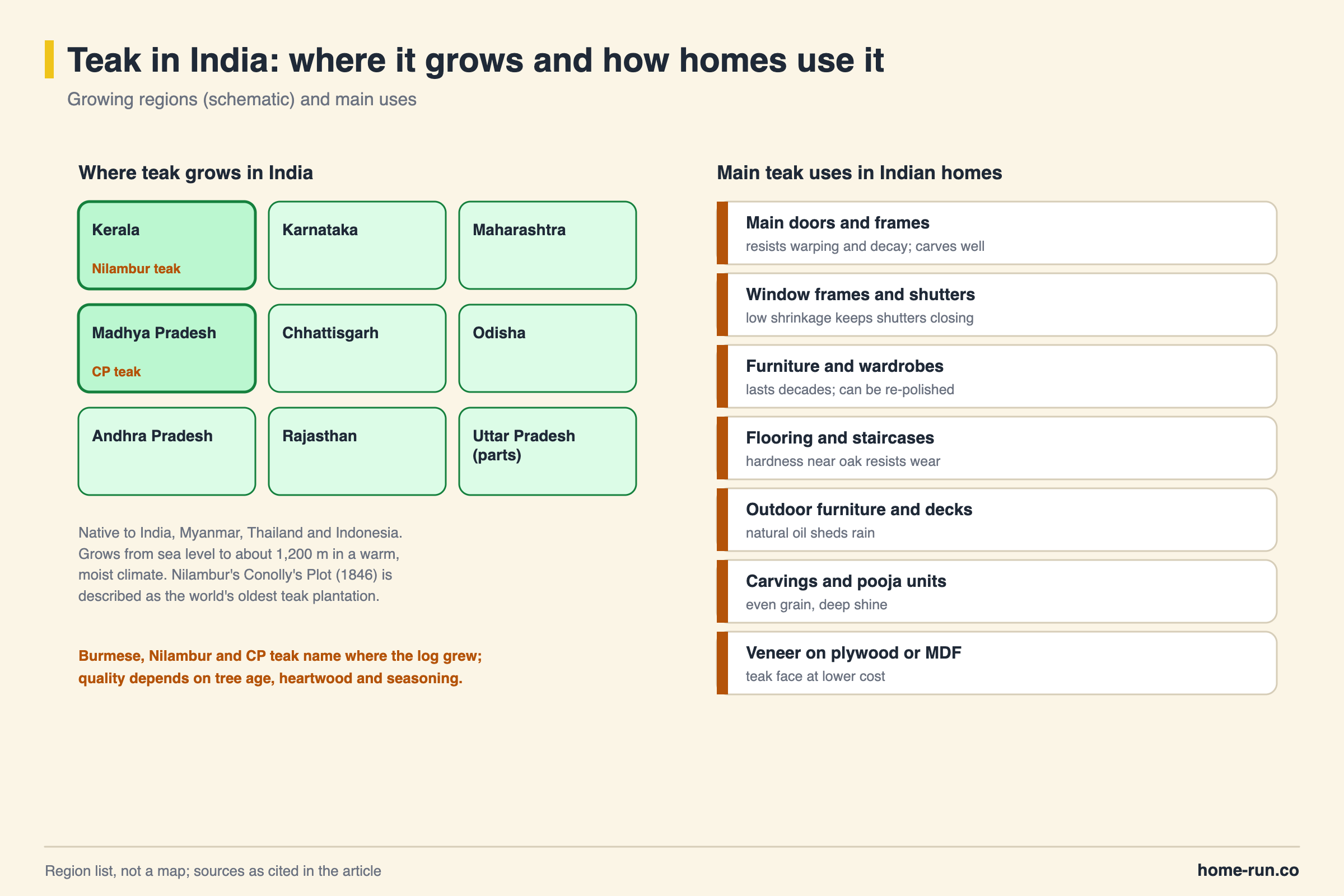
In India, teak grows naturally in Kerala, Karnataka, Maharashtra, Madhya Pradesh, Chhattisgarh, Odisha, Andhra Pradesh, Rajasthan and parts of Uttar Pradesh. The tree prefers a warm, moist climate and grows from sea level up to about 1,200 m.
Nilambur in Kerala is famous for teak. Its Conolly's Plot, planted in 1846, is described by Kerala Tourism as the world's oldest teak plantation.
Names like Burmese teak (Myanmar), Nilambur teak (Kerala) and CP teak (Central Provinces, now Madhya Pradesh) tell you where the log grew. Quality still depends on the tree's age, the share of heartwood and how well the timber was seasoned.
What Are the Characteristics of Teak Wood?
Teak wood is a medium-weight, medium-hard timber with golden-brown heartwood, a straight grain and a greasy, oily feel. Fresh-cut teak has a leathery smell.
Teak wood characteristics
Seasoned timber, published lab data| Property | Typical value | What it means in use |
|---|---|---|
| Density | 660–680 kg/m³ | Heavy enough to feel solid, light enough for shutters |
| Janka hardness | ≈ 1,000–1,155 lbf | Resists dents in floors and tabletops |
| Shrinkage, tangential / radial | 4.7% / 2.6% | Low movement, so doors and joints stay true |
| Decay resistance | Durable to very durable | High for old heartwood, lower for young plantation wood |
| Colour | Golden to mid brown | Darkens indoors; turns silver-grey in sun |
| Silica and oil | High | Blunts tools; needs fresh surfaces for glue |
Teak's low shrinkage matters most for joinery. Wood that moves less with humidity keeps doors from sticking in the monsoon. Properly dried timber is still essential; our guide to seasoning of timber explains the moisture level to ask for.
What Are the Main Teak Wood Uses in India?
The main teak wood uses in Indian homes are main doors, door and window frames, furniture and wardrobes, flooring, staircases and carved pooja units. Outside the home, teak goes into boats, decks and garden furniture.
- Main doors and frames: teak resists warping and decay, and takes carving well.
- Window frames and shutters: low shrinkage keeps shutters closing smoothly through wet and dry seasons.
- Furniture: beds, dining tables, sofas and cots last for decades and can be re-polished.
- Flooring and staircases: hardness near oak resists wear on treads and floor boards.
- Outdoor furniture and decks: the natural oil sheds rain and slows rot.
- Carvings, pooja units and panelling: the even grain cuts cleanly and polishes to a deep shine.
- Veneer: thin slices of teak give plywood or MDF a teak face at a fraction of solid-wood cost.
The Tropical Forest Research Institute (TFRI), Jabalpur, also lists railway sleepers and coaches, poles and construction timber among teak's traditional uses in India.
Why Is Teak Wood Used for Boats and Marine Decks?
Teak is used for boats and marine decks because it resists water, rot and marine borers, and stays stable when wet. Ship decks, rails, hatches and planking have used teak for centuries.
- Water resistance: the natural oleoresin (oily resin) in teak repels water.
- Salt-water service: CIRAD, the French tropical timber institute, rates teak as naturally fit for permanent contact with sea water, which it links to teak's high silica content.
- Stability: low shrinkage means deck planks do not open up as they wet and dry.
The same properties help at home in bathrooms, balconies, wet-area doors and coastal houses.
How Does Teak Compare With Other Hardwoods?
Teak is softer than sheesham, about as hard as white oak and harder than mahogany. Teak's edge is stability and weather resistance, not hardness.
Teak vs other furniture hardwoods
Janka hardness and typical density, seasoned| Wood | Janka hardness | Density | Strong point | Weak point |
|---|---|---|---|---|
| Teak Outdoor pick | ≈ 1,000–1,155 lbf | 660–680 kg/m³ | Stable, weather and rot resistant | Costly; blunts tools |
| Sheesham (Indian rosewood, Dalbergia sissoo) | 1,660 lbf | ≈ 770 kg/m³ | Hard, dense, rich grain | Moves more; better indoors |
| White oak | ≈ 1,350 lbf | Varies | Hard-wearing floors | Mostly imported in India |
| Mahogany | ≈ 800 lbf | Varies | Easy to carve and finish | Dents more easily |
The bigger choice for most buyers is old-growth versus plantation teak:
Old-growth (natural) teak
Exteriors, main doorsPoints
- More heartwood and natural oil
- Higher decay resistance outdoors
- Tighter grain, deeper colour
- Scarce and much costlier
Plantation teak
Indoor furniturePoints
- Less heartwood in young logs
- Less durable outdoors; treat it
- Paler, wider grain
- Similar strength and density
An ITTO (International Tropical Timber Organization) review found short-rotation plantation teak no weaker or lighter than natural teak, but less durable and less attractive. If you only need a flat, painted or laminated surface, plywood is cheaper; see engineered wood vs plywood.
How Does Teak Go From Tree to Teak Wood Furniture?
Teak takes decades to grow and several months of processing before it becomes a door or a table. Indian plantations are usually felled at 50–80 years; some natural forests in Madhya Pradesh and Tamil Nadu work on 100–150 year cycles.
Plant and grow
Forest departments and private growers raise teak in plantations, mostly for 50–80 years.
Fell and auction
State forest departments sell logs from their timber depots, mainly by auction.
Saw and season
Sawmills cut logs into planks, then air-dry or kiln-dry them to a safe moisture level.
Make and join
Carpenters cut frames, panels and furniture parts with carbide-tipped tools.
Finish
Sanding and polish, oil or PU coating bring out the colour and seal the surface.
How Do You Maintain Teak Wood So It Lasts?
You maintain teak by dusting it, wiping spills quickly and renewing the finish every few years. Outdoor teak needs more care than indoor teak.
- Dust indoor teak with a dry or slightly damp cloth; avoid soaking it.
- Clean outdoor teak with mild soap and a soft brush, then let it dry fully.
- Oil or seal outdoor teak if you want to keep the golden colour; untreated teak turns silver-grey in sun.
- Keep teak furniture off damp floors and away from leaking pipes.
For finishes, sanding steps and polisher rates, see our guide to teak wood polishing.
What Affects Teak Wood Price in India?
Teak wood price in India depends mainly on origin, log age, heartwood share, plank size, seasoning and paperwork. Old-growth Burmese and Nilambur teak sell at a premium over young plantation teak.
- Origin and age: old, slow-grown logs have more heartwood and fetch more.
- Section size: wide, long, knot-free planks cost more per cubic foot than short pieces.
- Seasoning: kiln-dried, ready-to-use timber costs more than green wood.
- Supply: Myanmar banned wild teak log exports in 2014, which cut supply of Burmese teak.
India holds about 43% of the world's teak plantation area, roughly 2.45 million hectares, per the ITTO review. Supply of mature logs is still limited.
The Karnataka Forest Department sells timber from its depots, such as Dandeli, Mundagod and Mangaluru, mostly through e-auctions. A 2018 retail scheme for individual buyers excluded teak, so most homeowners buy from licensed timber merchants. Ask for a bill showing species and origin, and compare per-cft quotes for the same grade and size.
Is Teak Wood Worth the Investment?
Teak wood is worth the cost for main doors, frames, exterior woodwork and furniture you plan to keep for decades. For flat indoor panels, plywood or veneered board gives a similar look for less.
Benefits of teak wood
- Long life indoors and outdoors with basic care.
- Low movement, so doors and drawers keep fitting.
- Takes polish, oil and carving well.
- Can be re-sanded and re-polished many times.
Disadvantages of teak wood
- High price: teak is among the costliest timbers in Indian markets.
- Fakes: stained lookalikes and young sapwood are often sold as teak.
- Hard to work: silica blunts saws, and the oil weakens glue joints on old surfaces.
- Sustainability: the IUCN Red List assesses wild teak as Endangered, so prefer plantation or certified wood.
Spend on solid teak where wood meets weather or daily wear: main door, frames, stair treads. Save with plywood and teak veneer on wardrobes and wall panels.
Working with teak at home?
Plywood, hardware, polish and adhesives delivered across Bengaluru.