On this page
- How Do You Identify Teak Wood by Its Features?
- Which Types of Teak Wood Are Sold in India?
- What Do Teak Wood Grades A, B and C Mean?
- How to Identify Fake Teak Wood: Telltale Signs
- How Do You Test Teak Wood Quality at Home?
- Which Woods Are Commonly Sold as Teak?
- When Should You Get Teak Wood Tested in a Lab?
- How Do You Maintain Teak Wood So It Lasts?
- How Do You Know Teak Is Legally and Sustainably Sourced?
- What Should You Check Before Buying Teak in Bengaluru?
- Genuine teak (Tectona grandis) has golden-brown heartwood, straight grain, an oily feel and a smell like old leather.
- Check several traits together: colour, grain, oil, smell, weight and end grain. Any one sign alone can be faked or stained.
- The water test only works on bare, unfinished wood, because polish makes any timber bead water.
- Grades A, B and C are trade terms, not a BIS standard. Ask the seller to write the teak type and "solid teak" on the invoice.
- For a large order, ICFRE-IWST in Bengaluru identifies wood species from ₹12,000 plus 18% GST per sample.
To identify teak wood, look for golden-brown heartwood with straight grain, a slightly oily surface and a leather-like smell when cut or sanded. Then confirm with weight, a water test on bare wood and a look at the end grain. No single sign is proof, so check them together.
How Do You Identify Teak Wood by Its Features?
You identify teak wood by six physical features: colour, grain, texture, oil, smell and weight. Teak is the timber of Tectona grandis, a tree native to India, Myanmar, Laos and Thailand.
Heartwood is the dark, mature core of the trunk; sapwood is the pale outer band under the bark. Only teak heartwood has teak's durability.
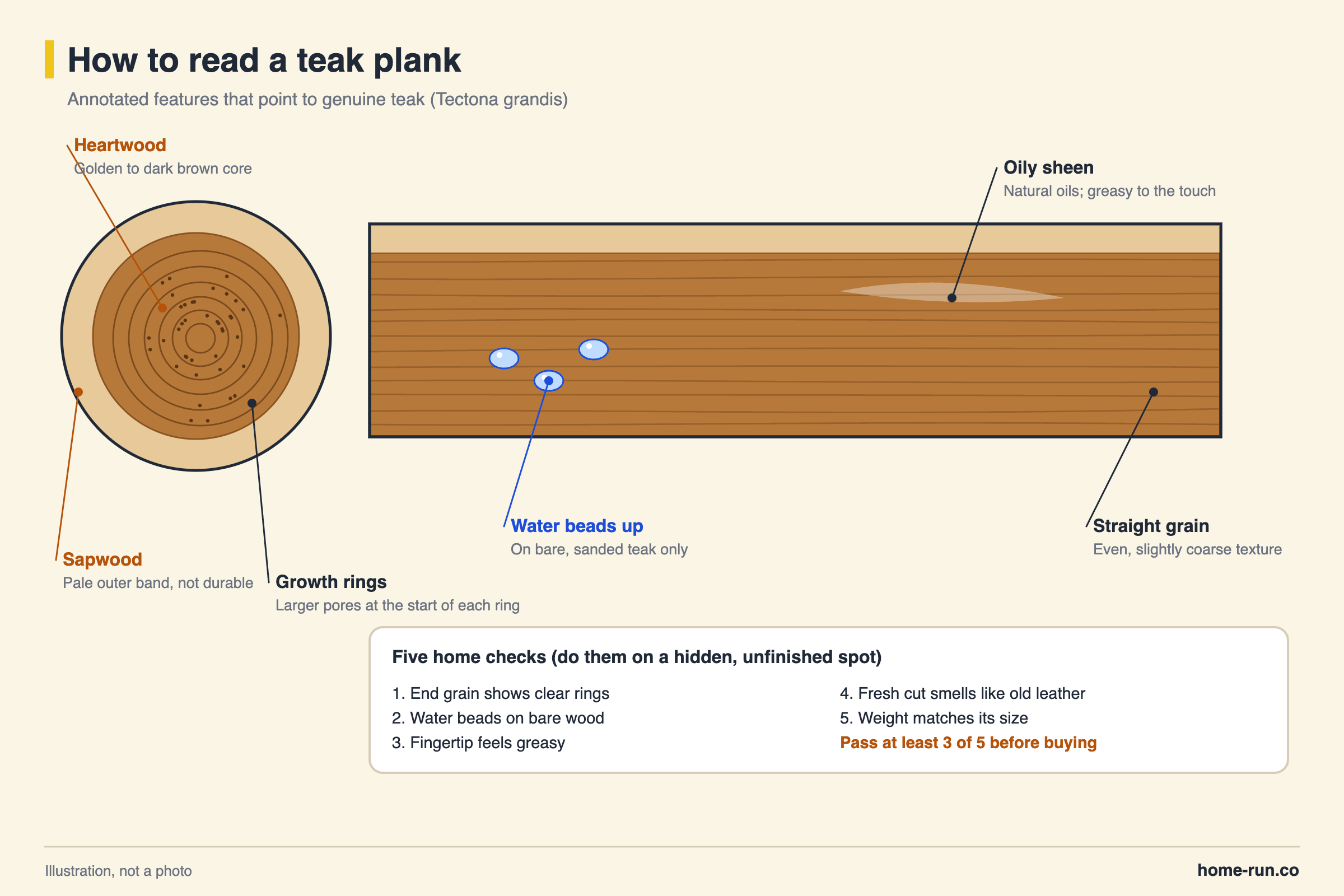
Features of genuine teak wood
Check at least four of these on any piece| Feature | Genuine teak | What to watch for |
|---|---|---|
| Colour | Golden brown to medium brown heartwood, darkening with age; whitish sapwood band | Uniform dark stain that hides the grain |
| Grain | Usually straight, with distinct growth rings | Printed or repeating patterns |
| Texture | Rather coarse and uneven to the touch | Glass-smooth plastic feel |
| Oil | Greasy or waxy feel on bare wood | Dry, chalky surface |
| Smell | Like old leather when freshly cut or sanded | No smell, or a resin or glue smell |
| Weight | Medium-heavy, about 17–21 kg per cubic foot | A piece that feels light for its size |
Teak heartwood carries natural oils that repel water and give the greasy feel. It also holds 0.2–1.5% silica. Carpenters notice the silica because saw teeth and chisels dull fast on teak, which rarely happens with rubberwood or pine.
Which Types of Teak Wood Are Sold in India?
Indian timber yards mainly sell Burma teak, Indian plantation teak and African plantation teak, all of which are the same species. They differ in growth rate, tree age and heartwood share.
Types of teak wood in India
Relative cost from timber trade guides| Type | Origin | Typical traits | Relative cost |
|---|---|---|---|
| Burma teak Premium | Myanmar, old natural forests | Golden brown, dense, fine grain, high oil | Highest; scarce because Myanmar restricts log exports |
| Indian (CP) teak | Indian plantations and forests | Light to dark brown with a golden hue | Mid; the common benchmark |
| African or Ghana teak | West African plantations | Younger trees, more sapwood and colour variation | Lowest for genuine teak |
| Indonesian teak | Java plantations | Tight, straight grain | Mid |
| "African teak" (iroko) Not teak | West Africa | Similar golden brown, slightly lighter, no leather smell | Sold as a cheaper substitute |
Plantation teak is cut younger, so logs hold more sapwood. PROTA reports heartwood at 35–55% of a 13-year-old tree, against over 80% past 50 years.
What Do Teak Wood Grades A, B and C Mean?
Teak grades A, B and C describe which part of the log the wood comes from. They are trade terms used by sellers. No Bureau of Indian Standards (BIS) grading defines them, so two sellers may mean different things.
Teak wood grades compared
As commonly used by furniture sellers| Grade | Part of the log | Look and oil | Best use |
|---|---|---|---|
| Grade A Best | Heartwood from the centre of a mature tree (often quoted as 25+ years) | Even golden colour, few knots, most oil | Main doors, frames, outdoor furniture |
| Grade B | Outer, less mature heartwood | More knots, some streaks, less oil | Indoor furniture, shutters |
| Grade C Avoid outdoors | Mostly sapwood near the bark | Patchy colour, pale streaks, filled knots, little oil | Hidden or low-wear parts |
How to Identify Fake Teak Wood: Telltale Signs
Fake teak wood usually gives itself away through printed or repeating grain, a dry surface, low weight or a cut edge that shows layers. Sellers may also stain cheaper timber dark to look like aged teak.
- Repeating grain: the same pattern on every panel points to a printed laminate or veneer.
- Layers at the edge: plywood or MDF (medium-density fibreboard) visible at a cut edge, drawer side or underside.
- Unusual lightness: a solid-looking door or chair that lifts too easily for its size.
- No oil, no smell: a dry, chalky surface and no leather smell when you sand a hidden spot.
- Price too low: "Burma teak" offered far below market rates is unlikely to be genuine.
Teak veneer over a plywood core is fine when sold as veneer; the problem is veneer sold as solid teak. Our guide to engineered wood vs plywood explains how those boards are built.
How Do You Test Teak Wood Quality at Home?
You can test teak wood at home with five simple checks, done on a hidden, unfinished spot. Together, they confirm most genuine pieces without special equipment.
- Look at the end grain. Cut or plane the end of a plank. Teak shows distinct growth rings, with larger pores at the start of each ring.
- Do the water test. Put a few drops of water on bare, sanded wood. On teak, the drops bead up and sit on the surface. On dry, oil-free woods, they soak in quickly.
- Rub for oil. Rub a freshly planed surface with a clean fingertip or white cloth. Teak feels greasy and may leave a faint oily mark.
- Smell a fresh cut. Sand a small hidden patch and smell it at once. Teak smells like old leather.
- Weigh a known size. Weigh a plank and compare with the expected weight in the worked example below.
Treat a piece as likely teak only if it passes at least three of the five home tests, including the water test on bare wood. If it fails two or more, ask for a lab test before you pay.
Weight alone cannot settle the question. Rubberwood (specific gravity 0.557) weighs almost as much as teak (0.604), and wet timber weighs more. Our guide to seasoning of timber explains moisture content.
Which Woods Are Commonly Sold as Teak?
The woods most often passed off as teak in India are iroko, rubberwood, mahogany and stained softwoods. Each one looks close from a distance but differs in colour, oil or durability.
Genuine teak
Tectona grandisPoints
- Golden-brown heartwood with a sharp, pale sapwood band
- Oily feel and leather smell on a fresh cut
- Heartwood resists termites and fungi
- Suits outdoor and wet-area use
Common substitutes
Check firstPoints
- Iroko: similar colour, slightly lighter, no leather smell
- Rubberwood: near-white to cream, often stained to look like teak
- Mahogany: reddish brown, finer and less oily surface
- Rubberwood needs preservative treatment for outdoor use
Some sellers use "African teak" for iroko, which is a different tree, and others for genuine plantation teak grown in Ghana. "Country teak" has no fixed meaning. Ask for the botanical name, Tectona grandis, on the bill.
When Should You Get Teak Wood Tested in a Lab?
Get a lab test when buying teak in bulk for doors and frames, or when home tests give mixed results. A lab reads the wood's cell structure, which no stain can fake.
In Bengaluru, ICFRE-IWST (Institute of Wood Science and Technology, Malleswaram) identifies wood and veneer species under IS 399, the Indian standard for classifying commercial timbers. Its listed fee is ₹12,000 plus 18% GST for a normal enquiry, with a 15 × 10 cm sample.
How Do You Maintain Teak Wood So It Lasts?
You maintain teak wood by cleaning it with mild soap and water, keeping it dry and re-oiling or re-polishing it when the surface looks dull. Teak heartwood is rated durable to very durable, so care is mostly about appearance.
- Dust weekly and wipe spills at once with a damp cloth
- Clean with mild soap and water, then dry the surface
- Avoid bleach, ammonia and harsh scrubbing pads
- Re-oil or re-polish indoor pieces when the surface looks dry
For finishes, products and a step-by-step method, read our guide on how to polish teak wood.
How Do You Know Teak Is Legally and Sustainably Sourced?
You know teak is responsibly sourced when it carries Forest Stewardship Council (FSC) certification or comes with a legal-origin bill from a forest department depot or licensed dealer.
FSC is an international body that certifies responsibly managed forests and tracks timber through the supply chain. Not all teak is FSC certified. In Karnataka, retail sales of timber from Forest Department depots exclude teak, so most buyers purchase teak through licensed timber merchants. Keep the GST invoice as proof of origin.
What Should You Check Before Buying Teak in Bengaluru?
Before buying teak in Bengaluru, inspect the actual planks, run the home tests on bare wood and get the teak type, grade and "solid teak" written on the invoice.
- Visit the yard or showroom and see the batch you will receive
- Ask for the teak type (Burma, Indian, African) and grade in writing
- Compare quotes in rupees per cubic foot, excluding tax, from three sellers
- Get a lab test for large orders of doors and frames
Prices vary by type and grade. Brick & Bolt reported Burma teak at ₹7,500–9,000 per cubic foot in Bengaluru, excluding taxes, in mid-2024. Treat this as a reference point and get current quotes.
Building doors and frames?
Plywood, wood polish, hardware and adhesives delivered across Bengaluru.