On this page
- What Are the Different Types of Doors for Home Use?
- Which Types of Doors for Home in India Suit Each Material?
- What Are the Different Types of Door Design?
- What Types of Door Opening Mechanisms Are There?
- How Do You Choose the Right Type of Door for Each Room?
- What Affects the Cost of Different Door Types in India?
- How Do You Maintain Doors in Indian Weather Conditions?
- Sort the types of doors for home use three ways: by material, by design and by how they open.
- Use solid teak, sal or steel at the main entrance, where strength and security matter most.
- Flush doors are the budget default for bedrooms; panel doors suit a classic look.
- Wet rooms need PVC, WPC or FRP doors that do not swell or rot.
- In small rooms, a sliding or pocket door frees the floor space a swing door needs.
The main types of doors for home use are wooden (solid or flush), steel, glass, uPVC or PVC, WPC and fibreglass doors. Each also comes in a design style, such as panel or flush, and an opening type, such as hinged or sliding.
The right door depends on the room. A main door has to resist force and weather, while a bathroom door has to survive daily splashes. This guide covers each option and where it fits in an Indian home.
What Are the Different Types of Doors for Home Use?
Different types of doors for home use fall into three groups: material, design and opening mechanism. Every door you buy sits in one option from each group, for example a teak panel door on hinges.
- Material: what the shutter is made of, which decides strength, weight and moisture resistance.
- Design and construction: how the shutter is built, such as panelled, flush or glazed.
- Operation: how the door moves, such as swinging on hinges, sliding or folding.
Your choice affects security, ventilation, privacy and how much floor space a room loses to the door swing. It also sets how much upkeep the door needs in a humid monsoon.
Which Types of Doors for Home in India Suit Each Material?
Hardwood and steel suit entrances, engineered wood suits dry interior rooms, and plastic or composite doors suit wet areas. The table compares the materials sold in India.
Door materials compared for Indian homes
Strength, moisture and best location| Material | Moisture resistance | Best for | Watch for |
|---|---|---|---|
| Solid hardwood (teak, sal) Main door pick | Good if seasoned and polished | Main door, pooja room, frames | High price, fake or unseasoned timber |
| Flush (plywood or blockboard core) | Fair; edges absorb water | Bedrooms, study, wardrobes | Swelling at the bottom edge |
| MDF or HDF moulded | Poor; swells when wet | Dry interior rooms | Never use in bathrooms |
| Steel | Good if coated | Main door, safety door, utility | Rust at scratches and the bottom rail |
| Glass in aluminium or uPVC frame | Very good | Balcony, terrace, living-to-garden | Needs toughened glass for safety |
| uPVC / PVC Wet areas | Waterproof | Bathrooms, utility, balcony | Light PVC flexes under heavy hardware |
| WPC (wood plastic composite) | Very good | Bathrooms, kitchens, wider openings | Heavier; needs a strong frame |
| FRP (fibreglass) | Very good | Bathrooms, internal doors | Plain look; check panel thickness |
Teak is the classic main door timber because its natural oils resist termites and decay, and it moves little as humidity changes. Oak has an attractive grain but is lighter in colour and less water resistant than teak. Our guide on how to identify teak wood helps you avoid look-alikes.
MDF (medium-density fibreboard) is wood fibre bonded with resin into a smooth board. It paints well but swells if water gets in. See engineered wood vs plywood to compare cores.
uPVC is unplasticised polyvinyl chloride: rigid and used for door frames and glazed doors. Standard PVC doors are lighter panel doors, mainly for bathrooms. Our PVC doors guide covers their construction, sizes and prices.
What Are the Different Types of Door Design?
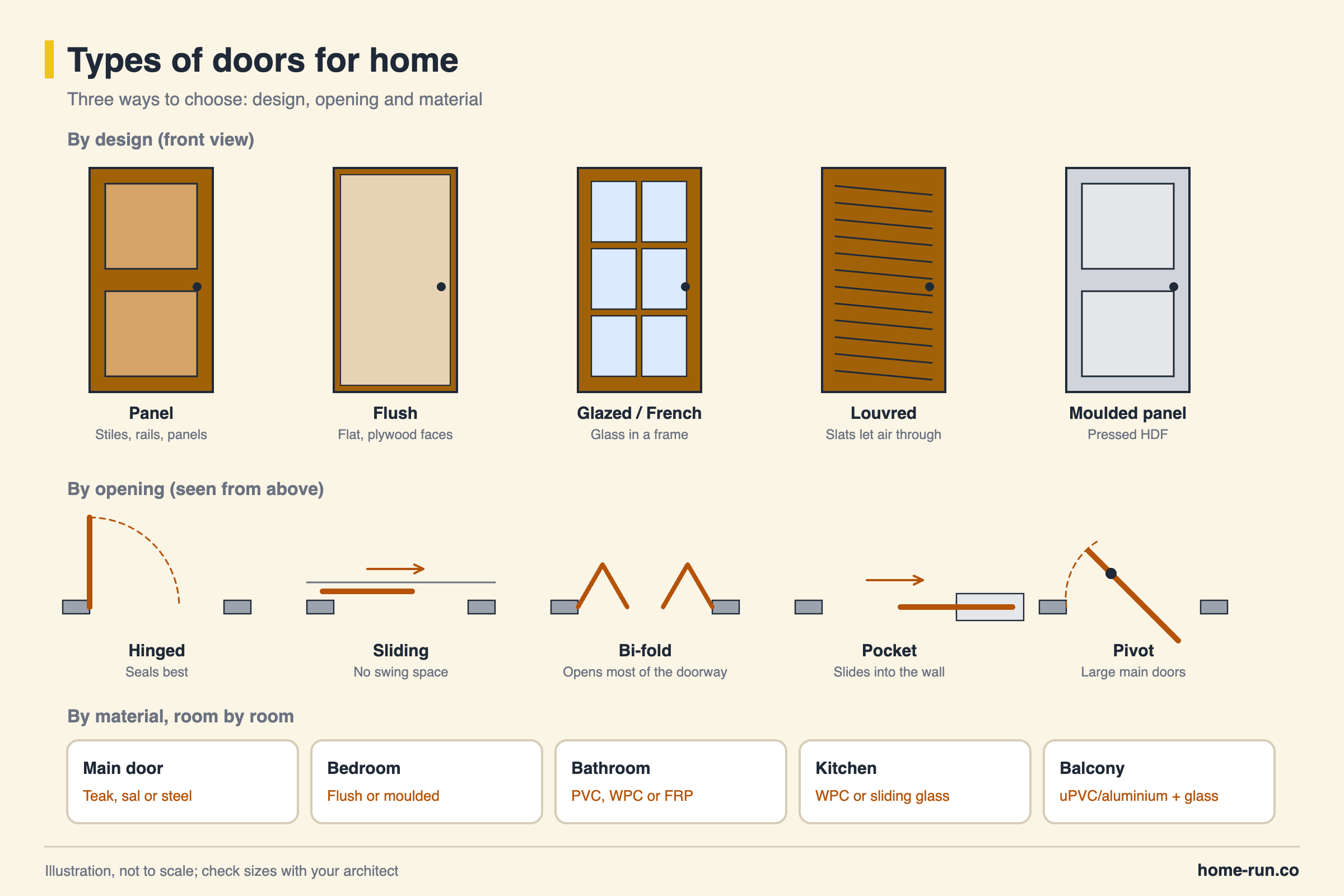
The main door designs are panel, flush, glazed (including French doors), louvred and sliding doors. Design describes how the shutter is built, not what it is made of.
- Panel door: a frame of stiles (verticals) and rails (horizontals) holding raised or flat panels. IS 1003 Part 1, the Indian standard for timber panelled and glazed door shutters, covers them.
- Flush door: a flat shutter with a solid core faced with plywood or veneer on both sides. IS 2202 Part 1 covers solid-core flush doors with plywood face panels.
- Glazed or French door: a frame filled with glass panes. French doors come in pairs and open onto a balcony, garden or sit-out.
- Louvred door: angled slats that let air through while blocking the view. They suit utility rooms, stores and wardrobe shutters.
- Moulded panel door: HDF (high-density fibreboard) pressed to look like a panel door at a lower price. IS 15380 covers moulded raised HDF panel doors.
Flush doors are the most common interior choice because they are flat, affordable and take laminate, veneer or paint. Panel doors cost more but give the carved, traditional look many Indian main doors use.
What Types of Door Opening Mechanisms Are There?
The main door opening types are hinged (swing), sliding, bi-fold, pocket and pivot doors. The mechanism decides how much clear floor space the door needs.
- Hinged door: swings on two or three hinges fixed to the door jamb. It seals best and is the default for most rooms.
- Sliding door: runs on a top or bottom track parallel to the wall. It suits balconies, wardrobes and kitchens.
- Bi-fold door: two or more leaves fold against each other, opening most of the doorway. It suits utility areas and wide balcony openings.
- Pocket door: slides into a cavity inside the wall, so it disappears when open. It must be planned before the wall is built or plastered.
- Pivot door: turns on a pin at the top and bottom instead of side hinges. It suits large, heavy statement main doors.
Door opening direction matters too. Door makers describe hand (left or right) by the side the hinges sit on when you face the door. Room doors usually open inward, away from the corridor. In very small bathrooms, some designers prefer an outward-opening or sliding door so a person inside cannot block it.
Hinged (swing) door
Most roomsPoints
- Seals well against sound, dust and draughts
- Takes standard locks and hardware
- Needs clear floor space for the swing arc
- Best for main doors, bedrooms and bathrooms
Sliding door
Tight spacesPoints
- Seals less tightly at the edges
- Needs a track, rollers and a sliding lock
- Uses no floor space when opening
- Best for balconies, wardrobes and small kitchens
The jamb is the frame the door hangs in. Our door jamb guide explains jamb types, sizes and fitting.
How Do You Choose the Right Type of Door for Each Room?
Choose a door by matching the material to the room's moisture and security needs, then the opening type to the space you have. The table gives a starting point for each room.
Best types of doors for home rooms
Typical Indian apartment or independent house| Room | Recommended door | Why |
|---|---|---|
| Main entrance Security first | Solid teak or sal panel door, or steel door; add a safety grille door | Strength, weather resistance, multi-point locks |
| Bedroom and study | Flush or moulded panel door, hinged | Privacy, sound control, low cost |
| Bathroom Wet area | PVC, WPC or FRP door with a WPC or uPVC frame | No swelling, rot or termites |
| Kitchen | WPC door, or a sliding glass door for open plans | Handles steam and frequent cleaning |
| Balcony and terrace | uPVC or aluminium sliding door with toughened glass | Light, ventilation, weather sealing |
| Pooja room | Carved teak or louvred wooden door, often with bells | Traditional look with airflow |
| Utility and store | Louvred, PVC or bi-fold door | Ventilation and easy access |
- Security: on the main door, check the shutter is solid and the lock is fixed into solid timber or steel, not a hollow core.
- Space: measure the swing arc; if furniture or another door blocks it, pick a sliding or pocket door.
- Moisture: keep MDF and plain flush doors away from bathrooms, wash areas and doors facing driving rain.
- Size: confirm the opening size with your architect; many homes use about 1,000 mm wide main doors and 700 to 750 mm wide bathroom doors.
- Style: match the main door's direction and design to your Vastu preferences, if you follow them.
Fitting new doors this month?
Plywood, hardware and finishes delivered across Bengaluru.
What Affects the Cost of Different Door Types in India?
Door cost in India depends mainly on the material, then on the design, size, hardware and fitting. A solid teak panel door sits at the top of the range, while flush, PVC and moulded doors sit at the lower end.
- Material: solid hardwood and steel security doors cost the most; PVC, flush and moulded HDF doors cost the least.
- Design: carving, raised panels, glass inserts and veneer or laminate faces add cost over a plain shutter.
- Size and thickness: wider, taller and thicker shutters need more material and stronger hinges.
- Frame and hardware: the frame, hinges, lock, handles, tower bolts and stopper are often priced separately.
- Installation and finish: carpentry labour, polishing or painting, and sliding tracks add to the final bill.
Door prices change by brand, thickness and city. Ask each supplier whether the quote covers the shutter only, or the shutter, frame, hardware and fitting, before you compare.
How Do You Maintain Doors in Indian Weather Conditions?
Doors in Indian weather last longest when you seal every edge, keep water away from the bottom and service hardware once or twice a year. Bengaluru gets most of its rain from June to November, so plan polishing and repairs for the dry months.
- Wood: polish or paint all six faces, including the top and bottom edges, so the door does not absorb moisture and swell.
- Steel: touch up scratches with primer and paint before rust spreads, and keep the bottom rail clear of standing water.
- Glass and fibreglass: clean with mild soap, check rubber gaskets each year and clear sliding tracks of grit.
- PVC and WPC: wipe with a damp cloth and avoid harsh solvents that dull the surface.
- Hardware: oil hinges and locks, and tighten loose screws before they strip the frame.
A wooden door that sticks only in the rainy season is absorbing moisture through an unsealed edge. Plane it lightly in the dry season and seal the cut edge at once, or it will swell again next monsoon.