On this page
- What Is Portland Cement and Why Is It Called That?
- What Is the Chemical Composition of Portland Cement?
- What Are the Types of Portland Cement in India?
- How Is Cement Clinker Made: Wet vs Dry Process?
- What Happens When Cement Meets Water?
- Which Cement Suits Each Job on an Indian Site?
- How Much CO2 Does Cement Production Release?
- Is Wet Cement Safe to Handle?
- How Do You Choose and Check Cement on Delivery?
- Portland cement is clinker ground with a little gypsum; almost every bag sold in India is a Portland cement.
- Two calcium silicates, C3S and C2S, give 70–80% of the cement and most of its strength.
- OPC is pure Portland cement; PPC and PSC replace part of the clinker with fly ash or slag.
- Special types cover special jobs: SRC for sulphate soils, white cement for finishes, low heat for mass pours.
Portland cement is the grey powder that binds sand and stone into concrete, mortar and plaster. It is a hydraulic cement, which means it sets and hardens by reacting with water, even under water.
Ordinary Portland cement (OPC), Portland pozzolana cement (PPC) and Portland slag cement (PSC) all start from the same clinker.
What Is Portland Cement and Why Is It Called That?
Portland cement is a fine powder made by burning limestone and clay into clinker, then grinding it with gypsum. With water, it forms a paste that hardens like stone.
English bricklayer Joseph Aspdin patented the process in 1824. He named it after Portland stone, a limestone quarried on the Isle of Portland in England, because set cement looked like that stone.
His son, William Aspdin, burned the mix hotter in the 1840s, giving a cement closer to today's product.
"Cement" means any binder. Portland cement is one specific kind. In India, OPC, PPC, PSC, white cement and SRC are all Portland cements under different IS codes.
What Is the Chemical Composition of Portland Cement?
Portland cement is mostly lime (CaO) and silica (SiO2), with some alumina (Al2O3) and iron oxide (Fe2O3). In the kiln, these oxides form four main compounds.
Average oxide composition of Portland cement
% by mass, typical ranges| Oxide | Typical range | What it does |
|---|---|---|
| Lime (CaO) | 60–67% | Builds the silicates; free lime expands |
| Silica (SiO2) | 17–25% | Forms the strength-giving silicates |
| Alumina (Al2O3) | 3–8% | Speeds setting; cuts sulphate resistance |
| Iron oxide (Fe2O3) | 0.5–6% | Kiln flux; gives the grey colour |
| Magnesia (MgO) | 0.1–4% | Kept low; IS 269 caps it at 6% |
| Sulphur trioxide (SO3) | 1.3–3% | From gypsum; IS 269 caps it at 3.5% |
The four compounds, written in cement chemists' shorthand, do different jobs:
- Tricalcium silicate (C3S), about 45%: hydrates fast and gives most of the early strength.
- Dicalcium silicate (C2S), about 25%: reacts slowly and adds strength over weeks and months.
- Tricalcium aluminate (C3A): reacts almost instantly, releases heat and is what sulphates attack.
- Tetracalcium aluminoferrite (C4AF): forms from iron oxide and adds little strength.
Gypsum, a few percent of the bag, slows C3A so the paste does not "flash set" in minutes. White Portland cement has almost no iron, so almost no C4AF. Our guide to white cement composition and properties covers that chemistry.
What Are the Types of Portland Cement in India?
India has about ten types of Portland cement, each with a Bureau of Indian Standards (BIS) code. Home builders mostly meet OPC, PPC, PSC and white cement.
Portland cement types and their IS codes
Strengths are code minimums at 28 days| Type | IS code | What makes it different | Typical use |
|---|---|---|---|
| OPC 33, 43, 53 Most common | IS 269:2015 | Clinker and gypsum only | RCC, precast, fast-track work |
| PPC (fly ash) Homes | IS 1489 (Part 1):2015 | 15–35% fly ash; 33 MPa minimum | Plaster, masonry, slabs |
| PSC | IS 455:2015 | 25–70% blast-furnace slag | Marine, sewage plants, aggressive soils |
| Composite cement | IS 16415:2015 | Clinker with both fly ash and slag | General and mass concrete |
| Sulphate-resisting (SRC) | IS 12330:1988 | C3A limited to 5% or less | Sulphate-rich soil or groundwater |
| Rapid hardening | IS 8041:1990 | 27.5 MPa at 3 days | Repairs, early formwork removal |
| Low heat | IS 12600:1989 | Low hydration heat | Dams, thick rafts, mass pours |
| White Portland cement | IS 8042:2015 | Very low iron oxide, so white | Putty, tile grout, decorative finishes |
OPC and PPC cover most house work:
Ordinary Portland cement (OPC)
Fast strengthPoint
- Pure clinker plus gypsum
- 53 grade reaches 27 MPa in 3 days
- More heat, more shrinkage-crack risk
- Suits columns, beams and fast formwork cycles
Portland pozzolana cement (PPC)
Everyday pickPoint
- 15–35% fly ash in place of clinker
- Slower start; 33 MPa minimum at 28 days
- Lower heat, denser paste with time
- Suits plaster, masonry and foundations
For grades and site checks, read our guide to OPC cement grades and uses.
US pages cite ASTM C150, which sorts Portland cement into Types I to V. Indian projects follow the IS codes above.
How Is Cement Clinker Made: Wet vs Dry Process?
Portland cement is made by grinding limestone and clay, burning the mix in a rotary kiln at about 1,400–1,450°C into clinker, then grinding the clinker with gypsum.
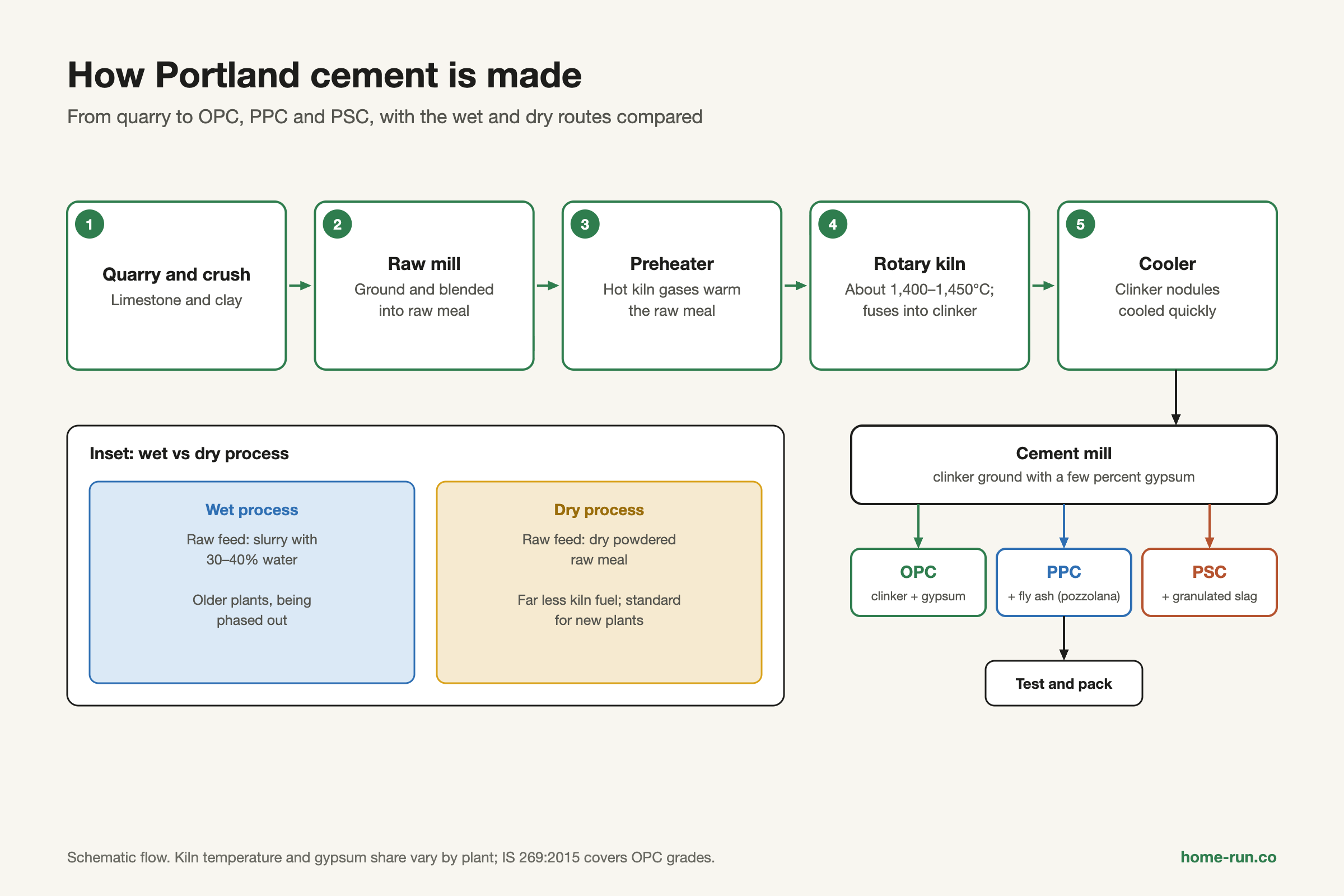
The wet and dry processes differ in how raw material enters the kiln. New plants use the dry process because it burns far less fuel.
Wet process vs dry process
Kiln heat input per ton of cement| Point | Wet process | Dry process |
|---|---|---|
| Raw feed | Slurry with 30–40% water | Dry powdered raw meal |
| Kiln heat (US EPA) | 5.5 MMBtu per ton | 4.1 (long dry) to 3.1 (preheater-precalciner) MMBtu per ton |
| Status today | Older plants, being phased out | Standard for new plants |
What Happens When Cement Meets Water?
Portland cement hardens through hydration, a reaction with water, not by drying. C3S and C2S form calcium silicate hydrate (C-S-H) gel, which glues sand and stone together.
The reaction needs water for weeks, so curing matters. IS 269 sets these milestones for OPC 53:
Mixing
Hydration starts.
Initial set
Place and compact before this.
Final set
600 min maximum. Start curing.
27 MPa
Early strength from C3S.
37 MPa
Keep the work wet.
53 MPa
Full grade strength.
These are lab mortar-cube strengths, not site concrete. PPC and PSC gain strength more slowly.
Buying cement for your build?
OPC, PPC and white cement delivered across Bengaluru.
Which Cement Suits Each Job on an Indian Site?
Portland cement goes into almost every part of an Indian building. The right type depends on the job:
Portland cement uses by job
Follow your engineer's drawings| Job | Usual choice | Why |
|---|---|---|
| Columns, beams, slabs (RCC) | OPC 53 or 43; PPC if designed | Early strength |
| Footings and raft foundations | PPC or PSC | Low heat, resists soil water |
| Brick and block masonry | PPC | Workable, fewer cracks |
| Wall plastering | PPC or OPC 43 | OPC 53 cracks too easily |
| Coastal and sewage structures | PSC or SRC | Resist chlorides and sulphates |
| Tile grout, putty, decorative work | White Portland cement | Clean colour, takes pigment |
Concrete grade comes first, then cement type. See our concrete mix ratio guide for M15 to M25 proportions.
Bengaluru is far from the sea, so most homes need no marine-grade cement. Ask for SRC or PSC only if a soil test shows sulphates or chlorides. PPC with OPC 53 for structural members is a common pairing.
How Much CO2 Does Cement Production Release?
Portland cement production releases about 0.6 tonnes of CO2 per tonne of cement, says the International Energy Agency (IEA). Most comes from limestone giving off CO2 as it turns to lime.
India is the second-largest producer, at about 9% of global output in 2022 (IEA).
Blended cements such as PPC and PSC replace part of the clinker with fly ash or slag, waste from power plants and steel mills. The IEA puts the global clinker-to-cement ratio at 0.71 in 2022 and wants it near 0.65 by 2030.
Is Wet Cement Safe to Handle?
Wet Portland cement is strongly alkaline, at pH 12–13, and can burn skin without pain for hours.
- Cement burns: wet mix trapped in boots or gloves causes deep alkali burns.
- Dermatitis: traces of hexavalent chromium can trigger allergic skin rashes.
- Eye damage: splashes and dust can injure eyes.
- Dust: dry powder irritates the nose, throat and lungs.
Wear alkali-resistant gloves, goggles, long sleeves and boots. If wet cement touches skin, rinse with running water for 20 minutes.
How Do You Choose and Check Cement on Delivery?
Choose Portland cement by job, exposure and the engineer's specification, then check every bag.
Use the type and grade on the structural drawings. If none is given, PPC suits most masonry, plaster and foundations, and OPC 53 suits columns and slabs that need early strength.
Before you accept a delivery, check:
- The ISI mark and the IS code printed on the bag match what you ordered.
- The week and year of manufacture; use the oldest bags first.
- Bags are sealed, dry and close to 50 kg.
- The cement feels smooth and has no hard lumps.