On this page
- What Is a Plumbing Vent Pipe and Why Does It Matter?
- How Does a Plumbing Vent Pipe Work?
- What Are the Types of Vents in Plumbing?
- What Size and Height Should a Vent Pipe Be?
- What Are the Signs of a Blocked Vent Pipe?
- How Do You Fix a Clogged Vent Pipe?
- How Do You Maintain Plumbing Vents in Indian Homes?
- When Should You Call a Plumber for Vent Diagnosis?
- A plumbing vent pipe balances air pressure in drains so water seals in traps are not sucked out or pushed out.
- Without venting, you get gurgling, slow drains and sewer smell inside the house.
- Indian code asks for a main vent of at least 50 mm, taken 1,500 mm above the roof, with a cowl on top.
- Vents in Indian homes are usually Type A uPVC SWR pipe to IS 13592, or cast iron in older buildings.
- Check the vent top before every monsoon for leaves, nests and a missing cowl.
A plumbing vent pipe is a pipe that lets fresh air into the drainage system and carries sewer gases out above the roof. It keeps air pressure in the drains balanced, so water flows away freely and the water seals in your traps stay in place.
This explainer covers venting only. For the full water supply and drainage picture, start with our guide to what plumbing is and how a home system works.
What Is a Plumbing Vent Pipe and Why Does It Matter?
A plumbing vent pipe is the air pipe of the drain-waste-vent (DWV) system. Drain pipes carry water and waste down; the vent pipe lets air move in and out so that flow stays smooth.
Venting protects:
- Trap seals: the water held in a P-trap or floor trap blocks sewer gas. Venting stops that water from being siphoned away.
- Drain speed: air behind the water lets basins and showers empty without glugging.
- Indoor air: sewer gases such as hydrogen sulphide leave above the roof.
The National Building Code of India 2016 (NBC), Part 9 Plumbing Services, asks every drainage system to keep "an adequate circulation of air in all pipes" so that traps are neither siphoned nor forced.
A vent stack is a separate pipe that only carries air. A stack vent is the top of a soil stack, above the highest fixture, carried on to the roof.
How Does a Plumbing Vent Pipe Work?
A plumbing vent pipe works by letting air enter the drain behind falling water and letting air escape ahead of it. That keeps pressure in the pipes close to outdoor air pressure.
A toilet flush sends a slug of water down the stack that acts like a piston:
- Below the water, air is squeezed and bubbles back through the nearest trap.
- Behind the water, suction pulls water out of basin and floor traps.
- With a vent, roof air fills the gap and trap seals stay put.
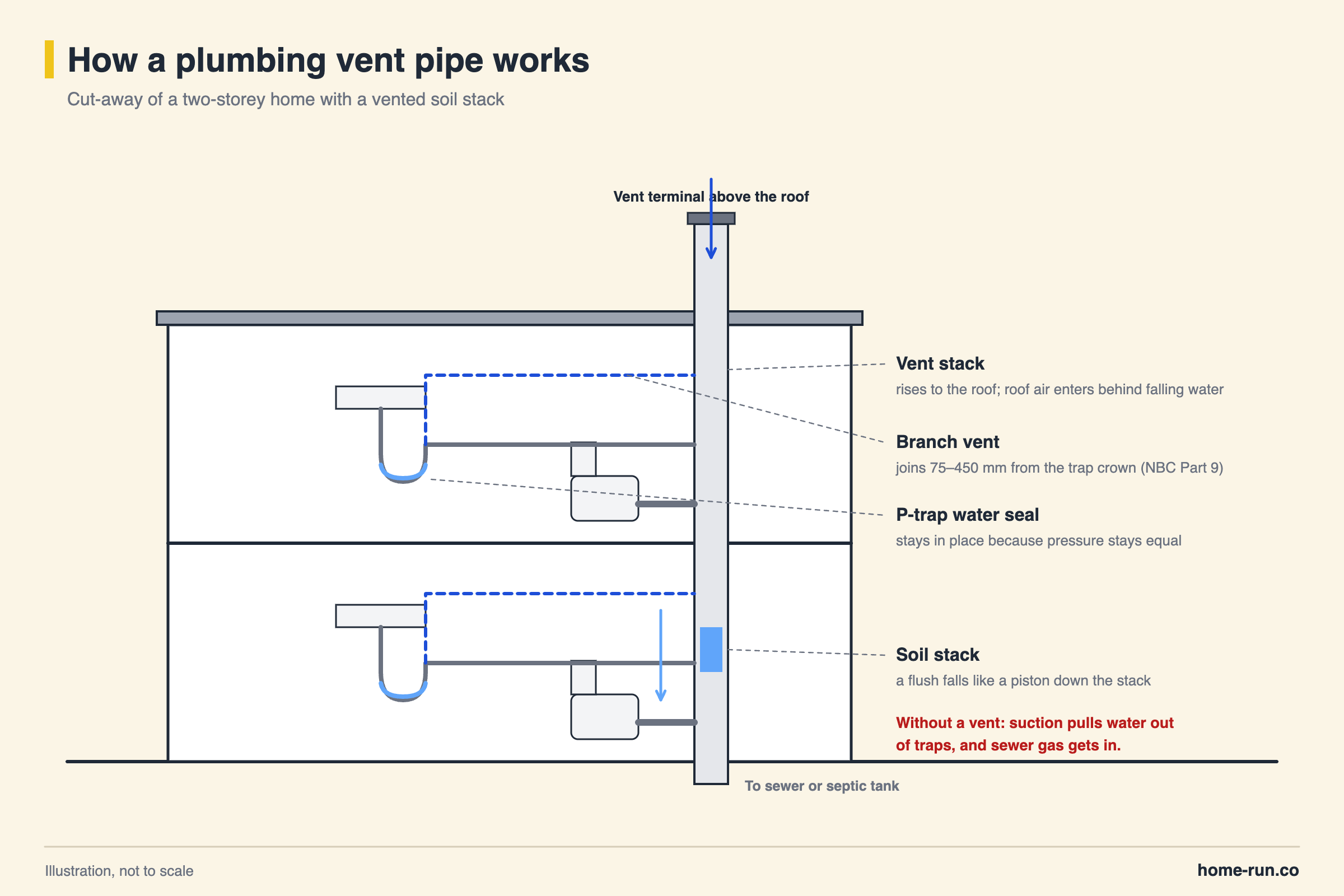
The key parts are the P-trap (a U-bend holding a water seal under each fixture), the branch vent near each trap, and the vent stack to the roof. NBC Part 9 joins a branch vent 75–450 mm from the crown of the trap.
In most homes, the plumbing vent pipe location is the terrace directly above the bathrooms. In apartments, it rises in the service shaft beside the toilets.
What Are the Types of Vents in Plumbing?
The main types of vents in plumbing are the stack vent, the vent stack, individual and branch vents, wet vents and air admittance valves. Indian codes describe them through the pipe system they belong to.
Common plumbing vent types
Terms as used in NBC 2016 Part 9 and Indian practice| Vent type | What it does | Where you find it |
|---|---|---|
| Stack vent Most homes | Soil or waste stack carried up past the top fixture to open air | Single stack systems in low-rise homes |
| Vent stack | Separate air-only pipe running beside the soil stack | One-pipe and two-pipe systems, apartments |
| Individual or branch vent (anti-siphonage pipe) | Small pipe from near a trap to the vent stack | Fully ventilated systems, long branch runs |
| Wet vent | Pipe that carries waste from one fixture and air for another | Compact bathroom groups |
| Air admittance valve (AAV) Check code | One-way valve that lets air in but not gas out | Island sinks, branches far from the stack |
An air admittance valve only lets air in. It cannot let sewer gas out, so a building still needs at least one open vent to the roof. Indian makers sell AAVs in 32–110 mm sizes to EN 12380, the European standard for these valves.
Vent pipe material in new Indian homes is usually uPVC SWR (soil, waste and rainwater) pipe made to IS 13592. Makers sell Type A for vents and rainwater and the thicker Type B for soil and waste. See our plumbing materials list for pipes and fittings by job.
What Size and Height Should a Vent Pipe Be?
In India, the main vent pipe must be at least 50 mm in diameter and rise at least 1,500 mm above a flat roof or eaves. These rules come from IS 5329:1983, the Bureau of Indian Standards (BIS) code for sanitary pipe work above ground, carried into NBC 2016 Part 9.
Plumbing vent pipe size chart (Indian code)
IS 5329 / NBC Part 9 minimums| Pipe | Minimum diameter | Rule |
|---|---|---|
| Main ventilating pipe | 50 mm | Never smaller, whatever the load |
| Building drain vent | 75 mm | Vents the main drain to the sewer or septic tank |
| Branch vent on a soil pipe | 32 mm | Serves WC branches |
| Branch vent on a waste pipe | 25 mm | At least 2/3 of the waste branch diameter |
| Stack vent or vent stack | 32 mm | At least half the drain served; sized by fixture units and length |
| Single stack vent | Same as stack | 100 mm stack for up to 5 floors |
The vent top must be at least 1,500 mm above the eaves or flat roof, or above the top of any window within 3 m horizontally, whichever is higher. It needs a cowl, and should clear a taller building next door where possible.
The Uniform Illustrated Plumbing Code India (UIPC-I), taught by the Indian Plumbing Association, asks for 2,100 mm above a terrace people use. For a terrace garden or sit-out, that is the safer figure.
Many sites quote the US International Plumbing Code (IPC), such as a 1¼ in (32 mm) minimum vent. Use the Indian code for design and approvals in India.
What Are the Signs of a Blocked Vent Pipe?
The clearest sign of a blocked plumbing vent pipe is gurgling from drains that are not in use, together with slow drainage and a sewer smell indoors.
- Gurgling or bubbling: a basin or floor trap glugs when a toilet is flushed elsewhere.
- Sewer smell: traps lose water, so gas comes up through floor drains and basins.
- Slow drains everywhere: several fixtures drain slowly at once, not just one.
- Water in the vent pipe: points to a sagging run or a choke below.
- Damp patch around the vent: a leak at the roof collar where the pipe passes through the slab or sheet.
Common causes in Indian homes are leaves, bird and wasp nests, a missing cowl, and vents cut short during terrace work.
If only one fixture drains slowly, the clog is usually in its trap or branch. If several fixtures gurgle and drain slowly together, suspect the vent or the main stack.
How Do You Fix a Clogged Vent Pipe?
You fix a clogged plumbing vent pipe from the top: remove the cowl, flush the pipe with water and, if needed, break the clog with a drain auger (plumber's snake).
- Confirm it is the vent. Run the quick check above. Clear any single slow trap first.
- Get safe roof access. Avoid sloping sheet roofs and unguarded edges.
- Remove the cowl or wire dome. Pull out leaves, nests and debris by hand, with gloves.
- Flush with a hose. Run water down the vent. If it backs up, the clog is still there.
- Use a drain auger. Feed a hand auger down and turn it to break the clog, then flush again.
- Refit the cowl and test. Flush the top-floor WC and listen for gurgling in basins and floor traps.
Do not cap a vent to stop smells or mosquitoes, and do not pour acid or caustic cleaners into it. A capped vent siphons traps. Use a cowl or wire dome instead.
How Do You Maintain Plumbing Vents in Indian Homes?
You maintain plumbing vents by inspecting the vent tops twice a year, before and after the monsoon, and by keeping every trap filled with water.
- Check that every vent has a cowl or wire dome, and that it is not clogged with leaves.
- Remove bird and wasp nests in the dry months, before the rains.
- Look for cracked, brittle or faded uPVC on open terraces, and replace damaged lengths.
- Check clamps and the roof collar; reseal the collar if you see damp marks below.
- Pour a mug of water into floor traps in rooms you rarely use, so the seal does not dry out.
For bathroom layouts, trap types and pipe routing, see our bathroom plumbing guide. Homes on a septic tank also need the tank's own vent pipe; our septic tank design guide covers it.
When Should You Call a Plumber for Vent Diagnosis?
Call a plumber when gurgling or sewer smell persists after you clear the vent top, or when the vent runs inside a wall, a duct or a shared apartment stack.
DIY check
Easy accessPoints
- Vent top on a flat, guarded terrace
- Blockage visible from the top
- Clears with water or a hand auger
- Single-family home, short stack
Professional plumber
Persistent problemsPoints
- Smell or gurgling returns within days
- Vent hidden in walls or a service duct
- Vent missing, cut short or rerouted
- Shared stack in an apartment building
A plumber can smoke-test the system for leaks and check vent sizes against the code. In apartments, report stack problems to the association, since one blocked stack affects every flat on it.
Fixing or adding a vent?
SWR pipes, fittings and plumbing supplies delivered across Bengaluru.