On this page
- What Are Laterite Bricks?
- How Is Laterite Cut and Made Into Blocks?
- What Are the Types of Laterite Bricks?
- What Sizes Do Laterite Blocks Come In?
- What Are the Advantages of Laterite?
- What Are the Limitations of Laterite Bricks?
- Where Is Laterite Used in Building?
- How Does Laterite Compare With Red Bricks?
- How Much Does a Laterite Block Cost?
- Are Laterite Bricks Eco-Friendly?
- Laterite bricks are cut stone blocks or cement-stabilised blocks made from iron-rich laterite.
- Natural blocks are cut soft and harden as they dry in air; they are not kiln-fired.
- Natural blocks are weak: one Kerala study measured about 2.5 N/mm², so they suit low-rise homes.
- Laterite is porous, so exposed walls need a breathable sealer or plaster and good roof overhangs.
- Most stone comes from coastal Karnataka and northern Kerala; Bengaluru buyers pay extra freight.
Laterite bricks are building blocks cut from laterite, a reddish rock rich in iron and aluminium oxides, or pressed from laterite soil with cement. They are a traditional walling material in coastal Karnataka, Kerala, Goa and the Konkan.
This page covers laterite only. For fired bricks, see our guides to clay bricks and red brick characteristics.
What Are Laterite Bricks?
A laterite brick is a masonry unit made from laterite, a soil and rock layer formed when heavy tropical rain leaches minerals out and leaves iron and aluminium behind. The iron gives the blocks their red-brown colour.
Francis Buchanan-Hamilton described laterite in 1807 on India's Malabar coast. He named it from the Latin later, meaning brick, because locals cut it straight from the ground into building blocks.
Today Madhya Pradesh holds about 56% of India's laterite resources, says the Indian Bureau of Mines.
How Is Laterite Cut and Made Into Blocks?
Natural laterite bricks are cut, not moulded or fired. Laterite is soft when quarried and hardens on exposure to air, according to the Indian Bureau of Mines.
- Clear the topsoil to reach the firm laterite bed.
- Cut the blocks to size in the pit with saw machines or chisels.
- Dress the faces so blocks sit level.
- Season in air so the blocks dry and harden.
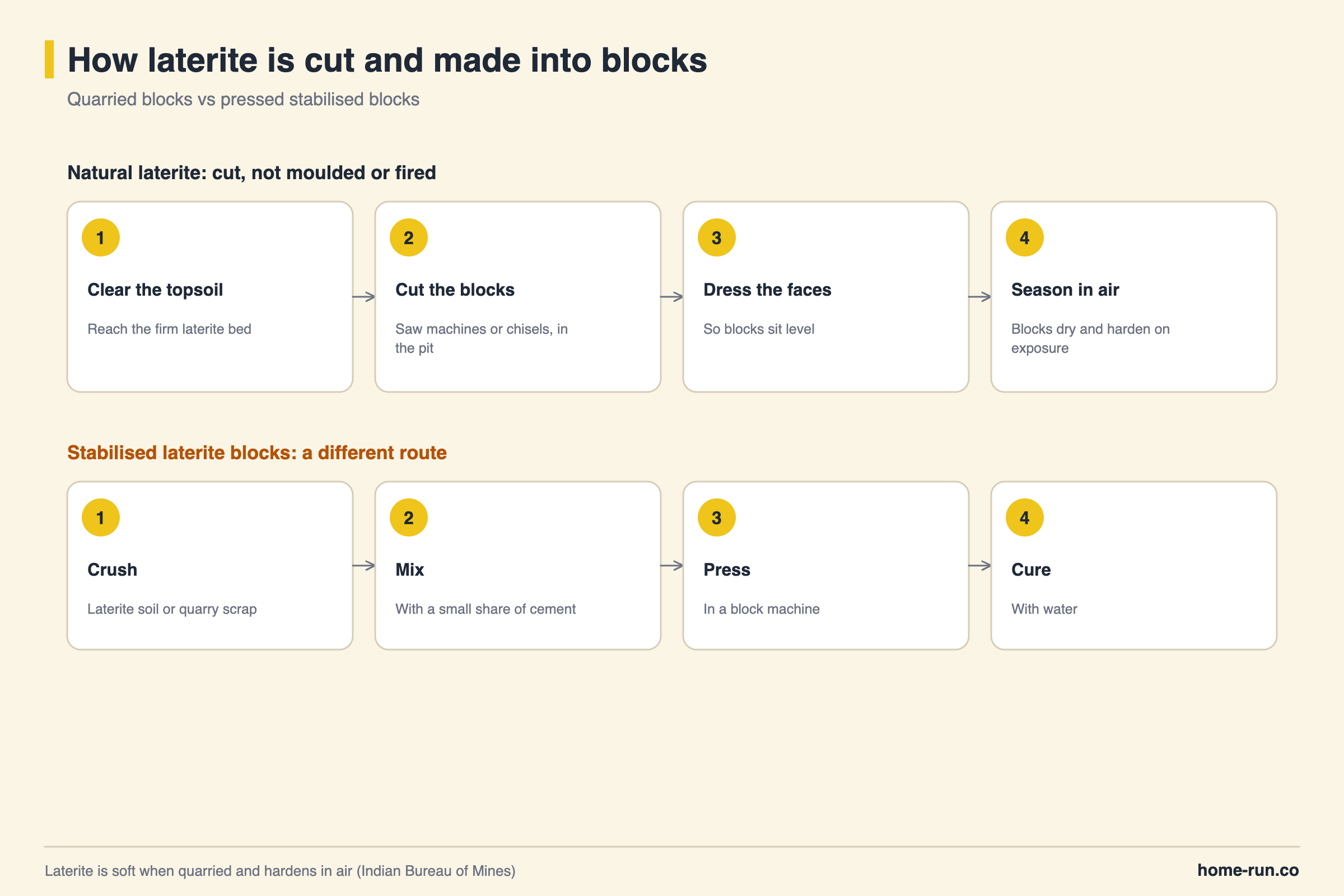
Stabilised laterite blocks follow a different route. Crushed laterite soil or quarry scrap is mixed with a small share of cement, pressed in a block machine and cured with water.
What Are the Types of Laterite Bricks?
Laterite bricks come in five common forms: natural cut blocks, small laterite bricks, stabilised blocks, interlocking blocks and cladding tiles.
Types of laterite bricks
Sizes from IS 3620 and Indian listings, Nov 2026| Type | How it is made | Typical size | Best for |
|---|---|---|---|
| Natural cut block Most common | Sawn from the quarry bed, air-hardened | 12 × 6 × 6 in to 15 × 9 × 7 in | Walls of 1–2 storey homes |
| Small laterite brick | Cut to brick size | 8 × 4 × 4 in | Arches, details, exposed feature walls |
| Cement-stabilised block | Laterite soil or scrap pressed with cement | Set by the machine mould | More even strength and size |
| Interlocking block | Stabilised mix pressed with keyed faces | Set by the maker | Fast, low-mortar walls |
| Cladding tile Finish only | Thin slices of laterite stone | About 20 mm thick | Exposed-stone finish |
Interlocking blocks work like other interlocking bricks.
What Sizes Do Laterite Blocks Come In?
Laterite bricks have no single size. IS 3620:1979, the Bureau of Indian Standards code for laterite stone block for masonry, lists a range of block sizes with a tolerance of ±5 mm.
Laterite block sizes
IS 3620 ranges and market listings| Source | Length | Width | Height |
|---|---|---|---|
| IS 3620:1979 block sizes | 300–600 mm | 150–250 mm | 150–300 mm |
| Common market block | 12 in (305 mm) | 6–8 in (152–203 mm) | 6–8 in (152–203 mm) |
| Small laterite brick | 8 in (203 mm) | 4 in (102 mm) | 4 in (102 mm) |
What Are the Advantages of Laterite?
The main advantages of laterite bricks are local supply on the coast, no kiln firing, a natural finish and fast wall building with large blocks.
- No firing: natural blocks harden in air, unlike kiln-fired clay bricks.
- Fewer units: one large block replaces several bricks, so walls rise faster.
- Natural look: the red, pitted face can stay exposed with a clear sealer.
- Local supply: near quarries in Udupi, Dakshina Kannada, Kannur and Kasaragod, freight is short.
A natural block varies with the quarry. A stabilised block adds cement and a press, so it is more even. A Ratnagiri, Maharashtra study reached 10–13.6 N/mm² with cement-stabilised laterite scrap blocks.
What Are the Limitations of Laterite Bricks?
The main limitations of laterite bricks are low and variable strength, high water absorption and surface weathering in the monsoon.
- Low strength: natural blocks from Kozhikode, Kerala tested at about 2.5 N/mm² when saturated. IS 1725, the code for stabilised soil blocks, sets a 3.5 N/mm² minimum for comparison.
- Variable quality: hardness differs between blocks, so skilled masons sort them.
- High water absorption: the stone is porous; IS 3620 caps absorption at 20% by mass.
- Weathering: shaded, wet faces grow moss and the surface can erode without protection.
- Supply swings: quarry curbs and labour shortages caused laterite shortages in Udupi in 2025 and in Kannur in 2026.
The Indian Bureau of Mines says laterite is weak under heavy loads. Ask for a strength test of your batch, and let a structural engineer set wall thickness and storeys.
Where Is Laterite Used in Building?
Laterite bricks are used mainly for walls of one- and two-storey homes, infill walls in RCC (reinforced cement concrete) frames, compound walls and cladding in coastal Karnataka, northern Kerala and Goa.
Bengaluru has no major laterite quarries, so blocks travel from the coast. With long freight, laterite often makes more sense as cladding or a feature wall than as the full structure. Sellers in Bengaluru list Kerala laterite blocks at about ₹110 per piece.
How Does Laterite Compare With Red Bricks?
Laterite bricks are larger, unfired and cheaper near the coast, while red clay bricks are fired, more uniform and easier to buy across India.
Laterite bricks
Coastal homesPoints
- Cut stone, air-hardened
- Large blocks, fewer joints
- Strength varies by quarry
- Cheapest near the quarries
Red clay bricks
Most citiesPoints
- Moulded clay, kiln-fired
- Small units, more joints
- Graded by IS 1077 class
- Sold almost everywhere
In Bengaluru, fly ash bricks and AAC (autoclaved aerated concrete) blocks are easier to source and more uniform.
Choose laterite when a quarry is close, the building is one or two storeys and the walls are protected from rain. Otherwise, fired or concrete units are simpler.
How Much Does a Laterite Block Cost?
Laterite bricks cost about ₹30–55 per block at coastal quarries, based on news reports from November 2025 to April 2026. Prices rise with distance.
- Dakshina Kannada: ₹50–55 per block at quarry units (November 2025).
- Kannur, Kerala: about ₹34.50 per stone within 7 km of quarries (April 2026).
- Kasaragod, Kerala: about ₹30 for first-quality stones (April 2026).
Are Laterite Bricks Eco-Friendly?
Laterite bricks have low processing energy because natural blocks are cut and air-dried instead of fired. Quarrying is the main environmental cost.
Open pits strip topsoil. In Dakshina Kannada, Karnataka's Upa Lokayukta has sought a report on illegal laterite quarrying, and police have seized machines at illegal sites. Buy from licensed quarries and ask for a royalty or transit pass.
Building with laterite or bricks?
Cement, sand, bricks and waterproofing delivered across Bengaluru.