On this page
- What Is a Header Bond in Brick Masonry?
- Why Do Masons Choose Headers for Curved Walls?
- How Do You Build a One-Brick Wall in Headers?
- Where Is This Bond Used in India?
- What Are Its Limitations?
- How Is Header Bond Different From Stretcher Bond?
- How Many Bricks Per m² Does It Need?
- Header bond lays only headers, so the wall is always one brick (230 mm) thick.
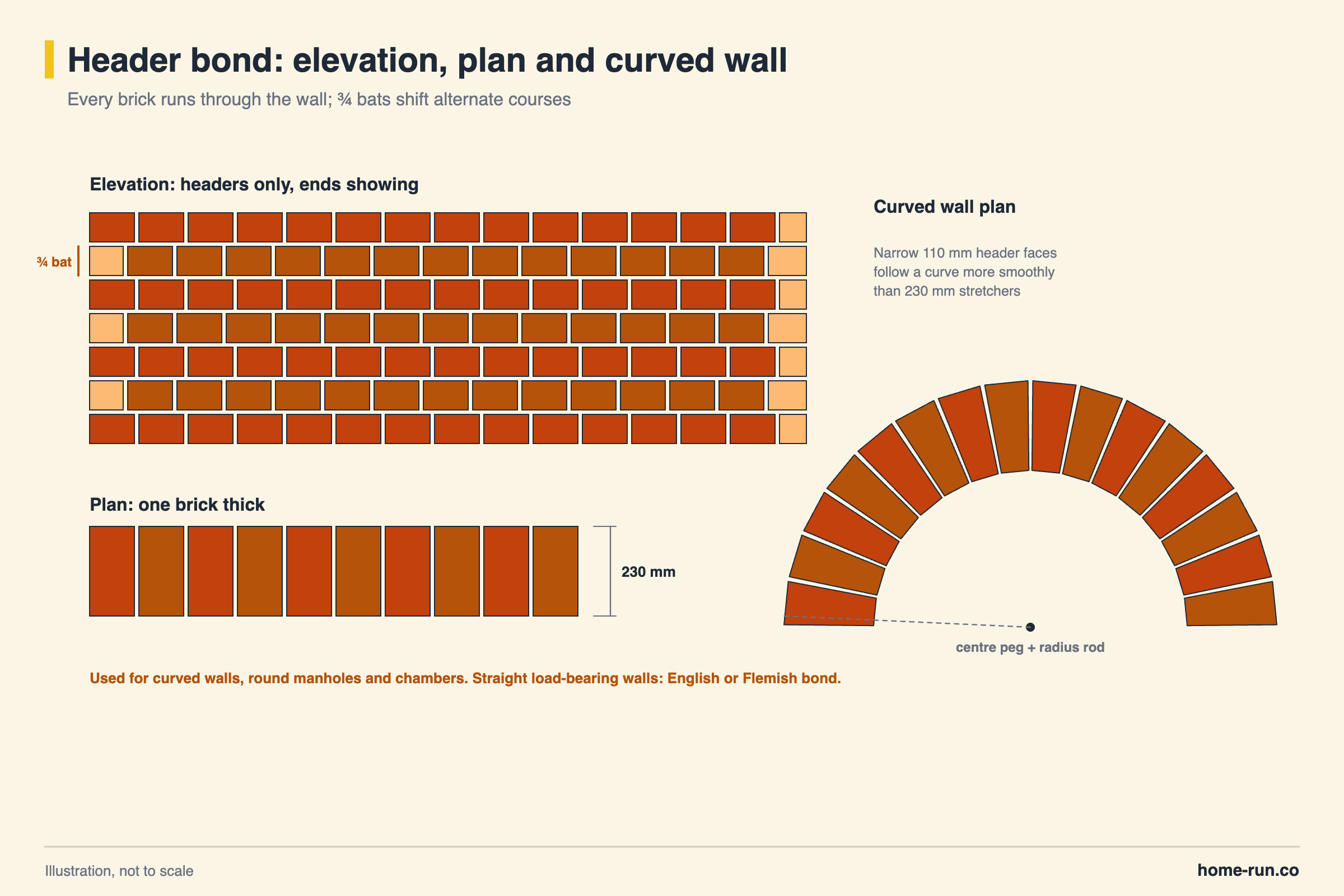
- Courses lap by half a brick's width, set with three-quarter bats at the ends of alternate courses.
- Short faces follow a curve closely, which is why it is the bond for curved walls and round manholes.
- Its lap along the wall is small, so it is weak for long straight walls.
Header bond is a brick masonry pattern in which every brick is laid across the wall, so only its short end, the header, shows on the face. Each course is shifted by half a brick's width from the one below.
This page covers header bond in depth. For half-brick walls, see stretcher bond. For every pattern side by side, see types of brick bonds.
What Is a Header Bond in Brick Masonry?
A header bond, also called heading bond, is a bond made only of headers. A header is a brick laid with its length across the wall; a stretcher lies along it.
Every brick runs through the wall, so the wall is one brick thick. The face shows twice as many vertical joints as stretcher bond.
English bond alternates header and stretcher courses. Flemish bond mixes both in each course. Header bond has no stretchers at all.
Why Do Masons Choose Headers for Curved Walls?
The main advantage of header bond is that it follows a curve neatly. A 110 mm header face makes a smoother arc than a 230 mm stretcher.
- Tied across: every brick links the front and back faces.
- Ordered look: an even face for exposed brickwork.
Tight curve, one brick thick: header bond. Straight one-brick wall that carries load: English or Flemish bond.
How Do You Build a One-Brick Wall in Headers?
You construct a header bond wall by laying a level course of headers, then starting every second course with a three-quarter bat to shift the joints. Check these before you start:
- Base level, cured and marked with the wall line
- Bricks of one size, such as burnt clay red bricks to IS 1077
- Three-quarter bats cut in advance
- Cement and sand mortar; CBRI suggests 1:6 for 230 mm walls
- Trowel, spirit level, plumb bob, line and a radius rod for curves
- Soak the bricks. CBRI advises watering clay bricks for about 4 hours.
- Set out the line. For a curve, fix a centre peg and swing a rod of the wall radius to mark the arc.
- Lay the first course. Place headers on a 10 mm mortar bed, frogs up, joints filled.
- Start the second course with ¾ bats. At a stopped end, a three-quarter bat shifts the course by half a header width.
- Raise the ends first, stepping them back, then fill the middle to the line.
- Check every course for level, plumb and radius.
- Keep within daily limits. CBRI suggests no more than 1.2 m of height a day, then cure for 7 days.
Header bond cannot turn a square corner on its own. Build quoins and jambs in English bond or with closers, then return to headers.
Where Is This Bond Used in India?
In India, header bond is used mainly where a brick wall has to follow a curve:
- Circular brick manholes and chambers on sewer and storm-water lines. India's Directorate General of Training course material lists circular walls and manholes as its uses.
- Curved compound walls, planters and steps.
- Footing courses under walls, a use some Indian builders also cite to spread load.
Bengaluru homes mostly have RCC frames with straight infill walls, so header bond appears mainly in chambers and curved garden work.
What Are Its Limitations?
Header bond's main limitation is its small lap along the wall. Watch for these red flags:
- Long straight walls: the small lap makes the wall weak along its length.
- Load-bearing walls: use English or Flemish bond, designed to IS 1905, the code for structural masonry.
- Missing ¾ bats: joints line up into a crack path.
- Thick outer joints on curves: a sign the radius is too tight for whole bricks.
How Is Header Bond Different From Stretcher Bond?
Header bond lays bricks across the wall (230 mm); stretcher bond lays them along it (115 mm).
Header bond
Curves- One brick, 230 mm thick
- Lap of half a header width, using ¾ bats
- About 104 bricks per m²
- Curved walls, manholes, footings
Stretcher bond
Partitions- Half brick, 115 mm thick
- Lap of half a brick length, using half bats
- About 52 bricks per m²
- Partitions, infill, cavity leaves
How Many Bricks Per m² Does It Need?
A header bond wall needs about 104 bricks per m² with 230 × 110 × 70 mm bricks and 10 mm joints.
Header bond uses as many bricks as any solid one-brick wall, twice a half-brick wall. To cut bricks in a one-brick wall, read about rat trap bond.
Planning a curved wall or chamber?
Get your engineer to confirm the bond, then order bricks, cement and sand delivered across Bengaluru.