On this page
- What Is the Difference Between Floor and Wall Tiles?
- Which Material Categories Do Floor and Wall Tiles Come In?
- Which Ratings Decide Whether a Tile Can Go on a Floor?
- How Slip-Resistant Should Floor and Wall Tiles Be?
- Which Floor and Wall Tiles Suit Each Room?
- How Do Bathroom Floor and Wall Tiles Differ?
- How Are Floor and Wall Tiles Installed Differently?
- How Do You Care for Tiles in Bengaluru's Climate?
- What Should You Check Before Buying Floor and Wall Tiles?
- Floor and wall tiles differ by rating, not by name: check wear class, absorption group, slip rating and strength.
- Use PEI 3 or higher on home floors. A PEI 0 tile belongs on walls only.
- Wet floors and outdoor areas need group BIa (0.5% or less) vitrified or porcelain tile.
- Bathroom floors need R10 at least; walls need no slip rating at all.
- Most floor tiles can go on walls with the right adhesive. Most wall tiles cannot go on floors.
Floor and wall tiles are tiles graded for where they go: floor tiles are made to resist wear, load and slipping, while wall tiles only need to look good and stay put. The material can be the same; the ratings on the box decide the use.
This page covers that floor-versus-wall decision. For each tile material in detail, see our guide to types of tiles.
What Is the Difference Between Floor and Wall Tiles?
The difference between floor and wall tiles is performance. A floor tile carries foot traffic, furniture and grit. A wall tile carries only its own weight.
- Strength: floor tiles have a denser body and higher breaking strength.
- Wear: floor tiles carry a PEI wear class of 3 or more for homes.
- Grip: floor tiles for wet rooms carry an R slip rating.
- Weight: wall tiles are lighter and more porous, so they bond easily on vertical plaster.
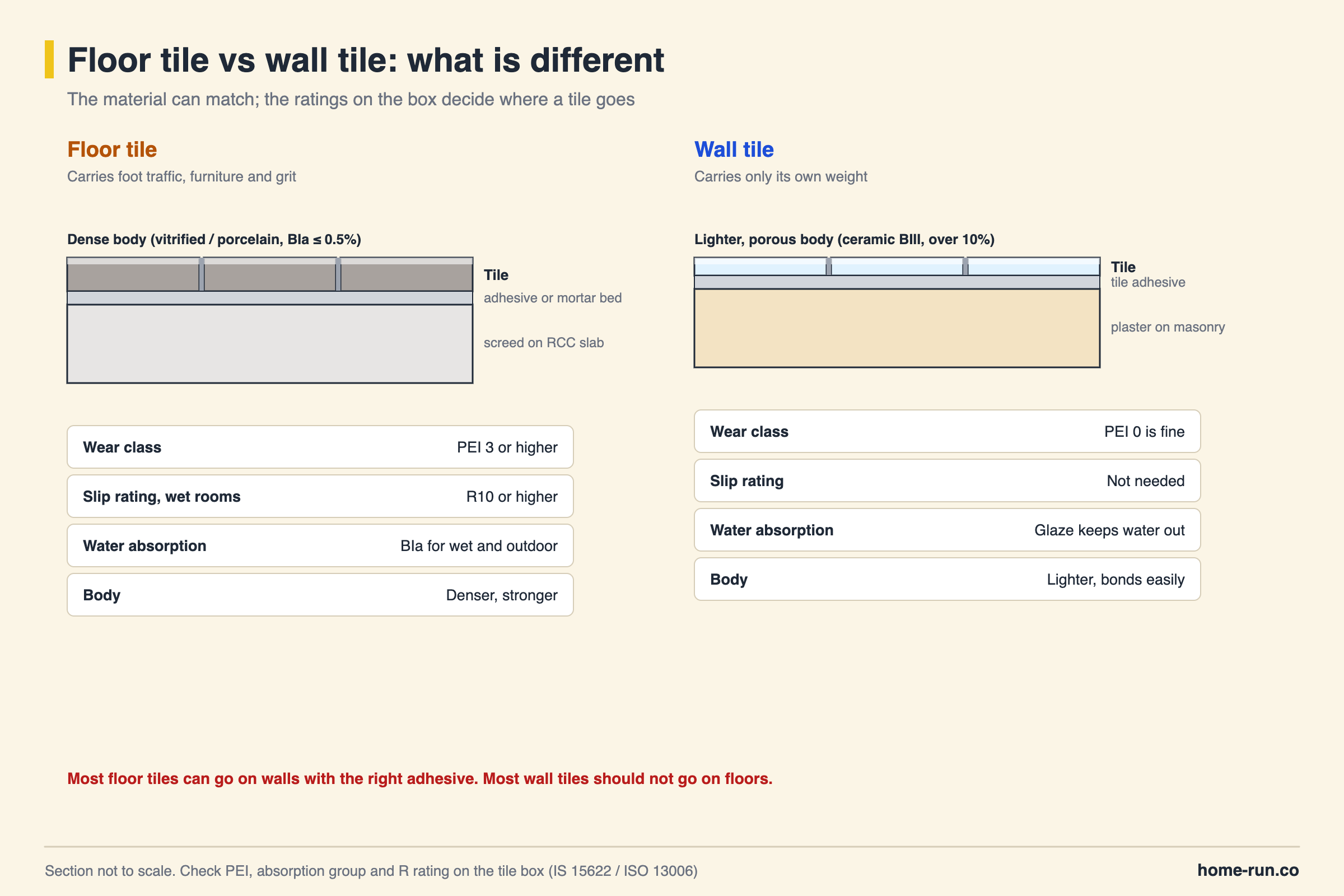
A floor tile can usually go on a wall. A wall tile should not go on a floor, because nothing on its box promises it will survive foot traffic.
Which Material Categories Do Floor and Wall Tiles Come In?
Floor and wall tiles fall into four practical categories in Indian shops. The table shows where each one suits.
| Category | Absorption group | Floors | Walls |
|---|---|---|---|
| Ceramic wall tile | BIII (over 10%) | No | Bathrooms, kitchens Default |
| Ceramic floor tile | BIIa or BIIb (3–10%) | Light-traffic dry rooms | Yes |
| Vitrified or porcelain (GVT, PGVT, double charge, full body) | BIa (0.5% or less) | All rooms, wet areas Default | Yes, with adhesive |
| Natural stone (granite, marble, Kota) | Varies by stone | Yes, sealed | Cladding with mechanical fixing |
Mosaic is a format of small tiles, not a material. Read more on ceramic tiles and porcelain tiles.
Which Ratings Decide Whether a Tile Can Go on a Floor?
Four ratings decide floor use: water absorption, wear class, breaking strength and slip resistance. IS 15622:2017, the Indian standard for pressed ceramic tiles, uses the same groups as ISO 13006.
- Water absorption: BIa 0.5% or less, BIb 0.5–3%, BIIa 3–6%, BIIb 6–10%, BIII over 10%. Lower means denser and stronger.
- PEI wear class: 0 for walls only, 1–2 for light home use, 3 for all home floors, 4–5 for busy commercial floors.
- Breaking strength: Kajaria's BIa spec sheet cites a 1,300 N standard minimum; its ceramic wall tiles quote a modulus of rupture of 12–15 N/mm² against over 35 N/mm² for BIa.
- Thickness: Kajaria lists 7.6 mm for 250×375 mm wall tiles and 12 mm for outdoor vitrified tiles. Thickness alone does not prove strength.
How Slip-Resistant Should Floor and Wall Tiles Be?
Wall tiles need no slip rating. Floor tiles in wet rooms need R10 or higher under DIN 51130, the German ramp test most tile boxes quote.
| Rating | Ramp angle | Use in a home |
|---|---|---|
| R9 | 6–10° | Dry living rooms and bedrooms |
| R10 | 10–19° | Bathroom and kitchen floors Minimum |
| R11 | 19–27° | Shower areas, balconies, sit-outs |
| R12–R13 | 27° and above | Ramps, open steps, pool edges |
For barefoot areas, DIN 51097 adds classes A, B and C. Class B covers showers.
Which Floor and Wall Tiles Suit Each Room?
Pick floor and wall tiles room by room. This table gives a baseline for most Bengaluru homes.
| Room | Floor | Wall |
|---|---|---|
| Living and bedrooms | Vitrified, PEI 3–4, R9 | Paint, or feature tiles |
| Kitchen | Matte vitrified, R10, stain-resistant | Glossy ceramic dado behind the counter |
| Bathroom | Matte BIa, R10–R11 | Ceramic or GVT, up to door height or full height |
| Balcony, sit-out, utility | BIa matte or textured, R11 | Outdoor-rated tiles |
| Staircase and entrance | PEI 4, R10–R11, matching nosing | Skirting only |
Big rooms take big tiles. In a small bathroom, use larger wall tiles for fewer grout lines and smaller floor tiles so the floor can slope to the drain.
For hall floors in depth, see living room floor tiles.
How Do Bathroom Floor and Wall Tiles Differ?
Bathroom floor and wall tiles do different jobs. The floor must grip wet feet; the walls must shed splashes and wipe clean.
Bathroom floor tiles
Grip first- Vitrified or porcelain, group BIa
- Matte, textured or anti-skid finish
- R10 minimum, R11 in the shower
- Laid to fall towards the drain
Bathroom wall tiles
Wipe clean- Glazed ceramic or GVT
- Glossy or satin finish is fine
- No slip rating needed
- Laid after the floor, above a skirting row
The tile is not the waterproofing. A membrane under the tiles stops leaks; the tile and grout only protect it.
How Are Floor and Wall Tiles Installed Differently?
Floor tiles go on a level, cured screed; wall tiles go on plumb, cured plaster. Both last longer on polymer-modified tile adhesive than on a thick cement bed.
- Check the base. Floors must be level or sloped as designed. Walls must be plumb and free of loose plaster.
- Waterproof wet areas first. Take the coating up the walls in bathrooms.
- Dry-lay the floor. Plan cuts to the walls and doorways, not the room centre.
- Lay the floor tiles. Spread adhesive with a notched trowel and back-butter large tiles.
- Start wall tiles one row up. Fix a batten above floor level, tile upwards, then fill the bottom row.
- Leave edge gaps. Keep a movement gap at walls and hide it under skirting.
- Grout after the adhesive sets. Use epoxy grout in showers and kitchens.
A glossy wall tile looks the same as a floor tile in the showroom. On a wet bathroom floor, an unrated glossy tile is a slip hazard.
How Do You Care for Tiles in Bengaluru's Climate?
Tile care in Bengaluru means handling monsoon damp, dust and hard borewell water. Use this checklist:
- Wipe hard-water scale off bathroom walls weekly with a mild descaler, then rinse
- Use a pH-neutral cleaner on matte floor tiles so the texture stays open
- Seal cement grout lines once a year, or switch to epoxy grout
- Keep entrance mats at balcony and main doors to stop grit wearing the glaze
- Check silicone at shower and sink joints before the June monsoon
What Should You Check Before Buying Floor and Wall Tiles?
Check the box, not the showroom label. Look for these before you pay:
- Use marked as floor, wall or both
- PEI class, absorption group and R rating printed
- Same batch and shade code on every box
- Thickness and size tolerance, and rectified edges for thin joints
- 5–10% extra for cuts and breakage
Tiling a floor or wall?
Order tiles, adhesive and grout delivered across Bengaluru.