On this page
- Which Living Room Floor Tiles Suit Most Indian Homes?
- Which Tile Types Work on a Living Room Floor?
- What Tile Size Is Best for a Living Room?
- Matte or Glossy: Which Finish Suits Living Room Floor Tiles?
- How Do You Choose a Living Room Tile Colour?
- Which Tile Looks Suit Which Home Style?
- How Much Do Living Room Floor Tiles Cost in Bengaluru?
- Which Specs Should You Check on the Box?
- How Do You Clean and Maintain Floor Tiles?
- Most Indian living rooms suit a vitrified tile in a matte or satin finish.
- 600x600 mm (2x2 ft) fits small rooms; 800x800 or 600x1200 mm suits larger halls.
- Larger tiles mean fewer grout lines but need a flatter base and skilled fitters.
- Light neutrals make a room look bigger; mid-tone grout hides dirt best.
- Budget about ₹120–220 per sq ft installed for mid-range vitrified in Bengaluru.
The best living room floor tiles for most Indian homes are vitrified tiles in a large format with a matte or satin finish. This explainer covers the four choices that decide the result: tile type, size, finish and colour.
Which Living Room Floor Tiles Suit Most Indian Homes?
A vitrified tile, 600x600 mm or larger, in matte or satin, suits most Indian living rooms. It absorbs little water, resists stains and gives good grip.
Choose differently when:
- Heavy footfall (large families, pets, home offices): double charge or full body vitrified.
- Tight budget: a plain glazed vitrified tile in 600x600 mm.
- Formal, small, well-lit room: a glossy PGVT can work if you accept more upkeep.
Decide the size first, then the finish, then the colour. Size sets the cost of laying, and finish sets daily upkeep.
Which Tile Types Work on a Living Room Floor?
Vitrified and porcelain tiles work best on a living room floor; ceramic tiles are the budget option for light traffic. The main difference is water absorption.
IS 15622, the Bureau of Indian Standards (BIS) specification for pressed ceramic tiles, groups tiles by water absorption, in line with ISO 13006.
Living room floor tile types compared
Water absorption groups per IS 15622| Tile type | Absorption group | Surface | Living room fit |
|---|---|---|---|
| Ceramic Budget | BIIb, 6–10% | Glazed, softer body | Light traffic only |
| GVT / PGVT | BIa or BIb, up to 3% | Printed design under a glaze | Widest design choice |
| Double charge Default pick | BIa or BIb, up to 3% | Thick pressed pattern layer | Busy family rooms |
| Full body / porcelain | BIa, up to 0.5% | Same colour all the way through | Heaviest traffic, hides chips |
GVT (glazed vitrified tile) has a printed glaze that can wear through. PGVT is the polished, high-gloss version. Double charge and full body tiles carry colour deeper, so chips show less. Compare prices only between the same family.
Our guide to types of tiles covers every family in detail. For dense, high-traffic floors, see porcelain tiles.
What Tile Size Is Best for a Living Room?
The best tile size for a living room is 600x600 mm for small rooms and 800x800 mm or 600x1200 mm for larger halls. Bigger tiles mean fewer grout lines and a calmer floor.
Indian shops often quote sizes in feet. 2x2 ft is sold as 600x600 mm and 2x4 ft as 600x1200 mm.
Tile size vs room size
Tiles needed for a 180 sq ft (15 x 12 ft) room, before wastage| Tile size (mm) | Shop name | Tiles needed | Best fit |
|---|---|---|---|
| 600x600 Common | 2x2 ft | 47 | Small to mid rooms, easiest to lay |
| 800x800 | About 2.6x2.6 ft | 27 | Mid to large halls |
| 600x1200 | 2x4 ft | 24 | Large halls, long rooms |
| 800x1600 | About 2.6x5.2 ft | 14 | Open-plan spaces; needs expert fitters |
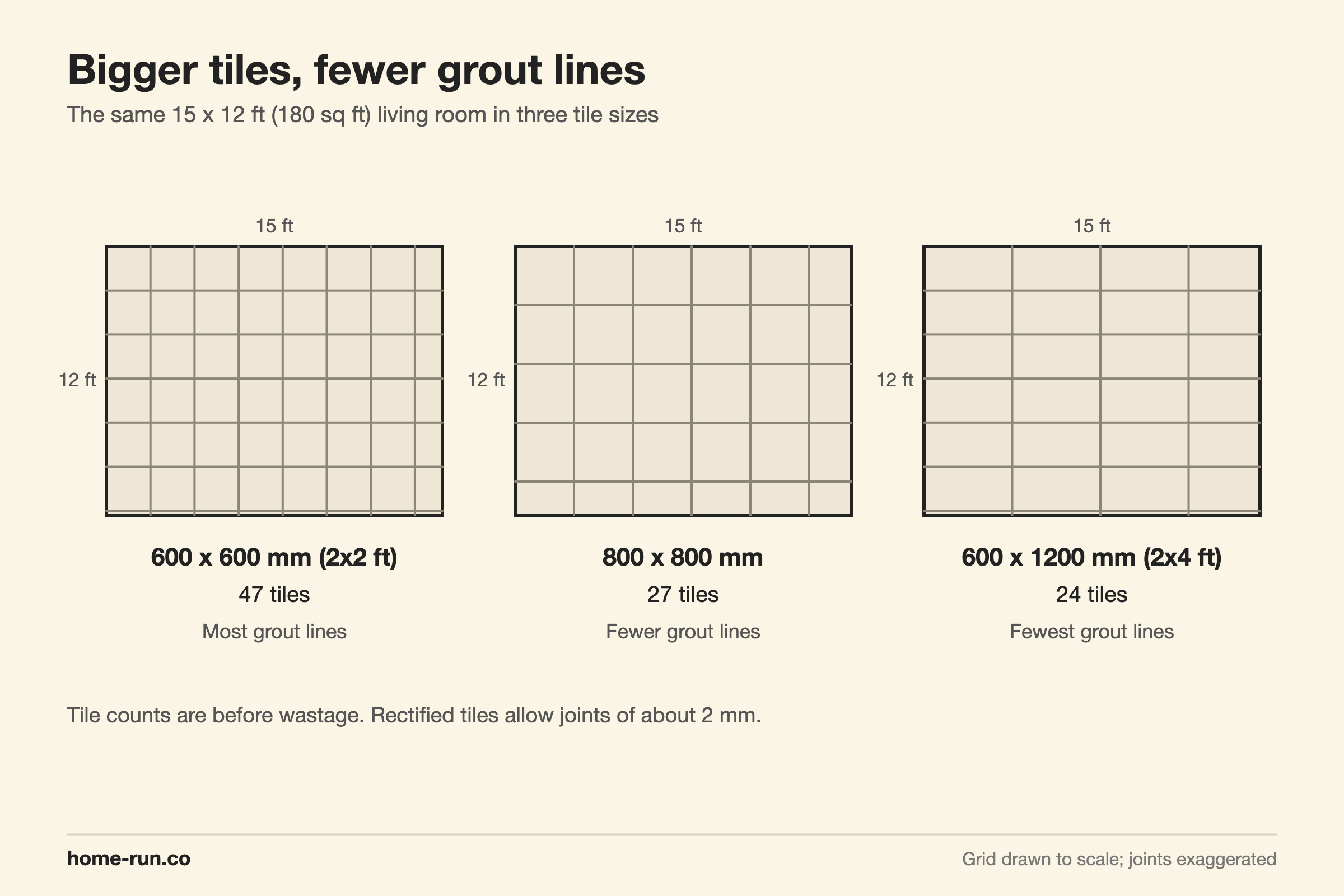
Rectified tiles have edges machine-cut square after firing. They allow joints of about 2 mm; non-rectified tiles need 3 mm or more (Studio Matrx).
A diagonal or staggered lay makes a narrow room look wider but wastes more tiles than a straight lay.
Matte or Glossy: Which Finish Suits Living Room Floor Tiles?
Matte or satin finish suits most living room floor tiles because it grips better, cuts glare and hides dust and footprints. Glossy suits a formal room that gets little wet traffic.
Matte or satin
RecommendedPoint
- Better grip when a drink spills
- Low glare from windows and lights
- Hides dust, scratches and footprints
- Safer for children and elderly members
Glossy or polished
Formal roomsPoint
- Slippery when wet
- Reflects light, so small rooms look brighter
- Shows footprints and fine scratches
- Needs frequent mopping to keep the shine
Anti-skid tiles are not essential in a dry living room. Slip ratings use the R scale from DIN 51130, a German ramp test; R9 covers mainly dry floors.
"Carving", "rustic" and "sugar" finishes add texture and grip.
Do not reuse a glossy living room tile outdoors or in a bathroom. Wet zones need a matte or anti-skid tile rated R10 or higher.
How Do You Choose a Living Room Tile Colour?
Choose a light neutral, such as beige, ivory or light grey, for most living rooms. Light floors bounce daylight and make small rooms feel larger.
Living room tile colours and where they work
Pairs with walls, furniture and light| Colour family | Suits | Watch out |
|---|---|---|
| Beige, cream, ivory Safe pick | Any style, small or dim rooms | Can look flat without texture |
| Grey, taupe | Modern homes, white or pastel walls | Cool greys feel cold in north light |
| White | Minimal rooms with good daylight | Shows hair, dust and grout stains |
| Warm brown, wood tones | Traditional and family homes | Darkens small rooms |
| Black, blue, green Use sparingly | Large, bright rooms; borders and accents | Shows dust and scratches fastest |
Keep the floor a shade darker than the walls in most rooms; it grounds the furniture. Go lighter than the walls only in small or dark rooms.
White floor tiles pair well with warm grey, sage or soft beige walls. Match grout to tile so joints fade, and pick mid-tone grey or beige to hide dirt.
Which Tile Looks Suit Which Home Style?
Marble-look tiles suit premium, formal rooms, and wood-look tiles suit warm family homes. These are printed designs on a vitrified or porcelain body.
- Marble look: a premium feel; glossy versions show footprints.
- Wood look: warmth with no termites or polishing; plank sizes such as 200x1200 mm.
- Stone and concrete look: modern or rustic; usually matte with good grip.
- Patterned and 3D tiles: best as a border or rug-sized panel, not a whole floor.
- A print that repeats every few tiles
- Busy patterns across a whole small room
Finish the edges with matching skirting tiles cut from the same series.
How Much Do Living Room Floor Tiles Cost in Bengaluru?
Living room floor tiles cost about ₹120–220 per sq ft installed in Bengaluru for mid-range vitrified tiles (Studio Matrx, June 2026). That covers tile, adhesive, laying, grout and GST.
Living room tiling cost by item
Indicative, 2026| Item | Rate |
|---|---|
| Tile, catalogue range (Orientbell) | ₹39–356 per sq ft |
| Tile, mid-range vitrified | ₹45–90 per sq ft |
| Laying labour, Bengaluru | ₹35–55 per sq ft |
| Tile adhesive, if quoted separately | ₹15–30 per sq ft |
| Skirting | ₹25–45 per running ft |
| Installed, mid-range GVT/PGVT Typical | ₹120–220 per sq ft |
| Installed, double charge | ₹150–260 per sq ft |
Retiling your living room?
Get tiles, adhesive and grout delivered across Bengaluru with a GST invoice.
Which Specs Should You Check on the Box?
Check five things on every box before the tiles reach your floor:
- ISI mark and IS 15622 on the label
- Water absorption group (BIa or BIb for floors)
- PEI class III or higher for glazed tiles
- The same batch, shade and calibre code on every box
- Rectified or not, and the stated thickness
Keep one spare box from the same batch for future repairs.
How Do You Clean and Maintain Floor Tiles?
Clean floor tiles with a dry sweep daily and a damp mop with a mild, pH-neutral cleaner. Grout needs more care than the tile.
- Sweep or vacuum grit, which scratches glossy glazes.
- Damp-mop with a pH-neutral cleaner; wipe spills at once.
- Avoid acid cleaners near cement grout.
- Seal cement grout after about a week and reseal every 1–2 years.
Epoxy grout resists stains and needs no sealer, which suits spill-prone open-plan rooms.