On this page
- What Are the Main Roff Tile Adhesive Types?
- How Do Roff Adhesive Grades Compare?
- How Do You Choose the Right Roff Tile Adhesive?
- Why Use Tile Adhesive Instead of Cement Mortar?
- Which Roff Tile Adhesive Is Best for Outdoor and Wet Areas?
- How Do You Apply Roff Tile Adhesive?
- How Much Roff Tile Adhesive Does a Bathroom Need?
- Where Can You Buy Roff Tile Adhesive and Get Data Sheets?
- Roff, a Pidilite brand, numbers its tile adhesives by grade: T01 to T26, with grey and white versions of most products.
- T01 is the entry grade for internal floors; T02/T09 handle internal floors, walls and tile-on-tile.
- T03/T04 Vitrofix suit vitrified, glass and engineered stone tiles indoors and on external floors.
- T07 Extrofix and T20 Extrofix Ultra are class C2TES1: deformable, for exteriors, wet areas and large tiles.
- Most grades allow about 120 minutes of pot life and need 24 hours before grouting.
Roff tile adhesive types are cement-based, polymer-modified tile adhesives sold under grade codes such as T01, T02, T03, T07, T09 and T20. Each grade targets a different tile, surface and exposure.
Higher grades meet stricter classes under EN 12004, the European tile adhesive standard, and IS 15477, the Indian Standard for tile adhesives.
What Are the Main Roff Tile Adhesive Types?
The main Roff tile adhesive types are New Construction Adhesive, Non-Skid Adhesive, Vitrofix, Extrofix and Extrofix Ultra. Each product has one grade code per colour.
- T01, New Construction Adhesive (NCA): grey; ceramic and terracotta tiles, internal use.
- T02 and T09, Non-Skid Adhesive (NSA): T02 grey, T09 white; regular-size ceramic, vitrified and stone tiles.
- T03 and T04, Vitrofix: T03 grey, T04 white; adds glass and engineered stone.
- T07 and T08, Extrofix: grey and white; internal and external floors and walls, pools and wet areas.
- T20 and T21, Extrofix Ultra: grey and white; facades, large format and slim tiles.
How Do Roff Adhesive Grades Compare?
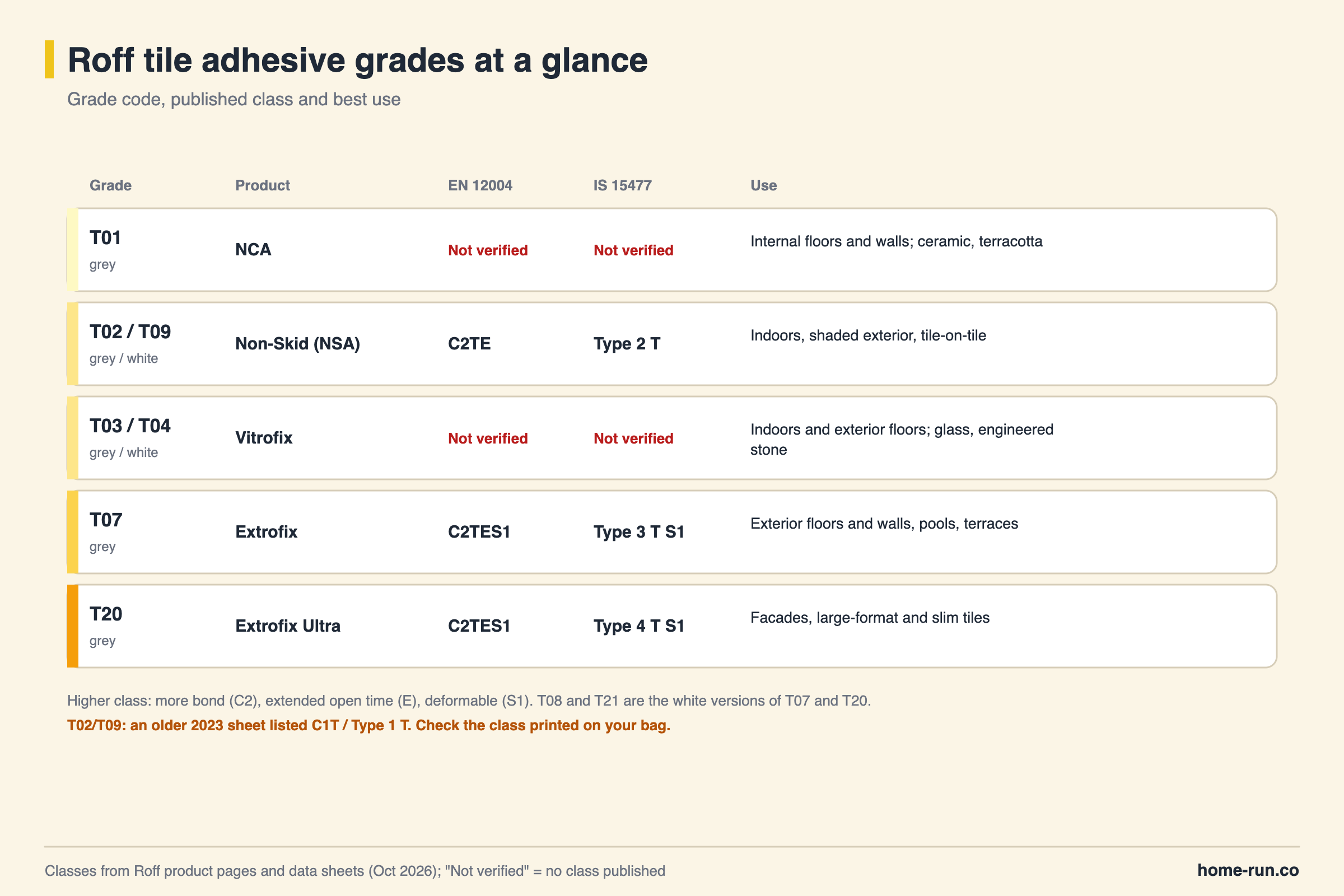
Roff adhesive grades differ mainly in exterior use, tile size and deformability. T07 and T20 carry the highest published classes.
Roff tile adhesive grades compared
From Roff product pages and technical data sheets, Nov 2026| Grade | EN 12004 class | IS 15477:2019 | Open time | Roff's listed use |
|---|---|---|---|---|
| T01 NCA (grey) | Not verified | Not verified | Not stated | Internal floors and walls |
| T02 / T09 NSA Indoor pick | C2TE | Type 2 T | ≥ 30 min | Indoors, external shaded areas, tile-on-tile |
| T03 / T04 Vitrofix | Not verified | Not verified | Not stated | Indoors, external floors only; glass, engineered stone |
| T07 Extrofix Exterior | C2TES1 | Type 3 T S1 | ≥ 30 min | Exterior floors and walls, pools, terraces |
| T20 Extrofix Ultra Facades | C2TES1 | Type 4 T S1 | ≥ 40 min | Facades, large format and slim tiles |
What Do C1, C2, T, E and S1 Mean on a Roff Bag?
The letters on a Roff bag are EN 12004 performance classes:
- C1: cement-based, normal adhesion, tensile strength of at least 0.5 N/mm².
- C2: cement-based, improved adhesion, at least 1.0 N/mm².
- T: wall tiles slip no more than 0.5 mm.
- E: still bonds 30 minutes after spreading.
- S1: deformable, bending 2.5–5 mm before failure, so it absorbs movement.
How Do You Choose the Right Roff Tile Adhesive?
Choose a Roff tile adhesive by matching four things: the substrate, the exposure, the tile material and the tile size.
- Substrate: gypsum, drywall and old wall tiles need T03 or higher.
- Exposure: external walls, terraces and pools need T07 or T20.
- Tile material: for engineered stone, Roff lists T03/T04 or Master Fix, not T01, T02/T09 or T20.
- Tile colour: pick white (T04, T09) for light marble and glass.
- Tile size: large format and heavy stone need the S1 grades.
Roff's Extrofix sheet says external wall tiles larger than 2 ft, or above 10 ft height, need a C2TES1 or Type 4 T S1 adhesive. Above 3 m, consider mechanical fixings too.
For tile basics, see our guide to types of tiles.
Why Use Tile Adhesive Instead of Cement Mortar?
Tile adhesive gives a thinner, more even bed with a tested bond strength, while site-mixed cement mortar varies with every batch.
Roff adhesives are polymer-modified cement. Roff says T01 is self-curing and needs no water curing. Graded products also list measured adhesion, open time and slip, which a site mix cannot show.
Which Roff Tile Adhesive Is Best for Outdoor and Wet Areas?
Roff T07 Extrofix and T20 Extrofix Ultra are the outdoor and wet-area grades. Both are class C2TES1, deformable and slip-resistant.
T07 Extrofix
Exterior floors and wallsPoints
- IS 15477 Type 3 T S1
- Open time of at least 30 minutes
- Tensile adhesion ≥ 1.5 N/mm² at 28 days
- Roff advises its technical team for external walls
T20 Extrofix Ultra
Facades and large tilesPoints
- IS 15477 Type 4 T S1
- Open time of at least 40 minutes
- Tensile adhesion ≥ 1.6 N/mm² at 28 days
- Roff lists it for facades and window frames
How Do You Apply Roff Tile Adhesive?
Apply Roff tile adhesive with a notched trowel on a clean, sound surface, and fix each tile within the open time.
- Prepare: clean off dust and oil, level dips and dampen very dry surfaces.
- Mix: add powder to about 5–6.5 litres of water per 20 kg bag, by grade. Rest 5 minutes.
- Comb: a 6 × 6 mm notch gives a 3 mm bed; 12 × 12 mm gives 6 mm.
- Fix and press: twist each tile into place and check full contact.
- Wait 24 hours, then grout with cement or epoxy grout.
Level uneven floors first; see our guide to screeding.
Never add water to a stiffening mix, and never spread more than you can tile within the open time. Roff says T02/T09 must not fill dips deeper than 15 mm.
How Much Roff Tile Adhesive Does a Bathroom Need?
A bathroom with about 20 m² of floor and wall tiling needs about five 20 kg bags of Roff T02 or T09 at a 3 mm bed.
Tiling a floor or bathroom?
Tile adhesive, grout, tiles and waterproofing delivered across Bengaluru.
Where Can You Buy Roff Tile Adhesive and Get Data Sheets?
Roff tile adhesives are sold through tile and hardware dealers and online building-material stores. Roff publishes each grade's technical data sheet and a coverage calculator on its website. Check the grade code and class on the bag before you buy.