On this page
- Is Painting Floor Tiles a Good Idea?
- Which Floor Tiles Can You Paint?
- What Paint Should You Use on Tile Floors?
- What Tools and Materials Do You Need?
- How Do You Paint Floor Tiles, Step by Step?
- How Long Does the Whole Project Take?
- Should You Paint Floor Tiles Yourself or Hire a Painter?
- How Do You Care for a Painted Tile Floor?
- How Long Do Painted Floor Tiles Last in Indian Homes?
- Is Painting Floor Tiles Right for Your Home?
- Painting floor tiles is a low-cost refresh, but paint on tile wears faster than the tile itself.
- Glazed ceramic tiles take paint best; vitrified and porcelain tiles need scuffing and a bonding primer.
- Use epoxy or a floor coating system; ordinary wall emulsion will not survive foot traffic.
- Run a tape adhesion test before painting the whole floor.
- Stay off the floor for 24 hours and do not wash it for 7 days.
Painting floor tiles means coating old ceramic or vitrified tiles with a floor-grade paint to change their colour without breaking them out. Done well, painting floor tiles costs a fraction of retiling and can be finished over a long weekend.
Success depends on the tile, the paint and the surface prep.
Is Painting Floor Tiles a Good Idea?
Painting floor tiles is a good idea for dry, low-traffic rooms when retiling is not an option. It is a poor idea for shower floors, entrances and kitchens with heavy daily use.
Advantages of painting your floor tiles:
- Costs far less than removing and relaying tiles, with no debris or hacking.
- Any colour or stencil pattern, including slate or cement-tile looks.
- Hides dated or stained tiles quickly.
Disadvantages of painting floor tiles:
- Paint chips at tile edges and in walkways, so touch-ups are part of ownership.
- Paint bonds poorly to dense, glossy tiles without careful prep.
- Moisture under or on the floor can lift the coating.
Sherwin-Williams advises against painting tiles on floors, high-traffic areas and spots in frequent contact with moisture.
Humidity matters more than heat. At GKVK, Bengaluru, mean morning relative humidity is 88% across the year (UAS Bangalore normals, 2013–2022). Paint dries and cures more slowly in damp air, so plan the job for a dry spell.
Which Floor Tiles Can You Paint?
Glazed ceramic floor tiles are the easiest to paint, while vitrified and porcelain tiles are the hardest because they absorb almost no water. Water absorption is set out in IS 15622, the Indian standard for ceramic tiles, which follows ISO 13006.
How well each tile type takes paint
Absorption groups per IS 15622 / ISO 13006| Tile type | Water absorption | Paintability | Prep needed |
|---|---|---|---|
| Glazed ceramic floor tile Best candidate | 3–10% (BIIa, BIIb) | Good | Degrease, scuff-sand, bonding primer |
| Vitrified tile (GVT, PGVT, double-charge) | ≤ 3% (BIa, BIb) | Hard | Thorough sanding, bonding primer, test patch |
| Porcelain tile | ≤ 0.5% (BIa) | Hardest | As vitrified; consider epoxy only |
| Terracotta or unglazed tile | High, porous | Good | Seal or prime so paint does not soak in |
| Mosaic or textured tile | Varies | Fair | Extra brushing into grout and texture |
| Shower floor, wet zone Avoid | Any | Poor | Retile or use a tile-grade epoxy system |
Compare ceramic tiles with porcelain tiles. For vinyl or laminate, use only a primer listed for those surfaces.
What Paint Should You Use on Tile Floors?
The best paint for ceramic tile floors is a two-part epoxy or a purpose-made floor coating system with a clear top coat. Ordinary acrylic wall emulsion lacks the abrasion resistance a floor needs.
Comparison of floor tile paint types
Always follow the product datasheet| Paint type | Durability on tile | Ease of use | Best for |
|---|---|---|---|
| Two-part epoxy floor paint Default pick | Highest | Harder: mix, limited working time | Kitchens, utility, bathroom floors outside the shower |
| Tile floor coating kit (base + top coat) | High with top coat | Easy, single-pack | Bedrooms, living rooms, DIY jobs |
| Quick-drying alkyd floor paint | Medium | Easy | Low-traffic rooms, fast turnaround |
| Acrylic floor emulsion Check label | Medium | Easy, water-based | Only if the label lists tiles |
| Wall emulsion or craft acrylic Avoid | Low | Easy | Wall tiles only, never floors |
Local product options: Asian Paints lists its Epoxy Floor Paint and Quick Drying Floor Paint for cement, concrete and tiled floors. Its Apex Floorguard emulsion is listed for cement and concrete floors only, so do not use it on tile.
For a bonding primer, Asian Paints SmartCare Terrace Tile Primer is a water-based acrylic primer that grips glazed tiles. The datasheet gives 150 sq ft per litre and 3–4 hours of drying before finish coats.
For more on epoxy systems, read our epoxy flooring guide.
What Tools and Materials Do You Need?
You need a degreasing cleaner, fine sandpaper, a bonding primer, floor-grade paint, a clear top coat, and short-nap rollers.
- Degreasing cleaner, such as Krud Kutter Cleaner & Degreaser or a strong detergent
- Fine-grit sandpaper or a sanding sponge, plus a vacuum and damp cloths
- Painter's tape and plastic sheet to mask skirting and cabinet bases
- Bonding primer made for glazed tiles (skip only if the paint system says so)
- Floor-grade paint and a clear floor sealant or top coat
- A 3/8-inch nap roller, a tray, and a small angled brush for grout and edges
- Utility knife and duct tape for the adhesion test; stencils and a foam roller if patterning
- Gloves, a respirator for solvent or epoxy paints, and ventilation
Painting your floor this weekend?
Paints, primers and painting tools delivered across Bengaluru.
How Do You Paint Floor Tiles, Step by Step?
To paint floor tiles, clean and degrease them, scuff the glaze, test adhesion, prime, roll on the base coat, then seal with a top coat. The timings below follow Rust-Oleum's published method; your product's label wins if it differs.
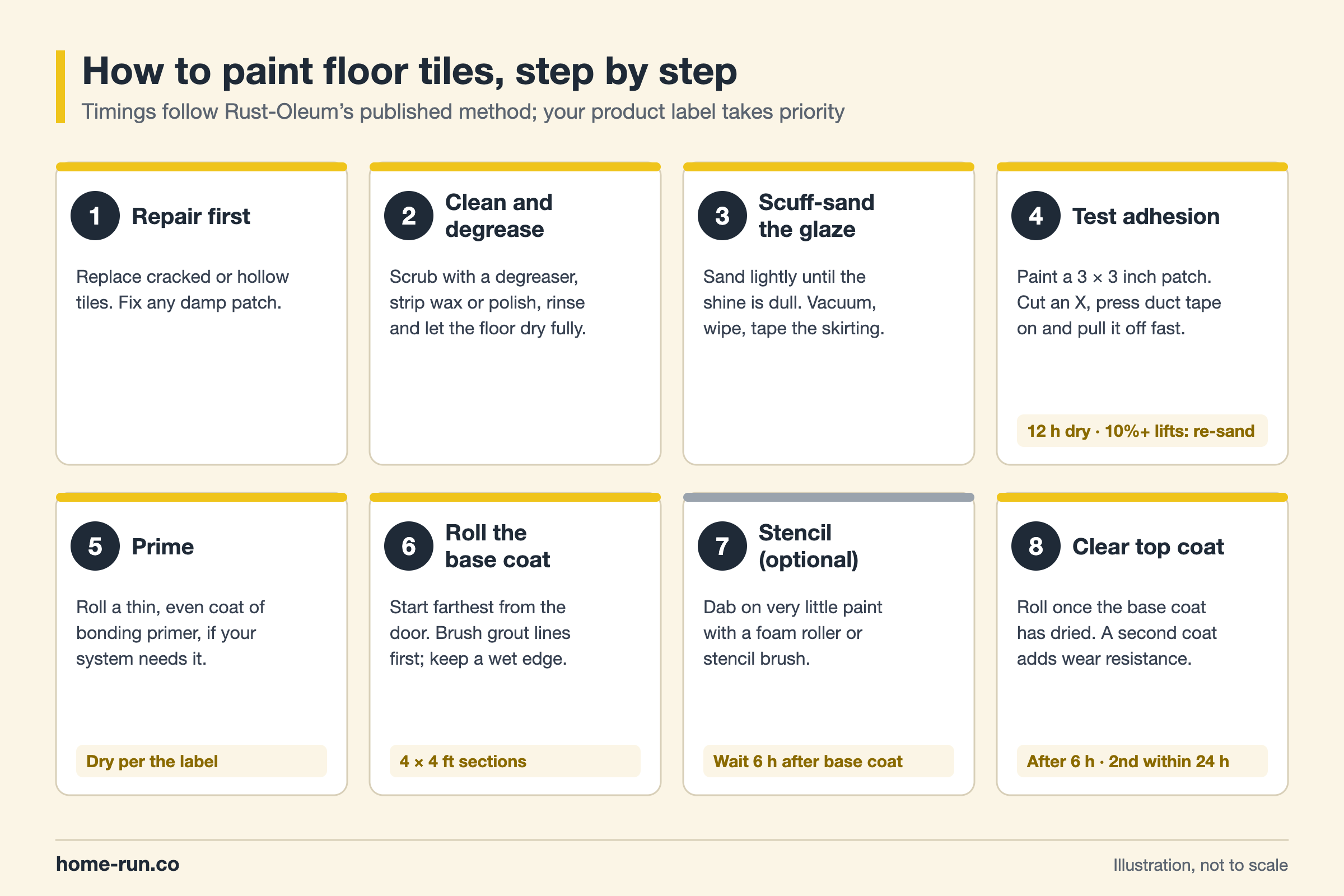
- Repair first. Replace cracked or hollow tiles and fix any damp patch.
- Clean and degrease. Scrub with a degreaser, strip any wax or polish, rinse, and let the floor dry fully.
- Scuff-sand the glaze. Sand lightly until the shine is dull. A chemical deglosser alone does not remove tile gloss, says Sherwin-Williams. Vacuum, wipe, and tape the skirting.
- Test adhesion. Paint a 3 × 3 inch patch and let it dry 12 hours. Cut an X through it, press duct tape on, and pull it off fast. If more than 10% of the coating lifts, sand more before painting.
- Prime, if your system needs it. Roll a thin, even coat of bonding primer and let it dry per the label.
- Roll the base coat. Start in the corner farthest from the door. Work in 4 × 4 ft sections and keep a wet edge. Brush paint into grout lines first.
- Stencil, if you want a pattern. Wait at least 6 hours after the base coat. Dab paint with a foam roller or stencil brush, using very little paint, to stop bleeding under the stencil.
- Apply the top coat. Roll the clear top coat once the base coat has dried 6 hours. A second top coat adds wear resistance; Rust-Oleum says to apply it within 24 hours of the first.
Never skip the adhesion test on vitrified tiles, or paint a damp floor in a rainy week. Thick coats dry soft and peel; two thin coats beat one heavy one.
How Long Does the Whole Project Take?
Painting floor tiles takes about 2 days of work, then 7 days of curing before normal use.
Repair, clean, sand, test patch
Leave the test patch 12 hours overnight.
Prime, base coat, top coat
About 6 hours between base and top coat.
Light foot traffic
24 hours after the final coat.
Furniture back
72 hours after the final coat; lift, never drag.
Full cure
7 days after the final coat; now you can mop.
Should You Paint Floor Tiles Yourself or Hire a Painter?
DIY suits one small room of ceramic tiles; hire a painter for vitrified tiles, epoxy or large areas.
DIY painting
Small, dry roomsPoint
- Lowest cost: you pay only for materials
- Single-pack floor kits are forgiving to apply
- Slower; you must keep the room empty for days
- Prep mistakes show up as peeling within months
Professional painter
Vitrified or epoxyPoint
- Higher cost for labour and equipment
- Handles two-part epoxy mixing and pot life
- Machine sanding gives better grip on dense tiles
- Ask for the paint system and a touch-up visit in writing
How Do You Care for a Painted Tile Floor?
Care for a painted tile floor by mopping with mild soap and water and touching up chips early. Do not wash it during the first 7 days.
- Cleaning: use mild soap and water or a general-purpose cleaner, never acid cleaners, bleach or scouring pads.
- Avoiding damage: put a doormat at entrances and felt pads under chair and table legs.
- Touch-ups: keep labelled leftover paint for small chips.
- Resealing: add a fresh top coat when walkways look dull or scuffed.
How Long Do Painted Floor Tiles Last in Indian Homes?
Painted floor tiles last longest in low-traffic, dry rooms; in busy walkways, wear usually shows within the first year. No manufacturer we checked gives a lifespan in years for paint on floor tiles.
One US homeowner's one-year review of a Rust-Oleum floor found chips and edge wear in walkways, but barely any in low-traffic areas.
- Humidity: damp air slows curing, and rising damp from the slab can lift paint from below. Avoid painting in September and October, Bengaluru's wettest months.
- Foot traffic: outdoor footwear carries grit that scratches paint, so entrances and kitchens wear first.
- Outdoor and terracotta tiles: use only a coating rated for exterior floors.
- Environmental impact: solvent-based paints release more VOCs (volatile organic compounds) than water-based ones, so pick low-VOC and ventilate.
A painted tile floor is only as good as the tile and slab beneath it. If tiles are loose or the floor stays damp, solve that first, or retile using our guide to types of tiles.
Is Painting Floor Tiles Right for Your Home?
Painting floor tiles is right for you if the tiles are sound, the room is dry, and you accept occasional touch-ups. Retile instead if the floor is cracked, damp or carries heavy daily traffic.
If the 12-hour tape test passes and the room stays dry, paint. If the test fails twice, or water reaches the floor daily, retile.