On this page
- What Is Paint Chalking?
- What Causes Paint Chalking?
- How Do You Identify Chalking Paint?
- Which Paints Resist Chalking Best?
- How Do You Fix Chalking Paint?
- How Can You Prevent Paint Chalking?
- Can Chalking Paint Be Fixed Without Repainting?
- When Should You Call a Professional for Chalky Walls?
- Paint chalking is a fine white powder on the paint surface, caused mainly by sunlight breaking down the binder.
- Rub the wall with a dark cloth: powder on the cloth confirms chalking.
- Light chalking can be washed off; heavy chalking needs cleaning, a primer or sealer, and a repaint.
- Never paint over chalk: new paint bonds to the loose powder and peels later.
- A high-quality acrylic exterior paint resists chalking best.
Paint chalking is the slow breakdown of a paint film into a loose, fine white powder on its surface. It shows up mostly on sun-facing exterior walls and makes colours look faded. Some chalking is normal with age, but heavy chalking wears the film away and leaves the wall unprotected.
What Is Paint Chalking?
Paint chalking is the formation of a loosely attached powder on a paint film as it weathers. The powder is mostly pigment left behind once the binder, the resin that glues pigment to the wall, breaks down.
You will notice faded, dull colour and a white smear on your hand when you touch the wall. Rain can also wash the powder down, leaving white streaks on brick or stone below.
Chalking wears paint away from the top down while the film stays stuck to the wall. Bubbling is the opposite: the film lifts off from below, usually because of moisture. If your wall has raised blisters, read our guide to paint bubbling on walls instead.
What Causes Paint Chalking?
Ultraviolet (UV) light from the sun is the main cause of paint chalking. UV rays break down the binder, and the freed pigment particles collect on the surface as powder.
Other factors speed up the process:
- Low-grade, highly pigmented paint: too little binder for the amount of pigment.
- Interior paint used outdoors: it is not formulated to resist sun and rain.
- Oil-based paint on exteriors: oil-based paints chalk more than latex (water-based) formulations.
- Over-thinned paint or coats applied too thin: less film to wear through.
- No primer on porous surfaces: bare plaster, brick or concrete soaks up the binder.
- Painting over a glossy, greasy or dusty coat: the new film bonds poorly and breaks down sooner.
- Moisture: rain and humidity weaken the film, especially on shaded or poorly sealed walls.
Bengaluru combines strong sun with a long wet season. A noon UV index of 13, rated extreme, was recorded on 9 March 2026, before peak summer. The city also averages 1,077.1 mm of rain a year, with September to November usually the wettest months.
Interior paint chalking is less common. It occurs in rooms with strong direct sunlight or in steamy bathrooms, and on walls finished with low-grade, high-pigment paint.
How Do You Identify Chalking Paint?
You identify chalking paint by rubbing the surface with a fingertip or a dark cloth. A powdery white or coloured film on the cloth means the paint is chalking.
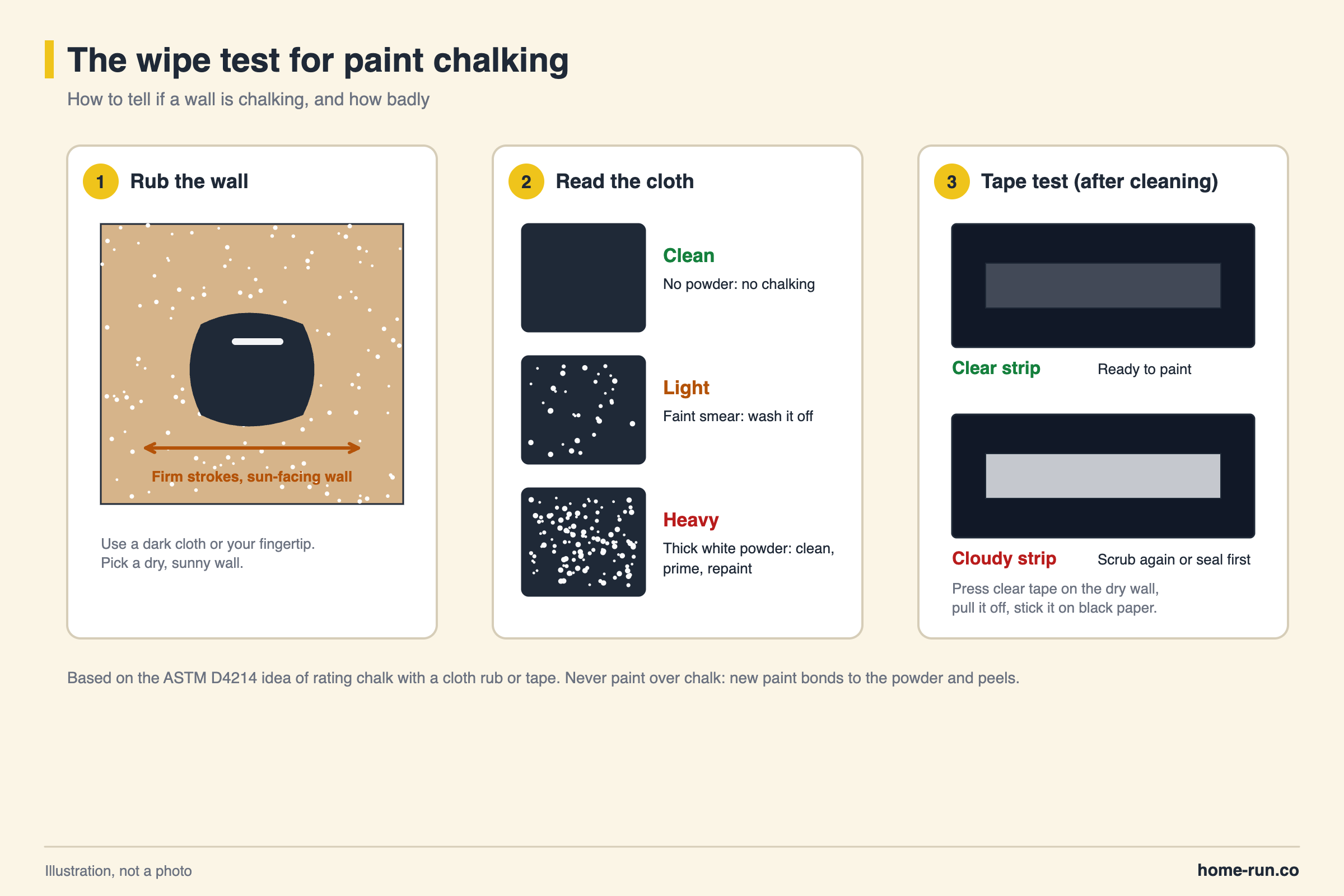
ASTM D4214, the American standard test methods for evaluating the degree of chalking of exterior paint films, uses the same idea. It rates chalk with a felt or velvet cloth rub, a wet finger rub, or clear tape pressed onto the film.
Chalking vs other powdery or failing paint
Use the wipe test and the location to tell them apart| Defect | What you see | Where it shows | Root cause |
|---|---|---|---|
| Chalking | Even, fine powder; faded colour | Sun-facing exterior walls | UV breaks down the binder |
| Efflorescence Moisture | White crystals or patches, often uneven | Damp masonry, wall bases, below terraces | Water carries salts to the surface |
| Bubbling | Raised blisters in the film | Damp walls, sun-heated fresh paint | Moisture or poor adhesion |
| Peeling Repaint | Paint lifting in flakes or strips | Any wall, often after bubbling | Lost bond with the surface |
Which Paints Resist Chalking Best?
A high-quality 100% acrylic exterior emulsion resists chalking best, because its binder holds up well under UV light. Oil-based paints and low-grade, high-pigment finishes chalk faster.
Paint type and chalking risk on exterior walls
Lower risk means longer before the wall turns powdery| Paint type | Chalking risk outdoors | Best use |
|---|---|---|
| 100% acrylic exterior emulsion Default pick | Low | Exterior walls, parapets, compound walls |
| Budget exterior emulsion | Medium to high | Short-term or low-budget repaints |
| Oil-based enamel Wood and metal | Higher than latex paints | Grilles, gates, doors |
| Interior emulsion or distemper Avoid outdoors | High | Interior walls only |
Brands such as Asian Paints and Dulux publish chalking guidance and product sheets, and formulations differ by country. Check the product sheet for exterior use before you buy. Our explainer on synthetic enamel paint covers where oil-based finishes still make sense.
How Do You Fix Chalking Paint?
To fix chalking paint, remove every trace of chalk, rinse and dry the wall, prime it if any powder remains, then apply two coats of a quality exterior acrylic paint.
- Test the surface. Wipe the wall with a dark cloth to see how heavy the chalking is.
- Clean light chalking. Hose the wall down and scrub gently with water and a mild detergent.
- Clean moderate chalking. Scrub with a stiff or wire brush, or sand lightly, then rinse with a strong spray.
- Clean heavy chalking. Pressure-wash the wall. If chalk remains, wash and scrub again.
- Rinse and dry fully. Rinse with clean water and let the wall dry thoroughly before the next step.
- Repeat the wipe test. Any chalk left behind will make the new paint peel later.
- Prime or seal. If chalking is still obvious, apply an oil-based or acrylic primer or sealer.
- Repaint. Apply two coats of a high-quality exterior acrylic emulsion.
Before you buy a primer, read our explainer on oil-based primer to see where it suits masonry. To clean chalk run-down stains on exposed brick, scrub with a stiff brush and detergent; stubborn stains may need professional cleaning.
Test and wash
Wipe test, then hose, scrub or pressure-wash.
Let the wall dry
Repeat the wipe or tape test once it is dry.
Prime or seal
Only if some chalk remains; follow the label drying time.
Two finish coats
Exterior acrylic emulsion, with the recoat gap on the label.
DIY fix
Small areasPoints
- Suits light chalking on low, reachable walls
- Needs a hose, brush, mild detergent and a dark cloth
- You control timing and product choice
- Risky on upper floors without proper scaffolding
Professional fix
Large or heavy chalkingPoints
- Suits whole facades and multi-storey walls
- Painters bring pressure washers and access equipment
- Can judge whether a sealer or full repaint is needed
- Costs more, so get a written quote after a site visit
Repainting a chalky wall?
Exterior paints, primers and painting tools delivered across Bengaluru.
How Can You Prevent Paint Chalking?
You prevent paint chalking by choosing an exterior-grade acrylic paint, preparing and priming the surface, and applying full coats at the right dilution.
- Use exterior-grade paint outdoors; never interior emulsion or distemper
- Pick a high-quality 100% acrylic emulsion for sun-facing walls
- Thin paint only as far as the label allows
- Apply two full coats rather than one thin one
- Prime porous plaster, brick and concrete before painting
- Clean and sand glossy, greasy or dusty surfaces first
- Fix damp walls before repainting; see our guide to causes of wall dampness
- Repaint exteriors after the monsoon, once walls are dry
Can Chalking Paint Be Fixed Without Repainting?
Yes, light paint chalking can often be fixed without repainting. Washing removes the loose powder, and the film below may still protect the wall.
A repaint becomes necessary when the chalk returns soon after cleaning or the colour has faded badly. It is also needed when the film has worn thin enough to show the surface below. At that point the paint no longer protects the wall.
Not directly. New paint applied over chalk sticks to the loose powder instead of the wall, and it can peel. Clean the wall first, and use a primer or sealer if the tape test still shows powder.
A chalky wall is telling you the binder has worn out. Wash it, test it, and only then decide whether it needs paint.
HomeRun Team
When Should You Call a Professional for Chalky Walls?
Call a professional when chalking covers a whole facade, sits on upper floors, or keeps returning after cleaning. A painter can pressure-wash safely and advise on a sealer or full repaint.
- Chalk that returns within months of a wash
- Bare plaster or brick showing through the paint
- White streaks running down brick, stone or windows
- Chalking mixed with cracks, damp patches or peeling
Check sun-facing walls once a year, ideally after the monsoon. Early washing is cheaper than a full repaint.