On this page
- What Is the House Construction Cost in India per Sq Ft?
- What Factors Change the Cost of Building a House?
- How Does House Construction Cost Differ Between Indian Cities?
- How Is the Budget Split Between Materials and Labour?
- How Is House Construction Cost Split by Stage?
- What Is the House Construction Process and Timeline in India?
- How Do You Calculate House Construction Cost in India?
- How Do Material Quality Levels Affect the Budget?
- What Hidden Costs Should You Budget For?
- How Can You Reduce House Construction Cost in India?
- What Are the Next Steps in Planning Your House Construction Budget?
- House construction cost in India runs about ₹1,400–₹3,500+ per sq ft of built-up area in 2026, depending on finish level and city.
- Materials take about 55–60% of the budget and labour 30–40%; the RCC frame alone is 25–30%.
- A 1,000 sq ft standard-finish house costs about ₹18–₹22 lakh to build, before approvals, utilities and contingency.
- Building a typical house takes 8–18 months from design to handover; keep a 2–3 month buffer.
- Land, approvals, utility connections, compound walls and interiors sit outside most per sq ft quotes.
House construction cost in India is about ₹1,400 to ₹3,500 or more per square foot of built-up area in 2026, for construction only. Most families building a standard-finish house in a city pay ₹1,800 to ₹2,200 per sq ft.
This guide is the national picture: what drives the rate, how it changes by city, where the money goes stage by stage, and how long the build takes. For plot-wise local numbers, see our city guides for house construction cost in Bangalore and construction cost in Chennai.
What Is the House Construction Cost in India per Sq Ft?
The house construction cost per square foot in India is ₹1,400–₹1,700 for an economy finish and ₹1,800–₹2,200 for a standard finish. Premium finishes cost ₹2,300–₹2,800, and luxury builds start around ₹3,000–₹3,500.
House construction cost in India by finish level
Civil construction, per sq ft of built-up area, 2026| Finish level | Rate per sq ft | 1,000 sq ft house | Typical specification |
|---|---|---|---|
| Economy Budget | ₹1,400–₹1,700 | ₹14–₹17 lakh | Basic tiles, standard fittings, simple elevation |
| Standard Most common | ₹1,800–₹2,200 | ₹18–₹22 lakh | Branded cement and steel, vitrified tiles, mid-range fittings |
| Premium | ₹2,300–₹2,800 | ₹23–₹28 lakh | Larger tiles or stone, UPVC windows, better fittings |
| Luxury Custom | ₹3,000–₹3,500+ | ₹30–₹35 lakh+ | Custom design, imported finishes, automation |
Builders quote on built-up area, which is the floor area including walls. The rate covers civil work and the finishes in the package. Land, approvals, utility connections, compound walls and interiors are usually extra.
What Factors Change the Cost of Building a House?
Location, material quality, labour rates and design complexity decide most of the cost of house construction in India. Soil and the number of floors move it further.
- Location: metro labour, transport and approval costs run higher than in tier-2 towns and villages.
- Material quality: branded cement, higher-grade TMT steel and premium tiles raise the rate per sq ft.
- Labour and contractor charges: skilled labour is scarcer and dearer in fast-growing cities.
- Design complexity: cantilevers, large spans, curved elevations and double-height spaces need more steel and shuttering.
- Soil and foundation: weak or filled soil needs deeper footings or a raft, which adds to the foundation stage.
- Floors: each extra floor shares the same foundation, but stairs, structure and finishes add cost.
How Does House Construction Cost Differ Between Indian Cities?
House construction costs most in Mumbai and Delhi NCR and least in tier-2 towns and rural areas. The gap at standard finish is about ₹500 per sq ft between a metro and a village.
House construction cost per square foot in Indian cities
Brick & Bolt, June 2026| City or area | Standard finish | Premium finish |
|---|---|---|
| Mumbai and Thane Highest | ₹2,000–₹2,500 | ₹2,800–₹3,500 |
| Delhi NCR | ₹1,900–₹2,400 | ₹2,600–₹3,500 |
| Bangalore | ₹1,900–₹2,300 | ₹2,500–₹3,500 |
| Pune | ₹1,900–₹2,300 | ₹2,500–₹3,400 |
| Chennai | ₹1,800–₹2,200 | ₹2,400–₹3,200 |
| Hyderabad | ₹1,800–₹2,200 | ₹2,400–₹3,200 |
| Tier-2 cities | ₹1,800–₹2,000 | ₹2,100–₹2,800 |
| Rural and semi-urban Lowest | ₹1,400–₹1,700 | ₹1,800–₹2,400 |
Metro cities
Mumbai, Delhi NCR, BangalorePoints
- Higher daily wages for masons, bar benders and carpenters
- Small, costly plots push owners to build G+1 or G+2
- Stricter approval rules and higher municipal fees
- Easy access to branded materials and fast delivery
Tier-2 towns and villages
Lower ratesPoints
- Lower labour rates, but skilled trades can be harder to find
- Larger plots allow single-floor houses
- Simpler approvals at the panchayat or town level
- Freight can add to the price of cement and steel
For smaller cities such as Dehradun, or towns in Punjab and Kerala, start from the tier-2 band above and confirm with two or three local builders. Coastal and hill areas can cost more because of transport and weather-proofing.
How Is the Budget Split Between Materials and Labour?
Materials take about 55–60% of a house construction budget in India and labour takes 30–40%, according to Brick & Bolt. JK Cement splits it as 50–60% materials, 25–30% labour and the rest on contractor overheads and professional fees.
On a standard ₹1,800–₹2,200 per sq ft rate, a 30–40% labour share works out to roughly ₹540–₹880 per sq ft. That is the labour cost for house construction per sq ft that most turnkey quotes carry.
Material cost for house construction in India
Thumb-rule quantities and dated prices| Material | Thumb-rule quantity | Price | Source and date |
|---|---|---|---|
| Cement (OPC or PPC) | 0.4–0.5 bags per sq ft | ₹356 per bag all-India average; ₹380–₹430 per 50 kg bag in builder guides | Centrum Broking, Sept 2026; Brick & Bolt, June 2026 |
| TMT steel (Fe 500D) | 3.5–4.5 kg per sq ft | ₹66–₹82 per kg in Bengaluru | InfraLens, Aug 2026 |
Bricks, AAC blocks (autoclaved aerated concrete blocks), sand and aggregate vary too much by region for a single national price. Get local rates per unit and multiply by your bill of quantities (BOQ), the item-by-item list of materials and work for your house.
How Is House Construction Cost Split by Stage?
The structural frame of columns, beams and slabs takes the largest share of house construction cost, at 25–30%. The foundation and plinth take 10–15%, and finishing work adds up to roughly half of the budget.
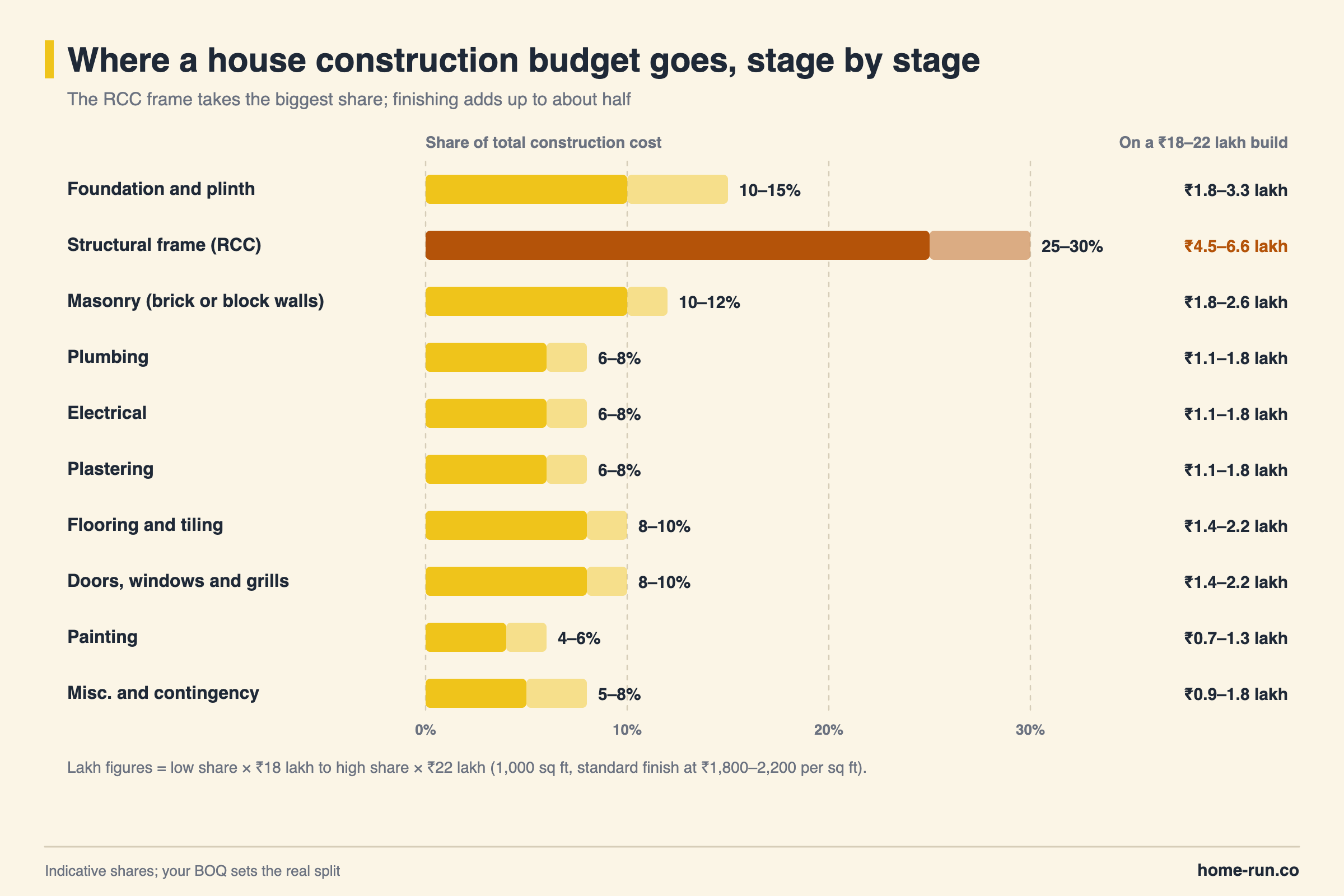
Stage-wise budget allocation
Share of total construction cost| Stage | Share of budget |
|---|---|
| Foundation and plinth | 10–15% |
| Structural frame (RCC) Largest | 25–30% |
| Masonry (brick or block walls) | 10–12% |
| Plumbing | 6–8% |
| Electrical | 6–8% |
| Plastering | 6–8% |
| Flooring and tiling | 8–10% |
| Doors, windows and grills | 8–10% |
| Painting | 4–6% |
| Miscellaneous and contingency | 5–8% |
Use these shares to plan cash flow. Builders usually tie payment milestones to stages, so the foundation and frame payments fall due in the first months of the build.
What Is the House Construction Process and Timeline in India?
House construction in India follows nine stages, from design and approvals to handover, and takes 8–18 months for a standard house. A single-floor house of 1,000–1,500 sq ft takes about 8–12 months; a two-floor home of 1,500–2,500 sq ft takes about 12–18 months.
Planning, design and approvals
Soil test, floor plans, structural drawings and building plan approval; approvals can stretch to 6 months.
Site preparation and layout
Clearing, levelling and marking the plan on the ground.
Foundation
Excavation, footings, plinth beam and plinth filling.
Superstructure and RCC frame
Columns, beams and slabs, floor by floor, with curing time.
Masonry and roofing
Brick or block walls, lintels and the roof slab or terrace.
Electrical and plumbing
Conduits, wiring and concealed pipes before plastering.
Plastering and flooring
Internal and external plaster, then tiles or stone.
Painting and interior finishing
Putty, primer, paint, doors, windows and fixtures.
Final inspection and handover
Snag list, utility connections and occupancy paperwork.
Stage durations are from Brick & Bolt's 2026 timeline guide. Larger villas of 2,500 sq ft or more take 18–24 months or longer. Keep a 2–3 month buffer for monsoon delays, material shortages and approval queues.
How Do You Calculate House Construction Cost in India?
To calculate house construction cost in India, multiply the built-up area by the per sq ft rate for your finish level and city, then add approvals, utilities and a 10–15% contingency.
- Fix the built-up area. Add the floor area of every floor from your plan, including walls and staircases.
- Pick a finish level. Choose economy, standard, premium or luxury, and use your city's band from the tables above.
- Multiply. Area × rate gives the construction cost.
- Add the extras. Approvals, utility connections, compound wall, sump and any interiors.
- Add contingency. Keep 10–15% for price rises and design changes.
- Check with a BOQ. Ask two or three builders for an item-wise BOQ and compare line by line.
The cement and steel lines are a check on the builder's quote, not extra cost; they sit inside the construction figure. The approvals range comes from JK Cement's 2026 guide. For a two-bedroom layout worked out in detail, see our 2 BHK house construction cost guide.
How Do Material Quality Levels Affect the Budget?
Material quality changes house construction cost more than any other choice you control. The right grade for each job matters more than the most expensive one.
- Cement: OPC (Ordinary Portland Cement) gains strength fast and suits RCC work. PPC (Portland Pozzolana Cement) blends in fly ash, gains strength more slowly and suits plastering and masonry.
- Steel: Fe 500 and Fe 550 are TMT (thermo-mechanically treated) steel grades with minimum yield strengths of 500 and 550 N/mm² under IS 1786, the Indian standard for high-strength deformed steel bars. Your structural engineer's design sets the grade.
- Walls: AAC blocks are lighter than clay bricks and can reduce the load on the frame.
- Windows: UPVC (unplasticised polyvinyl chloride) frames cost more than basic aluminium but need little upkeep.
Never downgrade what you cannot replace later: foundation, RCC frame, steel, concealed wiring and pipes. Save on finishes such as tiles, fittings and paint, which you can upgrade in a few years.
What Hidden Costs Should You Budget For?
The biggest hidden costs in house construction are approvals, utility connections, compound walls, statutory cess and site surprises such as weak soil. Together they can add several lakh rupees to a per sq ft quote.
- Approvals and legal: about ₹0.5–₹2 lakh for a 2,000 sq ft house, per JK Cement's 2026 guide.
- Utility connections: water, electricity and sewage connections cost about ₹50,000–₹2 lakh.
- Compound wall: about ₹1–₹3 lakh, rarely in the base package.
- Labour welfare cess: the Building and Other Construction Workers Welfare Cess Act, 1996 levies 1% of construction cost. An individual building their own home is exempt only if the total cost stays at or below ₹10 lakh.
- GST in material prices: cement GST dropped from 28% to 18% from 22 September 2025, so check that quotes reflect it.
- Site issues: weak soil, a high water table or rock can raise foundation cost after excavation starts.
- After handover: interiors, modular kitchen, wardrobes, landscaping and a sump or rainwater harvesting pit where local rules require one.
Ask every builder for a written list of exclusions. Anything not named in the package is a cost you pay separately.
How Can You Reduce House Construction Cost in India?
You can reduce house construction cost in India by fixing the design early, choosing a compact plan and buying materials at the right time, without cutting structural quality.
- Finalise drawings before work starts; changes mid-build are the costliest
- Choose a simple rectangular plan with stacked toilets and kitchens to shorten plumbing runs
- Build up rather than out on small plots, so floors share one foundation and roof
- Use AAC blocks or fly ash bricks where your engineer approves them
- Buy cement and steel in planned lots and compare dealer rates before each pour
- Compare at least three itemised BOQs and negotiate on finishes, not structure
- Tie payments to completed stages, never to dates
For more ways to save, read our guide to low cost house construction techniques and materials.
Starting your build in Bengaluru?
Cement, TMT steel, blocks and plywood delivered to your site across Bengaluru.
What Are the Next Steps in Planning Your House Construction Budget?
The next step is to turn the per sq ft estimate into a written, item-wise budget that you review at every stage.
- Draft the budget. Use the formula above, then split it with the stage table so you know what each month needs.
- Consult professionals. An architect and structural engineer firm up the design; local builders give quotes against it.
- Review regularly. Compare spend against budget at each stage payment and move contingency only when needed.