On this page
- What Is the Super Built-up Area Meaning in a Flat?
- What Does Super Built-up Area Include?
- What Is the Loading Factor, and How Is It Calculated?
- Worked Example: How Loading Changes Two Flat Quotes
- What Do RERA and Karnataka RERA Say About Flat Areas?
- Which Costs Depend on the Area Basis?
- How Do You Check the Area a Builder Quotes?
- What Red Flags Should You Watch For Before Signing?
- Super built-up area is built-up area plus your share of lobbies, lifts, stairs and amenities.
- You live in the carpet area, but many price sheets still bill on super built-up area.
- The loading factor is the gap between the two, and it is set by the developer.
- Bengaluru loading rose from 30% to 41% between 2019 and Q1 2025, per ANAROCK.
- Compare flats on total price ÷ RERA carpet area, never on the headline rate.
The super built-up area meaning is simple: it is the built-up area of your flat plus a proportionate share of the building's common areas. Those common areas include lobbies, staircases, lifts, corridors and amenities such as a clubhouse or gym.
Developers often call it "super area" or "saleable area". It is always the largest of the three area figures. Carpet area is the smallest, and it is the floor you actually use.
What Is the Super Built-up Area Meaning in a Flat?
Super built-up area is the billing area of a flat. It adds three layers together.
- Carpet area: the usable floor inside your walls.
- Built-up area: carpet area plus wall thickness and exclusive balconies.
- Super built-up area: built-up area plus your share of common spaces.
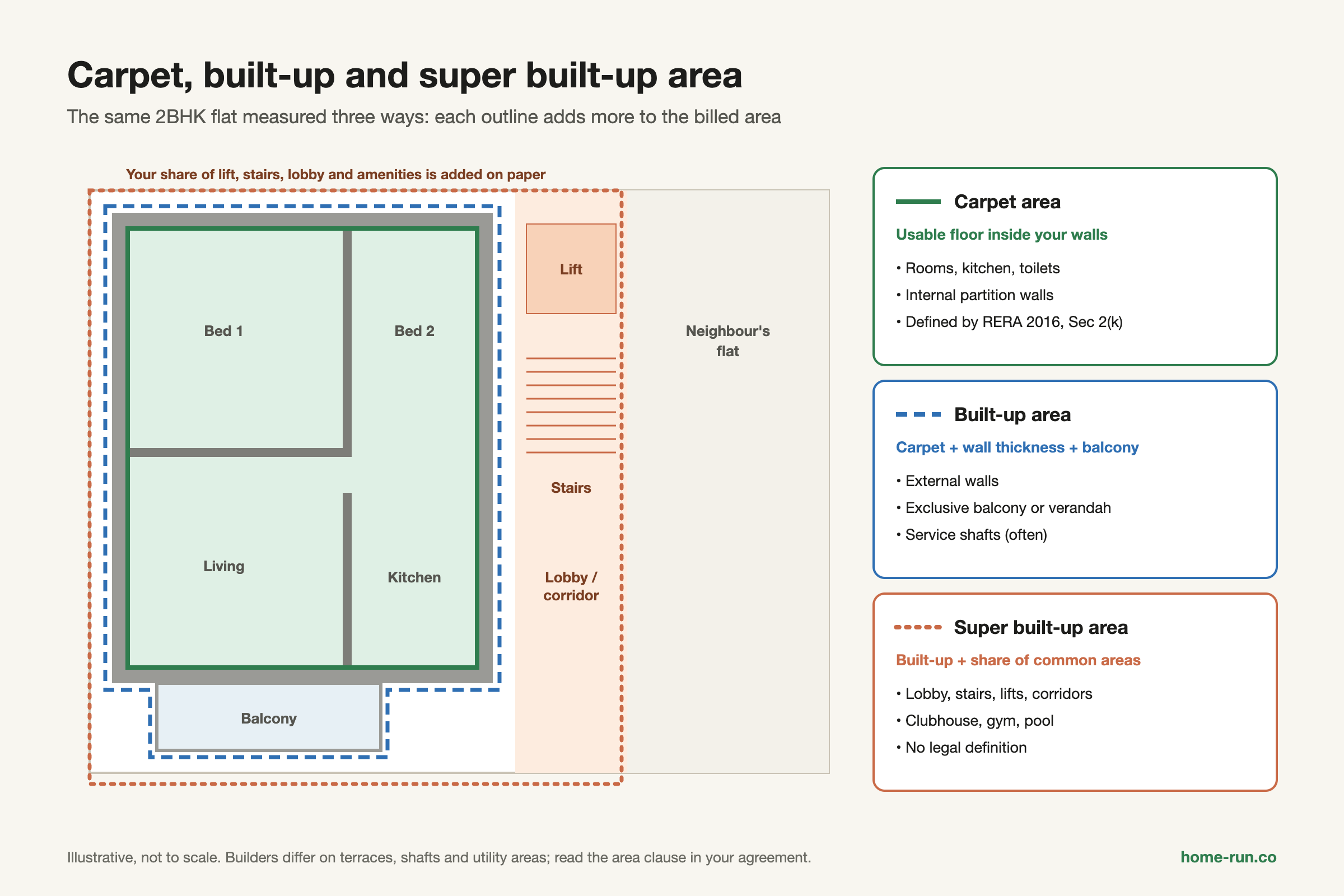
Our guide to carpet area vs built-up area covers the first two layers in detail. This page focuses on the third layer, which is where most of the gap appears.
What Does Super Built-up Area Include?
Super built-up area includes everything in your flat plus a slice of every shared space you can use. The table shows which items sit in each area figure.
What each area figure counts
Carpet area as defined by RERA 2016| Space | Carpet | Built-up | Super built-up |
|---|---|---|---|
| Rooms, kitchen, toilets | Yes | Yes | Yes |
| Internal partition walls | Yes | Yes | Yes |
| External walls | No | Yes | Yes |
| Exclusive balcony or verandah | No | Yes | Yes |
| Exclusive open terrace | No | Check agreement | Check agreement |
| Service shafts | No | Often | Yes |
| Lobby, stairs, lifts, corridors Loading | No | No | Share |
| Clubhouse, gym, pool Loading | No | No | Share |
A utility area or servant room inside your flat counts as carpet area only if it is part of your sanctioned unit. Check the approved plan before you accept either figure.
What Is the Loading Factor, and How Is It Calculated?
The loading factor is the percentage added to carpet area to reach super built-up area. It pays for walls, balconies and your share of common spaces.
Always ask which base a loading figure uses. A flat where 40% of the super built-up area is common space has a loading of about 67% on carpet area.
High-rise towers with large clubhouses, pools and wide lobbies load more than low-rise buildings. ANAROCK found that average loading across India's top seven cities rose from 31% in 2019 to 40% in Q1 2025. Bengaluru moved from 30% to 41%, the sharpest rise among them.
Higher loading is not wrong in itself. Ask for the list of common areas being loaded, then decide whether those amenities are worth paying for.
Worked Example: How Loading Changes Two Flat Quotes
A lower rate per sq ft on super built-up area can still cost you more. The figures below are illustrative, not market data.
Two projects, compared on carpet area
Illustrative figures| Measure | Project A | Project B |
|---|---|---|
| Headline rate (super built-up) | ₹8,000/sq ft | ₹8,500/sq ft |
| Super built-up area | 1,200 sq ft | 1,100 sq ft |
| Carpet area | 800 sq ft | 820 sq ft |
| Loading on carpet | 50% | 34% |
| Total price | ₹96,00,000 | ₹93,50,000 |
| Price per carpet sq ft Better value: B | ₹12,000 | ₹11,402 |
What Do RERA and Karnataka RERA Say About Flat Areas?
RERA defines carpet area only. Super built-up area has no legal definition. The Real Estate (Regulation and Development) Act, 2016 defines carpet area in Section 2(k) as "the net usable floor area of an apartment", excluding external walls, service shafts, exclusive balcony or verandah and exclusive open terrace, but including internal partition walls.
The Act requires developers to disclose the carpet area of each unit type at project registration. Some state regulators, including Haryana and Uttar Pradesh, have gone further and directed sales on a carpet area basis.
In Bengaluru, projects register with the Karnataka Real Estate Regulatory Authority (K-RERA) under the Karnataka RERA Rules, 2017. Check the project page on the K-RERA portal for the declared carpet area of your unit type.
RERA model agreements for sale let a developer charge for an increase of up to 3% in carpet area. If the delivered carpet area is smaller, the developer refunds the excess within 45 days with interest at the rate in the state rules. Confirm the exact clause in your own agreement.
Priced on carpet area
RecommendedRate × RERA carpet area.
- You pay for floor you can measure
- Easy to compare across projects
- Common areas sit inside the rate
- Shortfall is covered by the agreement
Priced on super built-up area
Check carefullyRate × carpet area plus loading.
- Headline rate looks lower
- Loading differs between projects
- Common areas cannot be measured by you
- Needs conversion before comparing
Which Costs Depend on the Area Basis?
Several running costs follow the area basis your agreement uses, so loading affects more than the base price.
- Maintenance: associations often bill per sq ft of super built-up area. Check the rate and basis before booking.
- Property tax: Bengaluru's civic body assesses property tax on built-up area under its own formula. Your assessment notice shows the figure used.
- Stamp duty and registration: these follow the higher of the sale value and the Karnataka guidance value, so a loaded price raises them.
- Home loan: banks lend against their own valuation. RBI caps loans at 90% of value up to ₹30 lakh, 80% from ₹30 to ₹75 lakh and 75% above ₹75 lakh.
If a bank values the flat below a heavily loaded price, you fund the gap from your own savings.
How Do You Check the Area a Builder Quotes?
Ask for a written area breakdown and match it against official documents at each stage.
Note the area basis
Ask whether the size shown is carpet, built-up or super built-up area.
Get the breakdown
Carpet, balcony, built-up and common-area share, in writing.
Match the carpet area
Compare with the unit type on the project's registration page.
Read the area clause
Confirm carpet area, price basis and the variation clause.
Measure the flat
Measure wall to wall in each room and add the areas.
RERA documents often use square metres. One square metre equals 10.764 sq ft, so convert before comparing.
Also check the occupancy certificate before possession. It confirms the building matches its sanctioned plan.
What Red Flags Should You Watch For Before Signing?
- Only super area shown: no carpet area anywhere on the price sheet.
- "Approx." areas: sizes with no breakdown or drawing.
- Balcony inside carpet area: RERA excludes exclusive balconies.
- Loading with no list: no schedule of the common areas being charged.
- K-RERA registration number and project page
- Written area breakdown with carpet area
- Sanctioned floor plan for your unit
- Draft agreement with the area and variation clause
Fitting out your new flat?
Interior materials delivered across Bengaluru.