On this page
- What Does the M15 Concrete Ratio 1:2:4 Mean?
- What Goes Into M15 Concrete, and What Does Each Ingredient Do?
- How Much Cement, Sand and Aggregate Do You Need for 1 m³ of M15?
- How Do You Batch M15 by Volume on an Indian Site?
- What Water-Cement Ratio Should You Use for M15?
- Where Can You Use M15 Concrete, and Where Not?
- M15 vs M10, M20 and M25: Which Concrete Grade Should You Choose?
- How Do You Mix, Place and Cure M15 Concrete?
- How Do You Test M15 Concrete, and Why Does It Fail?
- What Should You Check Before Ordering M15 Materials?
- The M15 concrete ratio is 1:2:4 (cement : sand : coarse aggregate) by volume.
- 1 m³ of M15 needs about 6.34 bags of cement, 0.44 m³ of sand and 0.88 m³ of aggregate.
- Keep the water-cement ratio at 0.50–0.55, which is 25–27.5 litres per bag.
- M15 is for plain concrete. IS 456 needs at least M20 for reinforced work.
- Cure for at least 7 days with OPC and 10 days with PPC.
The M15 concrete ratio is 1:2:4: one part cement, two parts sand and four parts coarse aggregate, measured by volume. Mixed and cured well, M15 reaches a characteristic strength of 15 N/mm² at 28 days.
What Does the M15 Concrete Ratio 1:2:4 Mean?
M15 is a concrete grade in IS 456:2000, the Indian code of practice for plain and reinforced concrete. "M" stands for mix. "15" is the characteristic compressive strength in N/mm² (the same as MPa) of 150 mm cubes tested at 28 days.
Characteristic strength is the value below which no more than 5% of cube results should fall.
- 1 part cement: OPC (ordinary Portland cement) or PPC (Portland pozzolana cement)
- 2 parts fine aggregate: river sand or M-sand
- 4 parts coarse aggregate: usually 20 mm crushed stone
1:2:4 is a nominal mix: fixed proportions that IS 456 allows for grades up to M20. The ratio gives 15 N/mm² only if the cement is fresh, the aggregate is clean, the water is controlled and the concrete is cured. A design mix, proportioned to IS 10262 from tested materials, is the alternative on larger jobs.
What Goes Into M15 Concrete, and What Does Each Ingredient Do?
M15 concrete has four ingredients: cement, sand, coarse aggregate and water. Water starts hydration, the reaction that hardens cement.
M15 ingredients and what to buy
For site-mixed PCC| Ingredient | Role | What to use |
|---|---|---|
| Cement | Binds the mix as it hydrates | OPC 43 or PPC in 50 kg bags, fresh and lump-free |
| Sand (fine aggregate) | Fills voids between stones | Washed M-sand or river sand, free of silt and clay |
| Coarse aggregate Default 20 mm | Carries load and adds volume | 20 mm crushed stone; 40 mm possible in thick plain beds |
| Water | Hydrates cement, gives workability | Clean water, fit for drinking |
Most Bengaluru sites use M-sand (manufactured sand). Ask for test results against IS 383, the Indian standard for concrete aggregates.
How Much Cement, Sand and Aggregate Do You Need for 1 m³ of M15?
One cubic metre of M15 concrete needs about 317 kg of cement (6.34 bags), 0.44 m³ of sand and 0.88 m³ of coarse aggregate, before wastage.
The calculation uses a dry volume factor of 1.54, because loose dry materials shrink once cement and sand fill the voids between stones. Our M20 concrete ratio guide uses the same factor.
M15 concrete quantities for common volumes
Before wastage| Concrete volume | Cement (bags) | Sand (m³) | Aggregate (m³) |
|---|---|---|---|
| 0.5 m³ | 3.17 | 0.22 | 0.44 |
| 1 m³ | 6.34 | 0.44 | 0.88 |
| 5 m³ | 31.7 | 2.20 | 4.40 |
| 100 sq ft PCC bed, 100 mm thick (0.93 m³) | 5.89 | 0.41 | 0.82 |
What is the M15 ratio by weight?
IS 456 Table 9 gives nominal M15 by weight as about 330 kg of dry aggregate per 50 kg bag of cement. Split 1:2 between sand and stone, that is 50 kg cement, 110 kg sand and 220 kg coarse aggregate, or about 1 : 2.2 : 4.4 by weight.
How Do You Batch M15 by Volume on an Indian Site?
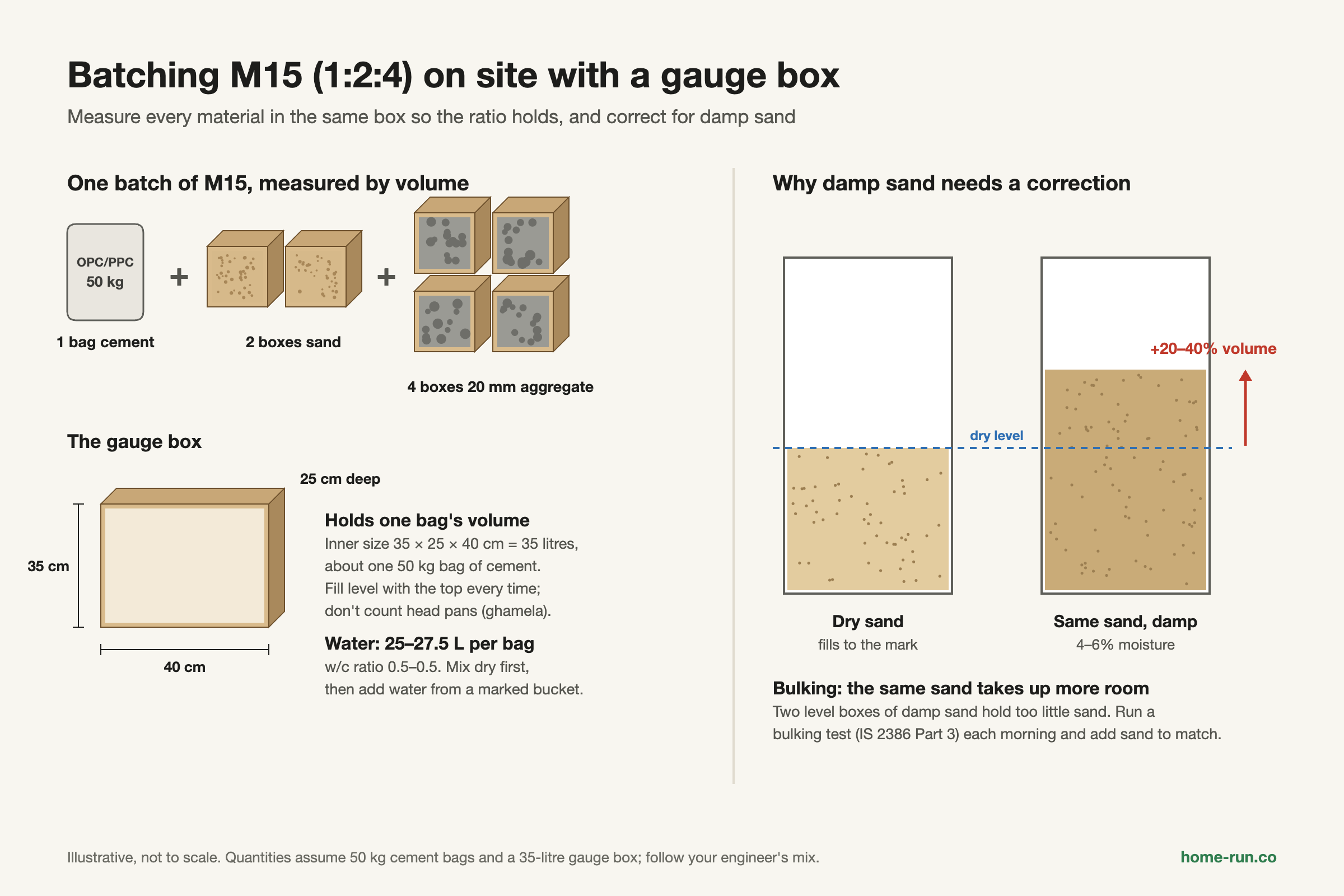
Batch M15 with a gauge box, a wooden or steel box that holds the volume of one 50 kg cement bag, about 35 litres. Any inner size that multiplies to 35 litres works, such as 35 × 25 × 40 cm.
- Empty one full bag of cement onto the platform or into the mixer.
- Fill the gauge box level with sand, twice.
- Fill the box level with coarse aggregate, four times.
- Mix dry, then add water from a marked bucket.
Damp sand swells. At about 4–6% moisture it can take up 20–40% more volume than dry sand. Two boxes of damp sand then hold too little sand, so run a bulking test (IS 2386 Part 3) each morning and add sand to match.
Counting head pans (tagari or ghamela) is the least reliable method, because pans are filled unevenly.
Gauge box batching
Small PCC jobsMeasured by volume.
- Cheap to make on site
- Quick for small pours
- Needs a bulking correction for damp sand
- Accuracy depends on levelling each box
Weigh batching
Larger poursMeasured by mass.
- Not affected by sand bulking
- Most consistent strength
- Needs scales or a batching plant
- Usually bought as ready-mix concrete
What Water-Cement Ratio Should You Use for M15?
Use a water-cement ratio of about 0.50–0.55 for M15, which is 25–27.5 litres of water per 50 kg bag of cement.
IS 456 Table 9 lists up to 32 litres per bag for nominal M15, a ratio of 0.64. Table 5 of the same code caps plain concrete at 0.60, so stay well under 32 litres.
- Slump check: IS 456 suggests a slump of 25–75 mm for mass concrete, floors and strip footings.
- Wet sand: reduce the water you add.
- Need more flow: add a plasticiser (water-reducing admixture), not more water.
Water added to make pouring easier is the most common cause of weak site concrete.
Where Can You Use M15 Concrete, and Where Not?
Use M15 for plain cement concrete (PCC), which is concrete without steel. IS 456 Table 5 sets M20 as the minimum grade for reinforced concrete (RCC), even in mild exposure.
M15 is a good fit for:
- PCC bed (blinding) under footings and plinth beams
- Base concrete under floor tiles
- Pathways, kerbs and paved yards
- Levelling courses and non-structural pads
Do not use M15 for:
- Roof and floor slabs
- Beams, columns and lintels with steel
- Reinforced footings and rafts
- Water tanks and sumps
For plain concrete, IS 456 sets M15 as the minimum in moderate exposure and M20 in severe exposure, such as coastal air or alternate wetting and drying.
If the concrete holds TMT bars, use M20 or the grade on your structural drawing. If it is a plain bed, floor base or path, M15 is enough.
M15 vs M10, M20 and M25: Which Concrete Grade Should You Choose?
Choose M15 for plain concrete and M20 for anything reinforced. M20 is stronger and uses about 27% more cement per m³ (8.06 bags against 6.34).
Concrete grades compared
Nominal ratios as commonly used in India| Grade | Ratio (C:S:A) | Strength (N/mm²) | Cement (bags/m³) | Typical use |
|---|---|---|---|---|
| M5 / M7.5 | 1:5:10 / 1:4:8 | 5 / 7.5 | 2.77 / 3.41 | Lean concrete, levelling |
| M10 | 1:3:6 | 10 | 4.44 | PCC levelling, bed concrete |
| M15 This guide | 1:2:4 | 15 | 6.34 | PCC under footings, floors, paths |
| M20 Default for RCC | 1:1.5:3 | 20 | 8.06 | House slabs, beams, columns, footings |
| M25 | Design mix (1:1:2 often quoted) | 25 | — | Moderate exposure, multi-storey RCC |
In Bengaluru, cement for 1 m³ of site-mixed M15 costs about ₹2,440–2,695 at OPC 43 prices of ₹385–425 a bag (InfraLens, April–May 2026). InfraLens lists ready-mix M10 at ₹3,850–4,312 and M20 at ₹5,500–6,160 per m³ (May 2026), but no M15 price, so ask suppliers for a quote.
Order M15 materials in the right quantities
Cement, M-sand and 20 mm aggregate for PCC beds, floors and paths, delivered across Bengaluru with a GST invoice.
How Do You Mix, Place and Cure M15 Concrete?
Mix M15 dry, add water, place and compact promptly, then keep it wet for at least 7 days.
Prepare the base
Compact the soil, moisten it and fix side shuttering.
Batch and dry mix
One bag of cement, two boxes of sand, four boxes of aggregate, mixed to an even colour.
Add water
Add the measured water and mix for at least 2 minutes in a drum mixer.
Place and compact
Do not drop it from a height. Tamp out trapped air, then level.
Cure
Cover with wet hessian or pond water: 7 days for OPC, 10 days for PPC.
These are the IS 456 minimums for OPC and blended cements. Extend them in hot, dry weather, and pour early during Bengaluru's March to May heat.
How Do You Test M15 Concrete, and Why Does It Fail?
You test M15 by crushing 150 mm cubes at 7 and 28 days, as per IS 516. The 28-day result decides whether the concrete is M15.
- Sampling: IS 456 asks for one sample of 3 cubes for 1–5 m³ placed in a day, two for 6–15 m³, three for 16–30 m³ and four for 31–50 m³.
- Acceptance: each result must be at least 12 N/mm² (15 − 3). The mean of four consecutive results must reach 18 N/mm² (15 + 3) or 15 + 0.825 × standard deviation, whichever is higher.
Watch for these signs that an M15 mix has gone wrong:
- Segregation: stones settle and slurry floats
- Bleeding: water pools on the surface
- Lumpy cement or muddy sand
- Surface dusting after a few days
If cubes fail, ask your engineer about core tests before breaking anything out.
What Should You Check Before Ordering M15 Materials?
- Confirm the grade and exposure on your engineer's drawing
- Calculate the volume and multiply by the per-m³ quantities above
- Add wastage and round cement up to whole bags
- Order fresh cement, washed sand and 20 mm aggregate
For a path or yard, also compare M15 with paving blocks.