On this page
- What Is a Biogas Plant for Home and How Does It Work?
- Which Type of Biogas Plant Suits Your Home?
- How Big a Biogas Plant for Home Do You Need?
- How Do You Install a Biogas Plant at Home, Step by Step?
- What Can You Feed a Home Biogas Plant?
- How Do You Maintain a Biogas Plant Safely?
- How Much Does a Biogas Plant for Home Cost, and Is There a Subsidy?
- Is Biogas Cheaper Than LPG?
- Size the plant from the waste you can feed every day, not from the tank size.
- Fixed dome plants suit cattle owners; portable units suit kitchen-waste homes.
- Vent the first two fillings of gas unused; they can hold explosive air.
- Test joints with soapy water, never a flame.
- MNRE support was ₹14,350 for a 2–4 m³ plant (general category) under the 2021–26 programme.
A biogas plant for home is a sealed tank that turns cow dung or kitchen waste into cooking gas. You feed it daily, pipe the gas to a stove, and use the leftover slurry as manure.
What Is a Biogas Plant for Home and How Does It Work?
A home biogas plant uses anaerobic digestion: bacteria break down waste in a tank with no air. The process gives biogas, which is 55–65% methane and 35–45% carbon dioxide, plus a wet residue called digestate or bio-slurry.
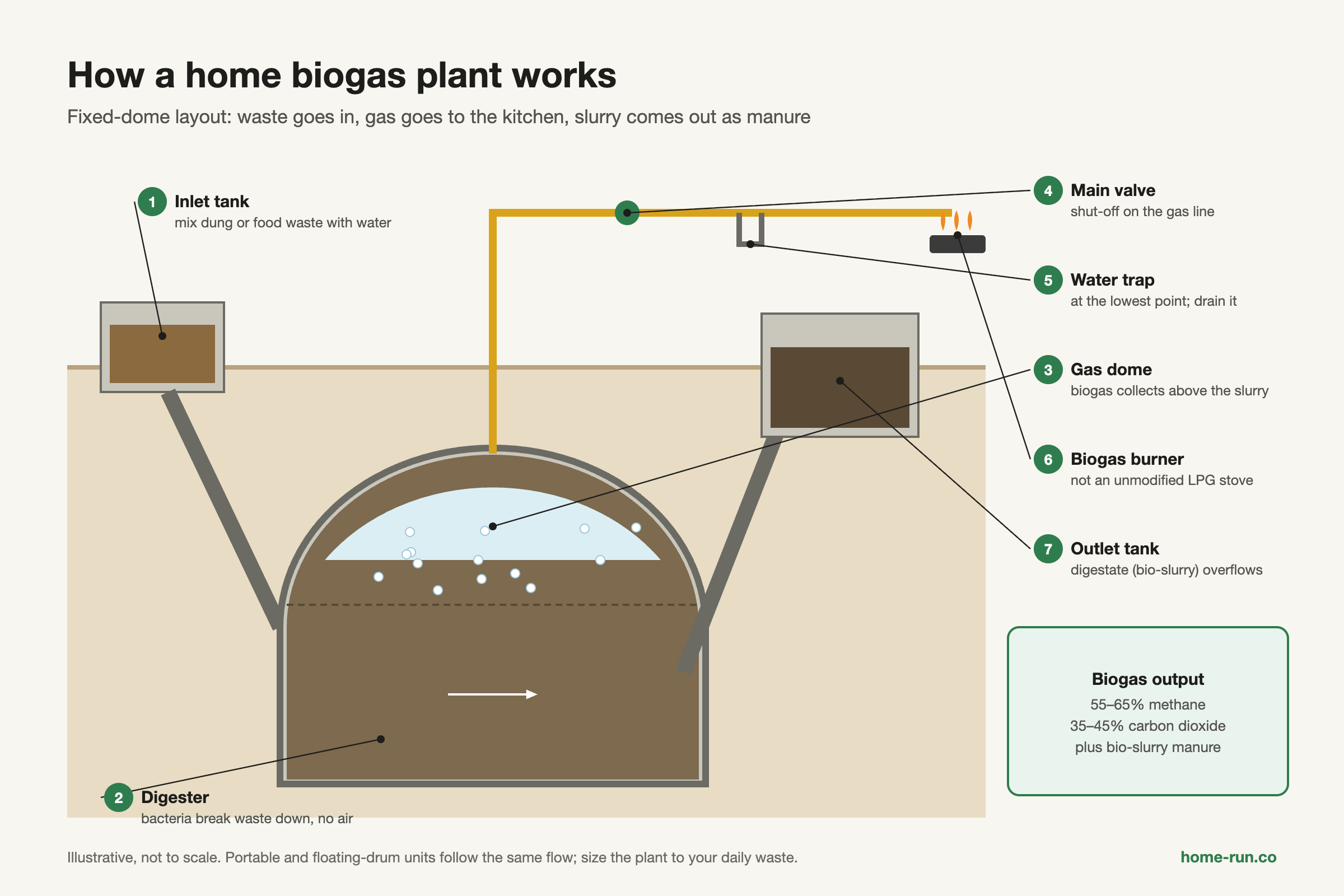
Gas collects in a dome, drum or bag; used slurry flows out to a pit.
The digester works like a sealed septic tank design that captures its gas.
Gobar gas is biogas made from cattle dung. Modern home units also accept food waste.
Which Type of Biogas Plant Suits Your Home?
Three designs are common in India: fixed dome (Deenbandhu), floating drum (KVIC, from the Khadi and Village Industries Commission) and portable units.
Home biogas plant types compared
Qualitative| Type | Build | Upkeep | Best for |
|---|---|---|---|
| Fixed dome (Deenbandhu) Cattle owners | Underground brick and cement; skilled mason | Low; dome leaks are hard to fix | Farms with daily dung |
| Floating drum (KVIC) | Masonry pit with a steel drum on top | Paint drum 1–2 times a year | Steady gas pressure |
| Portable (HDPE or FRP) Urban homes | Ready-made tank, set up in days | Low; smaller output | Kitchen waste, terraces, yards |
Most Bengaluru homes have only kitchen waste. Pick a portable unit rated for your daily food scraps.
How Big a Biogas Plant for Home Do You Need?
Size the plant by your daily cooking gas need and daily waste. Family plants are rated at about 1 to 4 cubic metres (m³) of gas per day.
Food waste is far richer: the Appropriate Rural Technology Institute (ARTI) puts 1 kg (dry weight) on par with about 20 kg of dung.
How Do You Install a Biogas Plant at Home, Step by Step?
You can install a biogas plant at home in seven steps. Masonry plants need a trained mason; suppliers install portable units.
- Measure your daily waste. Weigh a week of dung or scraps.
- Choose the site. Level, drained, sunny ground near the kitchen. Keep it away from wells, as with a soak pit.
- Build or place the digester. A fixed dome needs tight brickwork and the right concrete mix ratio.
- Connect the inlet and outlet. Lead the outlet to a covered slurry pit.
- Lay the gas line. Fit a main valve and a water trap at the lowest point.
- Make the first charge. Fill with cow dung mixed 1:1 with water, even for kitchen-waste units.
- Wait for good gas. Start daily feeding once the flame is steady.
Vent the early gas
Release the first two fillings unused; they hold leftover air.
Bacteria settle in
A weak flame or none is normal.
Steady cooking gas
Cold weather can stretch this to 1.5–2.5 months.
Use a biogas burner. Do not connect the line to an LPG stove.
What Can You Feed a Home Biogas Plant?
A home biogas plant runs best on cattle dung and soft, starchy food waste. Oily, acidic or hard material slows it down.
Feedstock guide
Check your supplier's list too| Material | Verdict | Why |
|---|---|---|
| Fresh cattle dung | Feed | Brings the right bacteria; steady gas |
| Cooked leftovers, flour, peels | Feed | High gas yield, fast breakdown |
| Citrus peel, cooking oil | Avoid | Acidity and scum upset digestion |
| Grass, wood, sand, plastic, chemicals | Avoid | Settle, block pipes or kill bacteria |
| Dung from animals on antibiotics | Avoid | Skip for 5 days after treatment |
How Do You Maintain a Biogas Plant Safely?
Maintaining a biogas plant means steady daily feeding, a dry gas line and leak-free joints.
- Feed at the same time daily and skim off floating material.
- Drain the water trap about twice a week.
- Test every joint with soapy water and watch for bubbles.
- Paint a KVIC steel drum once or twice a year.
- Replace clear flexible gas pipe every 2–3 years.
- Rotten-egg smell near the plant or kitchen (a leak)
- Weak or yellow flame after normal feeding
- No gas for a day or more after feeding
- A thick crust on the slurry, or a drum that will not rise
Smell gas indoors? Close the main valve, open windows and fix the leak first. Use the slurry as manure, diluted 1:1 in dry weather.
How Much Does a Biogas Plant for Home Cost, and Is There a Subsidy?
A 2 m³ biogas plant for home costs about ₹17,000 on average, per a 2026 JK Cement guide. Check that quotes include the gas holder, pipe, valve, stove and installation.
MNRE central subsidy per plant
₹, Biogas Programme FY 2021-22 to 2025-26| Plant size | General (₹) | SC/ST, hilly and NE states (₹) |
|---|---|---|
| 1 m³ | 9,800 | 17,000 |
| 2–4 m³ Most homes | 14,350 | 22,000 |
| Linked to a toilet (extra) | 1,600 | 1,600 |
The Ministry of New and Renewable Energy (MNRE) pays through state implementing agencies. Find Karnataka's on the MNRE biogas portal and confirm your model qualifies.
Building a biogas plant?
Cement, bricks, pipes and valves delivered across Bengaluru.
Is Biogas Cheaper Than LPG?
Biogas is cheaper than LPG to run. The worked example replaces about one 14.2 kg cylinder a month, listed at ₹944.50 in Bengaluru in 2026.
Biogas
Low running costPoints
- Near-zero fuel cost
- Free manure from the slurry
- Needs daily feeding
- Output drops in cool weather
LPG
ConvenientPoints
- About ₹11,300 a year at one cylinder a month
- No daily effort
- Steady flame in any season
- Price changes month to month