On this page
- What Is Ashlar Masonry?
- How Are the Stones Cut and Dressed?
- What Are the Types of Ashlar Masonry?
- How Does It Differ From Rubble Masonry?
- Where Is Dressed Stone Masonry Used in India?
- How Is an Ashlar Wall Built?
- What Is the Environmental Impact of Stone Quarrying?
- How Do You Plan Stonework for Your Project?
- Ashlar masonry uses stones cut square on all sides, so joints stay as thin as 3 mm.
- IS 1597 (Part 2) names six types, from plain ashlar to block-in-course.
- Bengaluru's Vidhana Soudha is built mostly of local granite in dressed stone.
- Build it with wetted stones, broken joints, bond stones every 1.5–1.8 m and 7 days of curing.
Ashlar masonry is stone masonry built from blocks dressed to exact, square dimensions and laid in regular courses. Because every face is true, the joints between stones are hairline thin.
New to the subject? Start with our explainer on what masonry means and its main types. This guide covers ashlar in depth.
What Is Ashlar Masonry?
Ashlar masonry is the finest class of stone masonry, using squared stones of uniform size laid in level courses. IS 1597 (Part 2): 1992, the Indian code of practice for ashlar masonry, sets its rules.
Under that code, each stone's breadth is at least its height, and its length at least twice its height. Courses are usually all the same height.
Palace facades at Knossos and Phaistos on Crete used ashlar around 1700–1450 BC. The Inca built dry ashlar, with no mortar at all, in Cusco and Machu Picchu.
How Are the Stones Cut and Dressed?
Stones for ashlar masonry are split from the quarry block, squared, then chisel-dressed on the beds, joints and exposed face. Dressing means working the surface with tools until it is flat and true.
- Flatness test: a straight edge laid on a dressed surface must not show a gap over 3 mm.
- Joint margin: for plain ashlar, joints are fine-tooled for about 6 mm back from the face.
- Corners: quoins (corner stones) are dressed square and vertical.
In Bengaluru, pick local granite: it is hard, dense and widely quarried. Porous stones such as sandstone or soft limestone need bond stones running about two-thirds into the wall.
What Are the Types of Ashlar Masonry?
IS 1597 (Part 2) describes six types of ashlar masonry, which differ mainly in how the exposed face is finished.
Types of ashlar masonry
As described in IS 1597 (Part 2): 1992| Type | Face finish | Max joint |
|---|---|---|
| Plain (fine) ashlar Finest | Fine tooled on all beds, joints and faces | 3 mm |
| Sunk or moulded | Face grooved, rebated, sunk or moulded | 3 mm |
| Rock (quarry) faced | 25 mm chisel draft at edges, rest left rough; bulge up to 7.5 cm | 3 mm |
| Chamfered | Edges bevelled at 45° to about 2.5 cm depth | 3 mm |
| Rough tooled (punched) | 2.5 cm fine draft at edges, rough tooled between | 3 mm |
| Block-in-course Heavy work | Hammer or pitch faced large blocks, 20–25 cm courses | 6 mm |
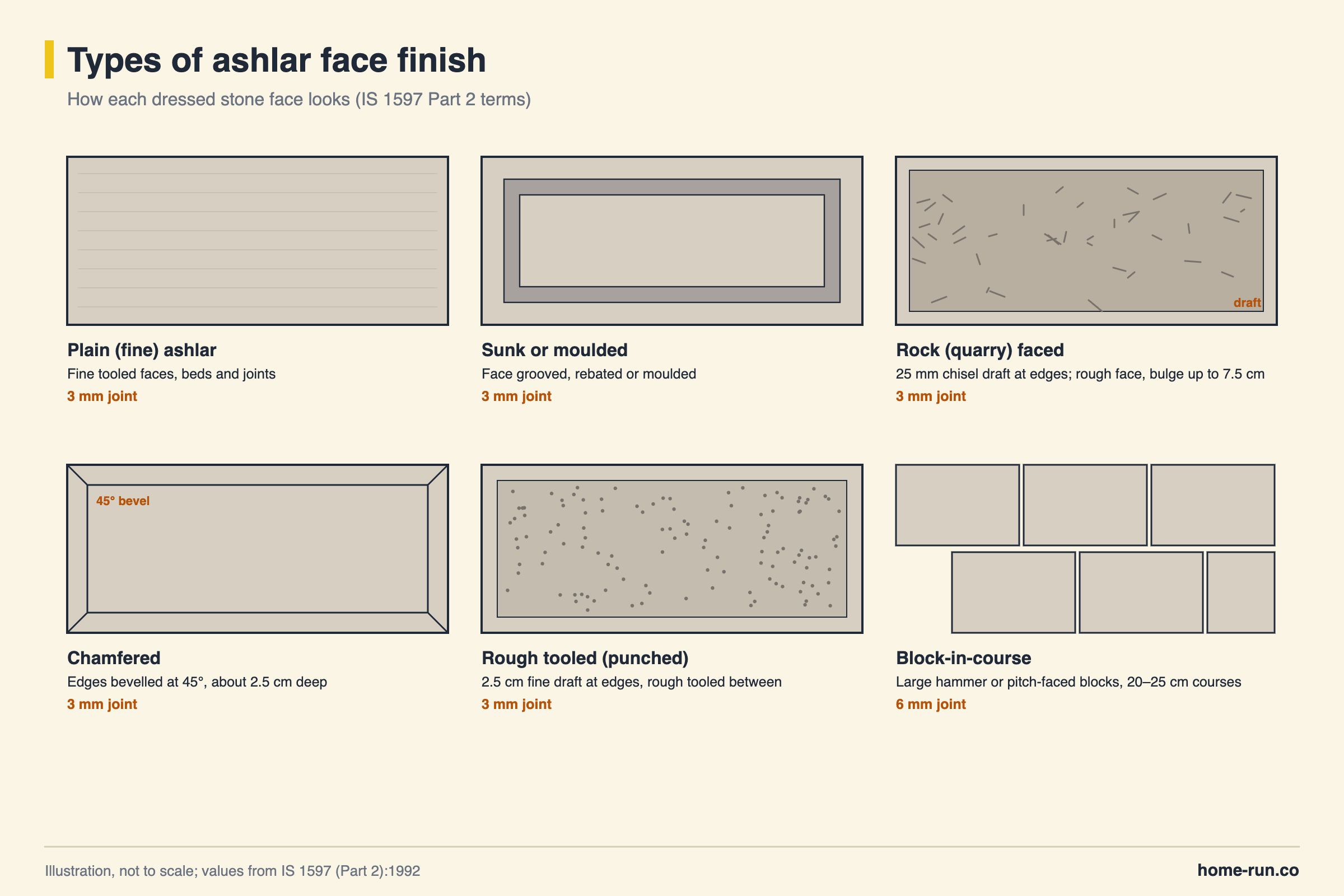
Ashlar facing, a dressed stone skin over brick or rubble backing, falls outside IS 1597 (Part 2) and needs its own specification.
How Does It Differ From Rubble Masonry?
Ashlar masonry uses fully dressed, squared stones, while rubble masonry uses undressed or roughly dressed stones of irregular shape. Our rubble masonry guide covers the rubble side in detail.
Ashlar masonry
Fine finishPoints
- Stones squared and dressed on all faces
- Joints up to 3 mm
- Regular courses at least 30 cm high
- Facades, monuments, feature walls
Rubble masonry
BudgetPoints
- Stones used as quarried or hammer-shaped
- Joints up to 20 mm (random rubble)
- Random or roughly coursed
- Foundations, retaining and compound walls
Where Is Dressed Stone Masonry Used in India?
Ashlar masonry is used in India for public buildings, heritage repair and premium residential stonework.
- Heritage and civic: Bengaluru's Vidhana Soudha (mid-1950s) is mostly Bangalore granite from Mallasandra and Hessaraghatta, with Magadi pink and Turuvekere black stone.
- Older public buildings: Victoria Hospital and Minto Eye Hospital in Bengaluru show the city's grey stone tradition.
- Homes: plinth facing, gate pillars, feature walls and boundary walls, often as ashlar facing over a brick backing.
How Is an Ashlar Wall Built?
An ashlar masonry wall is built by setting wetted, dressed stones course by course on thin mortar beds, keeping every course level and every joint broken. These steps follow IS 1597 (Part 2).
- Put up double scaffolding. Use two sets of vertical supports (IS 2750) so no holes are cut in the wall.
- Wet the stones. Soak them enough that they do not draw water out of the mortar.
- Lay the largest stones first. Place the biggest blocks in the bottom course and reduce course height towards the top.
- Bed stones correctly. Lay layered stone with its natural bed at right angles to the load.
- Break the joints. Overlap vertical joints by at least half the course height and alternate headers and stretchers.
- Add bond stones. Place through stones 1.5–1.8 m apart in every course; walls over 60 cm thick need overlapping sets of two or more.
- Check plumb and level. Keep courses horizontal, joints vertical, and use storey rods to mark door and window heights.
- Fill and point joints. Fill every joint fully. Point as you go, with the bedding mortar.
- Cure for 7 days. Keep all faces moist, cover green work from rain and flood the top at day's end.
Choose the mortar mix with your engineer; our cement mortar guide explains mix ratios.
Each stone spans the full 300 mm, so it acts as its own through stone.
What Is the Environmental Impact of Stone Quarrying?
Stone quarrying in India causes dust, land damage and health risks for workers and nearby residents. Drilling, blasting and crushing are the main dust sources.
A study in Mahendragarh, Haryana, modelled quarry dust travelling about 40 km in 4 hours. Since a Supreme Court ruling of 27 February 2012, even minor mineral leases under 5 hectares need environmental clearance. Ask your supplier for the quarry's lease and clearance details.
Building a stone wall?
Cement, sand and masonry tools delivered across Bengaluru.
How Do You Plan Stonework for Your Project?
Plan ashlar masonry by fixing the type, stone and specification first.
- Decide whether the wall is load-bearing ashlar or a facing over brick.
- Pick the face finish from the types table above.
- Have an engineer specify the mortar, bond stones and wall thickness.
- Check samples for the 3 mm straight-edge test and colour match.
- Hire masons with ashlar experience.