On this page
- Rubble masonry uses rough stones with thick mortar joints.
- IS 1597 (Part 1) groups it into random, squared and polygonal rubble.
- Granite must reach 100 N/mm² crushing strength.
- Bond stones decide how well the wall resists earthquakes.
Rubble masonry is stone masonry built from rough, undressed or roughly dressed stones laid in mortar. It costs less than ashlar masonry, which uses finely cut stones with thin joints.
New to the term? Start with our guide to what masonry means.
What Is Rubble Masonry?
Rubble masonry is a wall of irregular stones bedded in mortar, with small stone chips (spalls) packing the gaps. The stone goes in almost as it leaves the quarry.
What Are the Types of Rubble Masonry?
IS 1597 (Part 1):1992, the Indian code of practice for rubble stone masonry, groups rubble walling into random, squared and polygonal rubble.
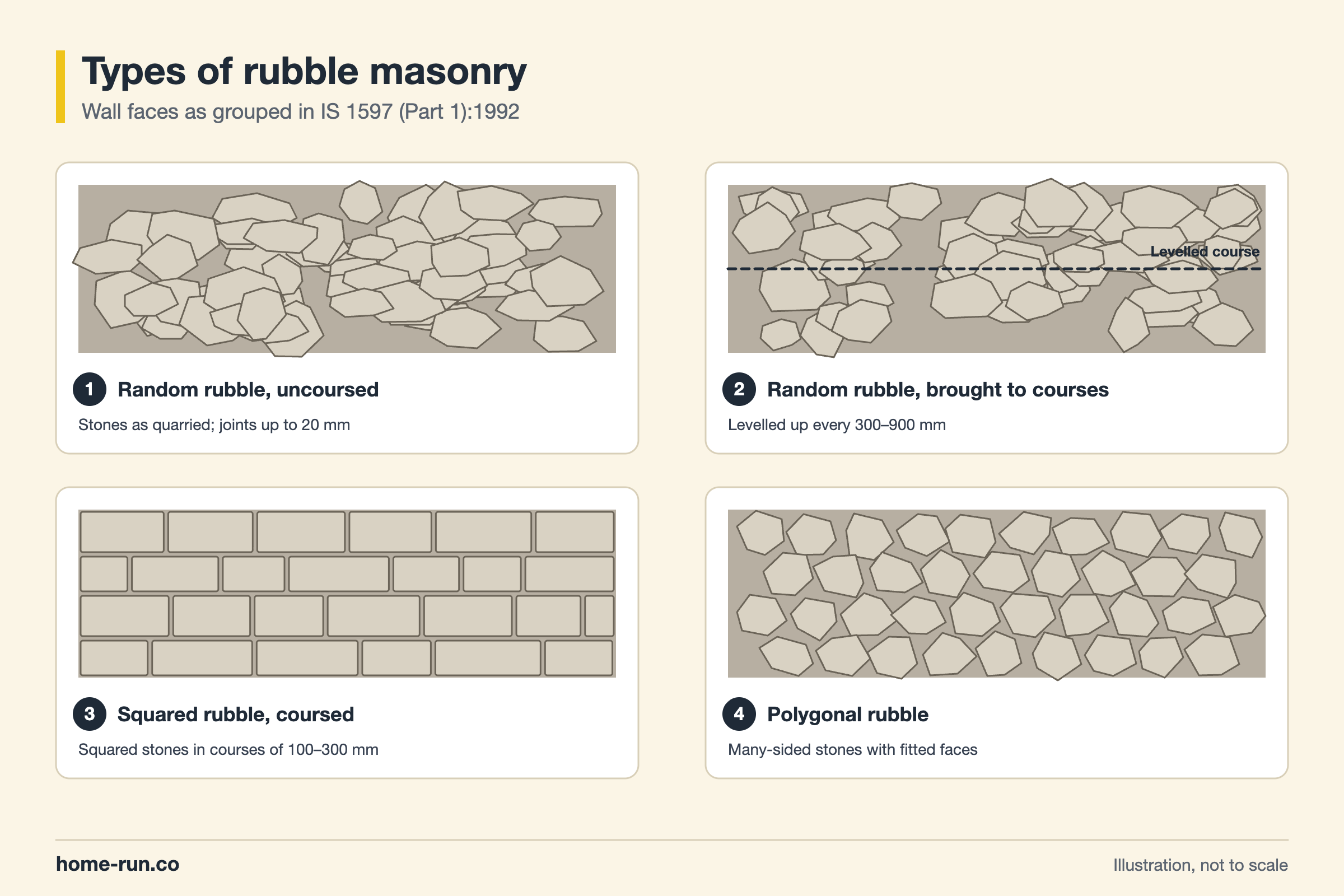
Rubble masonry types under IS 1597 (Part 1)
Course heights from the code| Type | How stones are laid | Course height |
|---|---|---|
| Random rubble, uncoursed | As quarried | No courses |
| Random rubble, brought to courses | Levelled up at intervals | 300–900 mm |
| Squared rubble, uncoursed | Squared, no courses | No courses |
| Squared rubble, brought to courses | Squared, levelled at intervals | 300–900 mm |
| Squared rubble, coursed First and second sort | Squared, in regular courses | 100–300 mm |
| Polygonal rubble | Many-sided, fitted faces | No courses |
Outside the code, flint rubble uses flint nodules and dry rubble uses no mortar, for low walls.
Random rubble vs coursed rubble
Random rubble
Foundations, wallsPoint
- Stones used as quarried
- Joints up to 20 mm
- Little dressing, lower labour
- Usually plastered or pointed
Coursed rubble
Exposed facesPoint
- Stones squared to shape
- Joints up to 10 mm
- More dressing, skilled masons
- Neater face, left exposed
What Properties Should Rubble Stone Have?
Rubble stone must be hard, sound and durable, and IS 1597 (Part 1) sets a minimum crushing strength for each stone. Water absorption should generally stay at or below 5%.
Minimum crushing strength of stone for rubble masonry
IS 1597 (Part 1), Table 1| Stone | Minimum strength |
|---|---|
| Granite | 100 N/mm² |
| Marble | 50 N/mm² |
| Basalt | 40 N/mm² |
| Sandstone | 30 N/mm² |
| Limestone | 20 N/mm² |
| Laterite | 3 N/mm² |
- Length: up to three times the height.
- Base breadth: 150 mm to three-quarters of wall thickness.
- Height: up to 300 mm.
Where Is Rubble Stone Masonry Used in India?
Rubble stone masonry is used most in foundations, plinths, compound walls, retaining walls and rural load-bearing homes where stone is local.
- Foundations and plinths: random rubble in cement mortar.
- Boundary and retaining walls: see our boundary wall design guide.
- Rural housing: stone homes are still built in Himachal Pradesh, Maharashtra and Gujarat.
Rubble houses failed widely at Killari (1993), Bhuj (2001) and in Nepal's 2015 Gorkha earthquake, where walls split into two layers.
In Zone V areas such as the Kashmir Valley, IITK-BMTPC guidance asks for through-stones every 600 mm of height, 1:6 cement mortar or richer and two storeys at most. The zone map in force is IS 1893 (Part 1):2016; BIS withdrew the 2025 revision, which had added a Zone VI, in March 2026.
What Are the Pros and Cons of Rough Stone Walls?
Rubble masonry is cheap and durable, but heavy and weak in earthquakes when badly bonded.
- Local material: uses quarry stone with little cutting.
- Strength: granite rubble carries heavy compressive loads.
- Weight: thick walls take more floor area than brick bond walls.
- Seismic risk: walls without through-stones can split apart.
Building a stone foundation or wall?
Cement, sand and steel delivered across Bengaluru.
How Do You Maintain and Repair Stone Walls?
Stone walls last longest when joints stay sealed and water drains away. Check them before each monsoon.
- Rake out and repoint loose or eroded joints.
- Match the repair mortar to the original, using lime mortar on lime walls.
- Keep weep holes in retaining walls clear.
- Ask an engineer to set wall thickness and bond stones.