On this page
- What Are the Main Types of Faucets?
- What Are the Parts of a Faucet?
- Which Faucet Handle Types Are There?
- What Are the Four Types of Faucet Valves?
- Which Faucet Material Suits Indian Water?
- Which Types of Faucets Should You Choose?
- How Do You Install a Faucet?
- How Much Does a Faucet Cost in India?
- The main types of faucets are sink mixers, basin taps, bib taps, health faucets, shower mixers, sensor and push taps.
- Inside, every tap uses one of four valves: compression, ball, cartridge or ceramic disc.
- Brass suits hot and cold lines; PTMT plastic taps suit cold water and hard water at a lower price.
- Seal threads with PTFE tape and keep an angle valve below each tap.
The main types of faucets are grouped three ways: by where they go (kitchen, basin, shower, garden), by how you operate them (lever, knob, push, sensor) and by the valve inside (compression, ball, cartridge, ceramic disc).
Below: parts, types, materials, installation and prices. For other bathroom fittings, see our plumbing fixtures guide.
What Are the Main Types of Faucets?
The main types of faucets in Indian homes are named by where they are fitted. Kitchen and bathroom taps differ mostly in spout height and mounting.
Different types of faucets for kitchen and bathroom
Where each one fits| Faucet | What it is | Used at |
|---|---|---|
| Sink mixer Kitchen default | Tall swivel spout; some pull out | Kitchen sink |
| Pillar tap | Single tap standing on the basin deck | Wash basin |
| Basin mixer | One spout mixing hot and cold | Wash basin, countertop basin |
| Bib tap (bib cock) | Wall tap, horizontal inlet | Bathroom, utility, garden |
| Health faucet | Hand spray on a hose | Beside the WC |
| Shower mixer | Wall mixer, often with a diverter | Shower area, bathtub |
| Concealed stop valve | Valve hidden in the wall | Bathroom inlet, shower line |
| Sensor faucet Touchless | Sensor opens and closes the flow | Basins, offices, public toilets |
| Push (pressmatic) tap | Press to open, shuts by itself | Public and office washrooms |
A tip-ton spout is a bath spout with a small button you lift or press to send water from the spout up to a hand shower. It is a simple two-way diverter; our guide to diverter valve types covers concealed and multi-way versions.
What Are the Parts of a Faucet?
A faucet has six main parts: body, spout, handle, valve, aerator and inlet. The valve wears first, so it decides how long the tap lasts.
- Body: brass, stainless steel, zinc alloy or PTMT shell.
- Spout: fixed, swivel or pull-out.
- Handle: lever, cross knob, push button or none (sensor).
- Valve: washer, ball or cartridge that opens and mixes flow.
- Aerator: mesh tip that adds air and cuts flow.
- Inlet and seals: threaded tail, O-rings and hose.
Which Faucet Handle Types Are There?
Faucet handles come in five common designs, and each sets how easily you control flow and temperature.
- Single lever: sets flow and temperature on a mixer.
- Double handle: separate hot and cold knobs.
- Quarter turn: a 90° turn opens the tap fully; easy for weak grips.
- Push button: self-closing, usually cold water only.
- Sensor: touchless; needs batteries or power.
A cross-knob tap can hide a ceramic disc and a lever can hide a cartridge, so ask what valve sits inside.
What Are the Four Types of Faucet Valves?
The four types of faucet valves are compression, ball, cartridge and ceramic disc. Compression valves use a rubber washer; the other three are washerless.
Types of faucet valves compared
What wears and how to repair it| Valve | How it works | What wears | Repair |
|---|---|---|---|
| Compression | Screw-down spindle presses a washer onto a seat | Rubber washer, seat | Change the washer |
| Ball | A slotted ball rotates to line up hot and cold ports | Rubber seats, springs, O-rings | Seat and spring kit |
| Cartridge | A stem turns or lifts inside a sleeve to open the ports | O-rings, then the cartridge | Swap the cartridge |
| Ceramic disc Longest life | Two hard ceramic discs slide to align their openings | Seals; discs rarely | Swap the disc cartridge |
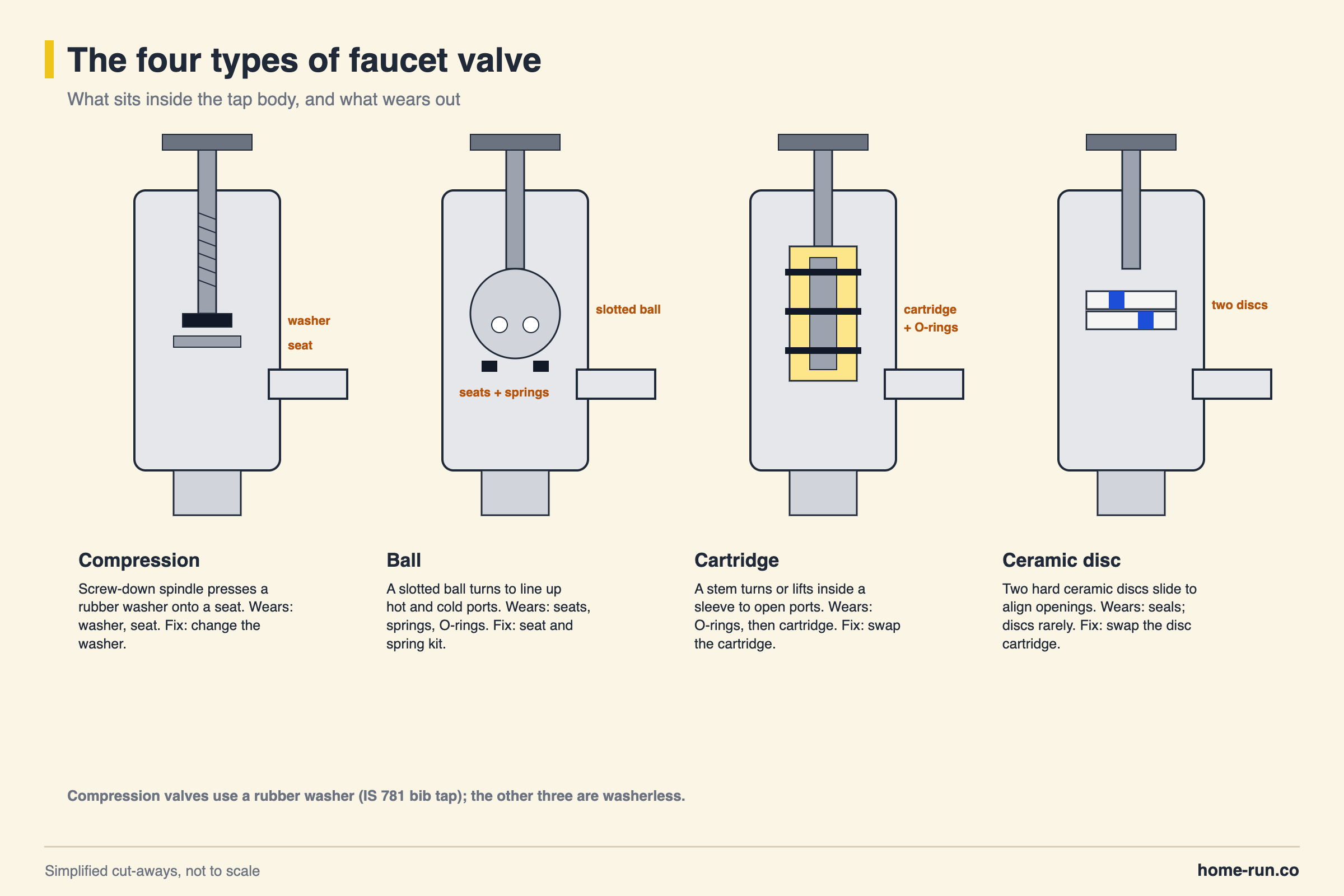
Quarter-turn taps use ceramic discs, as Jaquar describes them. Fine Homebuilding rates the ceramic disc as the longest-lasting and most leak-proof design, and the ball valve as the one needing the most upkeep.
Which Faucet Material Suits Indian Water?
Brass is the best all-round faucet material, stainless steel suits hard water, and PTMT suits cold-water points on a budget. Zinc alloy costs less but corrodes faster.
Faucet materials compared
Body material and finish| Material | Hot water | Strength | Watch for |
|---|---|---|---|
| Brass, chrome plated Default pick | Yes | Heavy, long life | Unmarked, very light castings |
| Stainless steel | Yes | Resists mineral corrosion, no plating to peel | Fewer designs, higher price |
| PTMT (plastic) Cold points | Check the rating | Does not rust or scale | Threads crack if over-tightened |
| Zinc alloy Avoid | Yes | Cheap, lighter | Corrodes once plating wears |
PTMT (polytetramethylene terephthalate) is an engineering plastic also called PBT. IS 9763, the Indian Standard for plastic bib taps, pillar taps and stop valves, lists PBT as a body material.
Bengaluru homes mixing BWSSB and borewell water see more scaling, so a good chrome finish and ceramic cartridge pay off.
Use brass or stainless steel wherever a geyser line connects. Use PTMT only on cold-water points such as garden, utility and washing machine taps.
Which Types of Faucets Should You Choose?
Choose faucets by the point they serve, then by valve, material and budget. Mixers suit hot and cold points; simple taps suit cold-only points.
Single-lever mixer
Hot and cold pointsPoints
- One lever sets flow and temperature
- Ceramic cartridge, no washers
- Needs both hot and cold supply lines
- Kitchen sink, basin, shower
Single tap (pillar or bib)
Cold-only pointsPoints
- One handle, one water line
- Quarter-turn or screw-down valve
- Lowest cost, PTMT or brass
- Utility, garden, washing machine
- Water pressure: homes on low-pressure overhead tank supply should check the minimum working pressure on the box, especially for sensor taps and rain showers.
- Water saving: BWSSB's aerator drive cut tap flow from 8–12 L/min to about 3 L/min. See our guide to water-efficient fixtures for star ratings.
Changing taps this week?
Taps, fittings and plumbing hardware delivered across Bengaluru.
How Do You Install a Faucet?
You install a faucet by shutting the supply, sealing the threads with PTFE (Teflon) tape and tightening the tap until snug and upright. Mixers also need two hoses to angle valves.
- Shut off and drain. Close the angle or stop valve and open the old tap.
- Remove the old tap. Unscrew it and clean old tape off the wall thread.
- Wrap the thread. Wind PTFE tape clockwise, the way the fitting tightens, so it does not unwind.
- Fit the tap. Hand-tighten, then finish with a cloth-wrapped spanner.
- Connect mixers. Fix the backnut under the basin and join the hoses to the angle valves.
- Test. Open the supply slowly and recheck joints after an hour.
Concealed diverters and wall mixers must be set to the right depth before tiling. Our bathroom plumbing guide lists rough-in heights for each fitting.
How to keep faucets working
- Unscrew and rinse the aerator every month or two in hard-water areas.
- Fix a drip early: a washer on compression taps, a cartridge on mixers.
- Close and reopen angle valves twice a year so they do not seize.
How Much Does a Faucet Cost in India?
A basic faucet in India costs a few hundred rupees for PTMT and roughly ₹700 to ₹2,400 for branded brass taps, going by one brand's online list prices. Mixers, sensor taps and designer finishes cost several times more.
Example faucet prices from one Indian brand
MRP incl. taxes, Ruhe website, checked Nov 2026| Faucet | Material | MRP (₹) |
|---|---|---|
| Round push tap Budget | PTMT | 520 |
| Square push tap | Brass, chrome | 697 |
| Nozzle bib tap, quarter turn | Brass, ceramic cartridge | 2,097 |
| Bath spout with tip-ton | Brass | 2,368 |
Plumber charges vary, so get a quote that includes removing the old tap and new hoses.