On this page
- What Are Water-Efficient Fixtures?
- Which Water-Saving Taps, Showers and Toilets Are Sold in India?
- What Do India's Star Ratings for Fixtures Mean?
- What Are the Benefits of Water Efficient Fixtures?
- What Did Bengaluru's Aerator Drive Achieve?
- How Do You Choose Water Efficient Fixtures for Your Home?
- What Stops Homeowners From Switching?
- How Do You Upgrade Your Home's Fittings Step by Step?
- Water efficient fixtures cut the litres per minute or per flush while keeping the fixture usable.
- The main types are aerated taps, low-flow showers, dual-flush toilets, sensor taps and flow restrictors.
- India's BIS standard IS 17650: 2021 sets 1 to 3 star limits; 3 star is the most efficient.
- Bengaluru's water board, BWSSB, made aerators compulsory for apartments and businesses in March 2024.
- Check your water pressure before you buy: low-flow fittings behave differently on gravity tanks and pressure pumps.
Water efficient fixtures are taps, showers, toilets and urinals built to use less water for the same task. They work by mixing air into the stream, limiting the flow rate or reducing the flush volume.
In India, the Bureau of Indian Standards (BIS) now rates these fixtures from 1 to 3 stars. This guide explains each type, the rated limits, what you can save and how to choose.
What Are Water-Efficient Fixtures?
A water-efficient fixture is a plumbing fitting that delivers a set task with a lower, controlled volume of water. Flow rate is measured in litres per minute (L/min) for taps and showers, and litres per flush for toilets.
Water efficient fixtures matter because fixtures use a large share of a building's water. The Centre for Science and Environment (CSE), a Delhi-based research body, says toilet and kitchen fixtures use more than 40% of total building water.
- Aerator: a small mesh insert at the tap mouth that mixes air with water, so the stream feels full at a lower flow.
- Flow restrictor (flow regulator): a disc or insert that caps the litres per minute, whatever the supply pressure.
- Dual flush: a cistern with two buttons, a full flush for solids and a reduced flush for liquids.
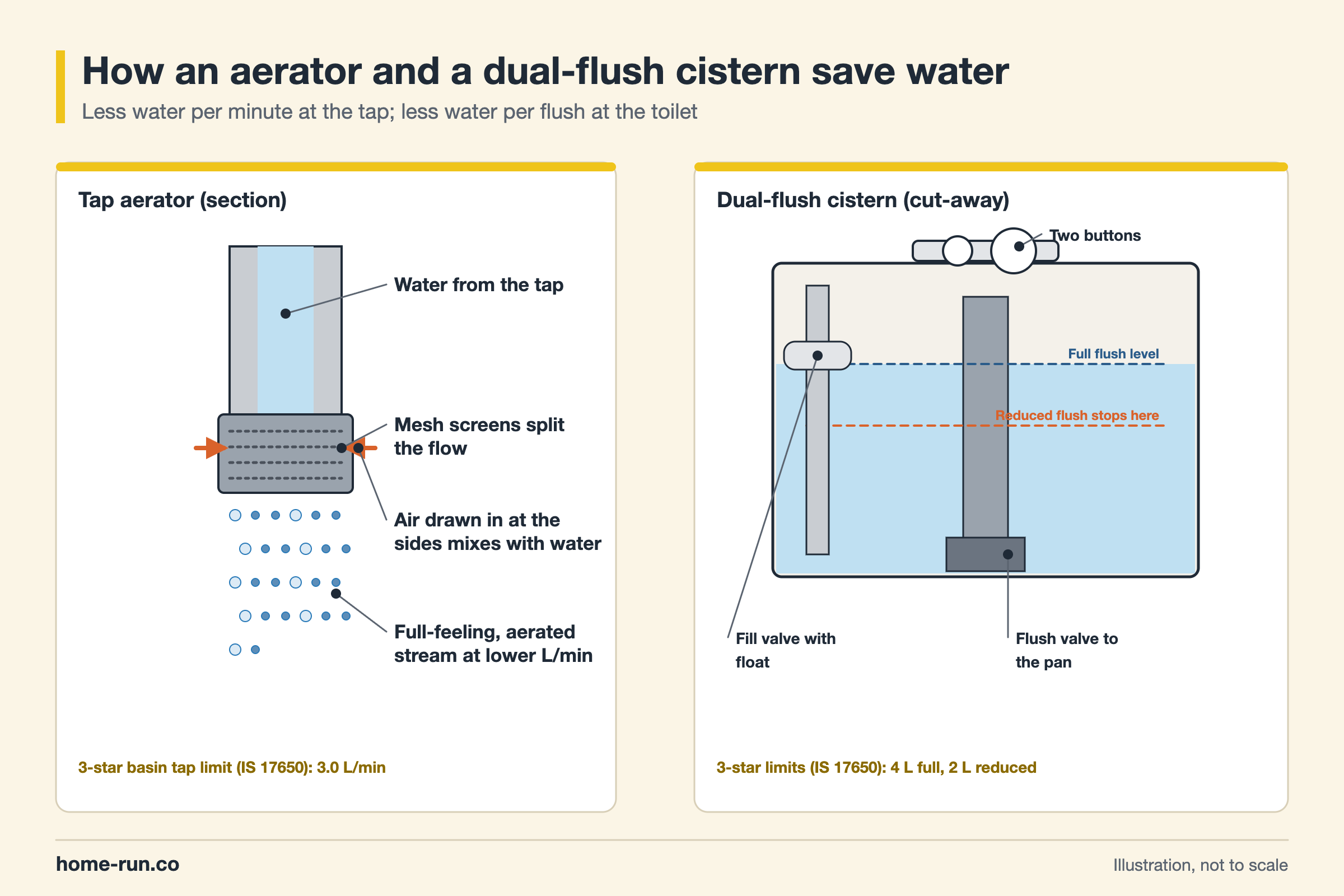
A cheap restrictor can cut flow so far that you rinse for longer and save nothing. A good efficient fixture keeps the spray, rinse or flush working at the lower volume.
Which Water-Saving Taps, Showers and Toilets Are Sold in India?
The main water efficient fixtures in India are aerated taps, low-flow showers, dual-flush toilets, sensor and metering taps, and add-on flow restrictors. Several Indian sanitaryware brands sell rated versions.
Types of water efficient plumbing fixtures in India
How each one saves water| Fixture | How it saves water | Best for |
|---|---|---|
| Tap aerator Easiest upgrade | Mixes air into the stream at the spout | Basin and kitchen taps, existing homes |
| Flow restrictor | Caps flow at a set L/min | Showers and taps on pressure pumps |
| Low-flow shower | Smaller nozzles and air induction | Overhead and hand showers |
| Dual-flush toilet New bathrooms | Two flush volumes for solids and liquids | New builds and toilet replacements |
| Sensor tap | Runs only while hands are under it | Busy basins, offices, common areas |
| Metering (push) tap | Releases a fixed dose, then shuts | Public and shared washrooms |
| Waterless urinal | Uses a trap seal in place of a flush | Offices, schools, malls |
For a wider look at taps, traps and sanitaryware, see our plumbing fixtures guide.
What Do India's Star Ratings for Fixtures Mean?
India's star ratings for water efficient fixtures come from IS 17650, the BIS standard for water efficient plumbing products. Part 1 covers sanitary ware such as toilets and urinals, and Part 2 covers sanitary fittings such as taps and showers.
Maximum flow and flush limits by star rating
IS 17650 (Parts 1 and 2): 2021| Fixture | 1 star | 2 star | 3 star |
|---|---|---|---|
| Toilet, full flush (L) | 6 | 4.8 | 4 |
| Toilet, reduced flush (L) | 3 | 2.8 | 2 |
| Urinal (L per flush) | 3 | 2 | 1 |
| Basin tap, incl. sensor (L/min) | 8.0 | 6.0 | 3.0 |
| Kitchen sink tap (L/min) | 8.0 | 6.0 | 4.5 |
| Overhead shower (L/min) | 10.0 | 8.0 | 6.8 |
| Hand shower (L/min) | 8.0 | 6.0 | 4.0 |
| Health faucet / ablution spray (L/min) | 6.0 | 5.0 | 4.0 |
| Metering basin tap (L per use) | 1.0 | 0.8 | 0.6 |
MoHUA launched these rated fixtures under its "Bharat Tap" initiative in May 2022. Two other labels also appear on Indian products:
- WEP-I (Water Efficient Products India): a voluntary label run by IAPMO India and the Indian Plumbing Association, adopted in 2011 and revised in 2017.
- WaterSense: a US Environmental Protection Agency (EPA) label. WaterSense toilets use 1.28 gallons (about 4.8 L) per flush or less, and WaterSense showerheads 2.0 gallons per minute (about 7.6 L/min) or less.
Green building rating systems such as IGBC (Indian Green Building Council) and GRIHA also award points for efficient fixtures in certified projects.
What Are the Benefits of Water Efficient Fixtures?
The main benefits of water efficient fixtures are lower water use, smaller water and power bills, and less pressure on tankers, borewells and city supply. Savings depend on how often each fixture runs and on your supply pressure.
- Less water drawn: a 3-star basin tap is capped at 3.0 L/min, against 8.0 L/min at 1 star.
- Lower energy use: less water to pump to the overhead tank and less hot water to heat in a geyser.
- Longer-lasting sump and borewell water: useful in summer when Bengaluru homes rely on tankers.
- Points in green ratings: efficient fixtures count towards IGBC and GRIHA water credits.
Maker and agency claims vary widely. The MoHUA manual says aerators can save "up to 80%", and Kohler India says WaterSense-certified taps use up to 30% less than standard models. Treat these as upper limits, and check your own meter or bill after the change.
The usage times and flush counts above are assumptions for illustration. The flow limits are the IS 17650 maximums, so real savings will be lower if your current fittings already run below 1-star flow.
Upgrade the fixture that runs longest first. In most homes that is the shower, then the kitchen tap, then the toilet.
Efficient fixtures cut demand; collecting rain adds supply. Pair them with rainwater harvesting, which BWSSB already requires on many Bengaluru plots.
What Did Bengaluru's Aerator Drive Achieve?
Bengaluru's aerator drive is the largest Indian example of water efficient fixtures at city scale. BWSSB (Bangalore Water Supply and Sewerage Board) ordered aerators during the March 2024 water crisis.
- March 2024: BWSSB made aerators mandatory on public taps and told apartment complexes, restaurants, industries and commercial buildings to fit them.
- Penalty: Deccan Herald reported on 28 March 2024 a ₹5,000 fine and a 50% supply cut for establishments that did not comply. The deadline was later extended.
- October 2025: BWSSB said about 15 lakh taps now carry aerators, saving nearly 10 crore litres a day, about 5% of the city's daily supply.
The order covered apartments and businesses, not individual houses. Independent houses can still fit aerators by choice, and BWSSB has urged households to do so.
Many hotels and businesses had still not fitted aerators by late 2025. Rules help, but the savings came from simple, cheap fittings that people actually installed.
How Do You Choose Water Efficient Fixtures for Your Home?
Choose water efficient fixtures by matching the star rating to your water pressure, your plumbing and how each fixture is used. Start with the rating label, then check fit and build quality.
- Look for an IS 17650 star rating or a WEP-I label on the box or spec sheet.
- Check the rated flow and the test pressure in the maker's data sheet.
- Match aerator thread size and type (male or female) to your existing tap.
- For a new toilet, confirm the outlet type (P-trap or S-trap) and rough-in distance.
- Choose ceramic disc cartridges and solid brass bodies; they leak less over time.
- Keep the receipt and warranty card for cartridges and flush valves.
Water-efficient fixtures
RecommendedPoint
- Rated flow, for example 3.0 to 6.0 L/min at a basin
- Dual flush, 4 L full and 2 L reduced at 3 star
- Aerated stream feels full at low flow
- Higher upfront price for rated models
Traditional fixtures
Uses more waterPoint
- Flow set by supply pressure, often uncapped
- Single flush on older cisterns
- Splashes more on pressure pump lines
- Lower purchase price
Upgrading your bathroom fittings?
Taps, showers, sanitaryware and plumbing fittings delivered across Bengaluru.
What Stops Homeowners From Switching?
The main barriers to water-efficient fixtures are upfront cost, low awareness of ratings and fit problems with old plumbing. Most have simple fixes.
- Cost: start with aerators and shower restrictors, which fit existing taps. Replace toilets only at renovation time.
- Awareness: many buyers do not know star ratings exist. Ask the dealer for the IS 17650 or WEP-I rating in writing.
- Old plumbing: non-standard threads and wall-mounted cisterns may need adapters or a plumber.
- Hard water: borewell water clogs aerator mesh with scale, so plan to clean it.
If a tap feels weak, clean the aerator before you remove it. Removing the insert brings back full flow and wastes the saving. Persistent weak flow points to low pressure or a blocked line.
How Do You Upgrade Your Home's Fittings Step by Step?
You install water-efficient fixtures by auditing current fittings, buying rated replacements and fitting the simple parts yourself. Call a plumber for toilets and concealed valves.
- List every fixture. Note each tap, shower and toilet, and time how long a 1-litre bottle takes to fill at each.
- Work out the flow. 60 divided by the seconds to fill 1 litre gives L/min. Compare it with the star table.
- Start with aerators. Unscrew the old spout insert by hand, clean the thread and screw in the new aerator.
- Swap shower heads. Wrap PTFE tape on the arm thread and fit the rated head hand-tight.
- Plan toilets with a plumber. A dual-flush cistern or new WC needs the right outlet and a leak test.
- Check after a month. Compare your water meter or tanker count with the month before.