On this page
- PVC doors are plastic, with no wood inside.
- Most are hollow-ribbed; heavier ones are foam-filled.
- They suit bathrooms and wet rooms, not main entrances.
- Most list at ₹1,000–5,500, often without frame.
PVC doors are door leaves moulded or extruded from rigid polyvinyl chloride (PVC), a hard plastic. With no wood inside, they do not swell, rot or attract termites, which makes them a low-cost bathroom choice.
What Are PVC Doors and How Do They Differ from UPVC, WPC and FRP?
A PVC door is an all-plastic leaf; sellers often confuse it with three look-alikes.
PVC and look-alike door materials
Check construction| Material | Made of | Typical use |
|---|---|---|
| PVC Budget wet rooms | Moulded PVC, hollow or foamed | Bathrooms, toilets |
| UPVC | Unplasticised PVC profiles, often steel-reinforced | Balcony doors, windows |
| WPC | Wood fibre bonded with plastic | Bathrooms, door frames |
| FRP | Glass-fibre-reinforced resin | Heavy-use wet areas |
How Are PVC Doors Constructed?
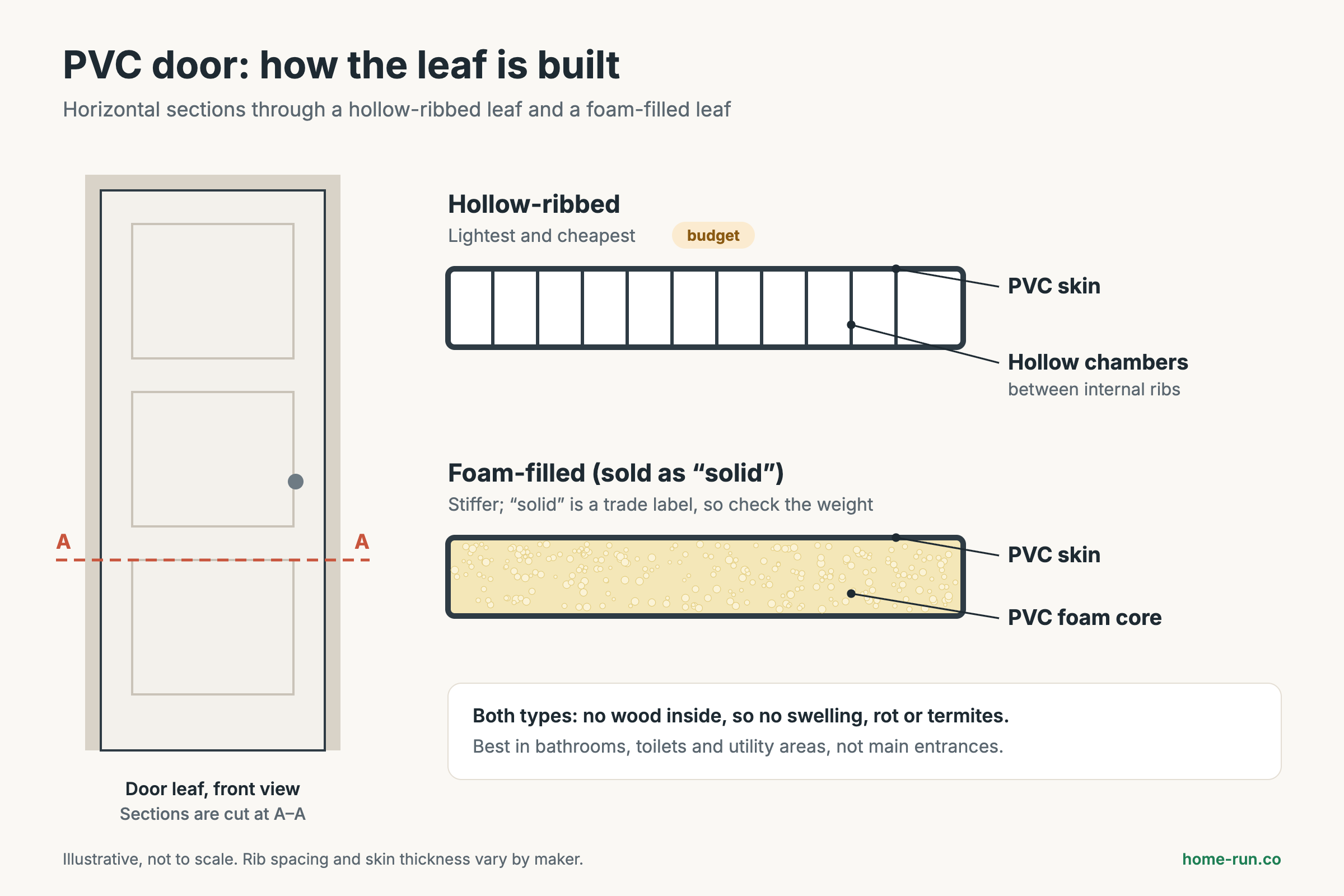
A PVC door is a plastic skin over hollow ribbed chambers or PVC foam.
- Hollow-ribbed: lightest and cheapest.
- Foam-filled ("solid"): stiffer; "solid" is a trade label, so check weight.
- Faces: flush, panel, fluted or printed.
What Are the Advantages and Limits?
PVC doors resist water and termites, cost little and clean easily.
- No swelling in wet rooms
- No polish or paint; wipe with mild soap
- Hollow doors flex and hold screws weakly
- Rigid PVC distorts near 62–65 °C; avoid sun-baked exteriors
Where Should You Use PVC Doors at Home?
PVC doors suit damp interior rooms that need privacy, not security.
- Best: bathrooms, toilets, utility areas.
- Good: covered balconies, store rooms, cupboards.
- Avoid: main entrances and fire-rated doorways.
For balconies, compare aluminium door systems; for cabinets, see MDF board types.
What Sizes and Prices Should You Expect?
Bathroom PVC doors are usually 6–7 ft high and 2–3 ft wide, such as 1980 × 660 mm. Most IndiaMART listings (November 2026) sit at ₹1,000–5,500 each.
Frame, hinges and fitting are often extra, so confirm what each quote includes.
Fitting a bathroom door?
Hinges, locks and screws delivered in Bengaluru.