On this page
- What Is Conduit Wiring, and How Are Its Types Grouped?
- What Are the Types of Conduit Wiring by Material?
- How Does IS 9537 Classify Conduit Types?
- Flexible vs Rigid Conduit: Which Should You Use?
- What Are the Advantages and Disadvantages of Conduit Wiring?
- Where Is Each Type of Conduit Wiring Used?
- What Should You Check When Installing Each Conduit Type?
- How Do You Choose the Right Type of Conduit?
- What Are the Next Steps for Your Conduit Wiring Project?
- The main types of conduit wiring are rigid PVC, rigid steel, flexible and liquid-tight conduit.
- Rigid PVC comes in LMS, MMS and HMS grades; use HMS inside RCC slabs.
- Conduit size is the outside diameter, so a thicker wall leaves less room for wires.
- Metal conduit must be earthed; PVC needs an earth wire run inside it.
- Use flexible conduit only for short final links to motors and fittings.
The types of conduit wiring are grouped by conduit material and stiffness: rigid PVC, rigid steel, flexible (PVC or metal) and liquid-tight flexible conduit. Each type suits a different place, from RCC slabs to pump connections.
This guide compares the types side by side. For the basics of surface and concealed systems, read conduit wiring explained.
What Is Conduit Wiring, and How Are Its Types Grouped?
Conduit wiring is a wiring method in which insulated wires run inside a protective tube called a conduit. The conduit shields the wires from impact, moisture and fire, and lets you pull wires out later.
Conduit wiring types are grouped in two ways:
- By installation method: concealed conduit wiring (hidden in walls and slabs) or surface conduit wiring (fixed on the wall face).
- By conduit material: insulating (PVC) or metal (steel, aluminium), and rigid or flexible.
Concealed conduit means the pipe sits inside a chase or slab and is plastered over. Most new homes in Bengaluru use concealed rigid PVC conduit. This article focuses on the material types.
What Are the Types of Conduit Wiring by Material?
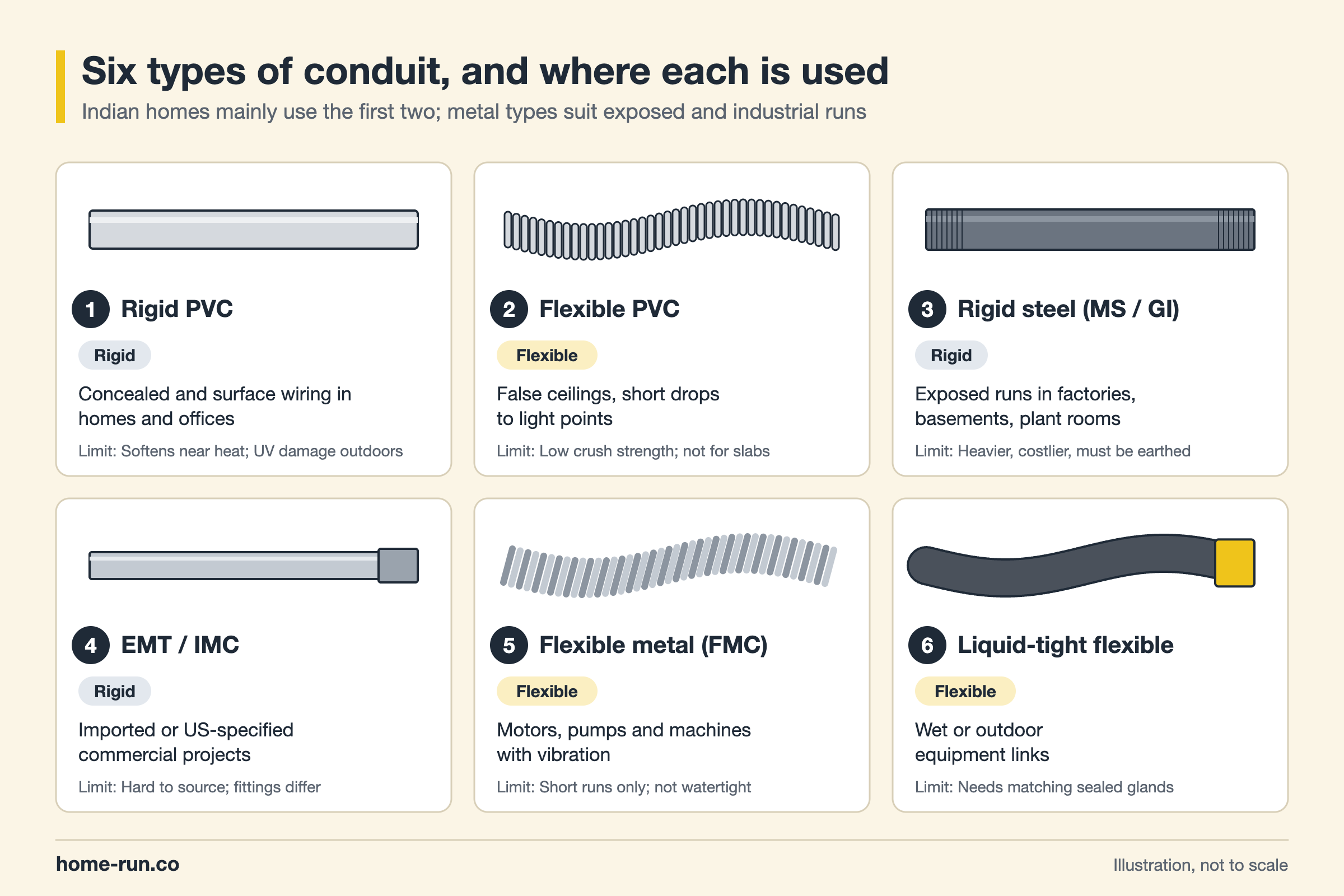
There are six common types of conduit for electrical wiring. Indian homes mainly use the first two; the metal types appear in factories, basements and plant rooms.
1. Rigid PVC conduit
Rigid PVC (polyvinyl chloride) conduit is a straight, non-conducting plastic pipe, usually sold in 3 m lengths. It is light, rust-free and low cost. Bend it with a bending spring or use factory bends.
2. Flexible PVC conduit
Flexible PVC conduit is a corrugated plastic pipe that bends by hand. Electricians use it in false ceilings and for short drops to light points.
3. Rigid steel conduit (RMC, MS or GI)
Rigid metal conduit (RMC) is a thick-walled, threaded steel pipe. In India it is sold as black-enamelled mild steel (MS) or galvanised iron (GI). It gives the highest impact protection and fire resistance.
4. EMT and IMC
Electrical metallic tubing (EMT) is a thin-walled steel tube joined with set-screw or compression fittings, not threads. Intermediate metal conduit (IMC) sits between EMT and RMC in wall thickness. Both are common under the US National Electrical Code (NEC) but uncommon on Indian sites.
5. Flexible metal conduit (FMC)
Flexible metal conduit is a spiral of interlocked steel or aluminium strip. FMC absorbs vibration, so it suits the last metre to motors, pumps and machines.
6. Liquid-tight flexible conduit
Liquid-tight flexible conduit is FMC (or a non-metallic core) with an outer PVC jacket. Use it outdoors and in wet areas such as pump rooms, terraces and car washes.
Types of conduit wiring compared
Typical uses in Indian buildings| Conduit type | Stiffness | Best for | Main limit |
|---|---|---|---|
| Rigid PVC Default pick | Rigid | Concealed and surface wiring in homes and offices | Softens near heat; UV damage outdoors unless rated |
| Flexible PVC | Flexible | False ceilings, short drops to lights | Low crush strength; not for slabs |
| Rigid steel (MS/GI) Industrial | Rigid | Exposed runs in factories, basements, plant rooms | Costlier, heavier, must be earthed, can corrode |
| EMT / IMC Rare locally | Rigid | Imported or US-specified commercial projects | Hard to source; fittings differ from Indian stock |
| Flexible metal (FMC) | Flexible | Motors, pumps, machines with vibration | Short runs only; not watertight |
| Liquid-tight flexible | Flexible | Wet or outdoor equipment links | Needs matching sealed glands |
Which rigid PVC grade should you use?
Rigid PVC conduit comes in three mechanical-stress grades: light (LMS), medium (MMS) and heavy (HMS). A higher grade has a thicker wall and higher crush resistance.
Minimum wall thickness of rigid PVC conduit
mm, manufacturer data citing IS 9537 Part 3| Nominal size | LMS | MMS | HMS |
|---|---|---|---|
| 20 mm | 1.0 | 1.4 | 1.8 |
| 25 mm | 1.1 | 1.5 | 1.9 |
| 32 mm | 1.2 | 1.6 | 2.1 |
How Does IS 9537 Classify Conduit Types?
IS 9537, the Bureau of Indian Standards (BIS) specification for conduits for electrical installations, splits conduits into parts by material and stiffness.
IS 9537 parts and the conduit type each covers
BIS listing, checked 16 Nov 2026| Part | Covers | Year |
|---|---|---|
| Part 1 | General requirements for all conduits | 1980 |
| Part 2 | Rigid steel conduits | 1981 |
| Part 3 | Rigid plain conduits of insulating material (rigid PVC) | 1983 |
| Part 4 | Pliable self-recovering conduits of insulating material | 1983 |
| Part 5 | Pliable conduits of insulating material | 2000 |
| Part 6 | Pliable conduits of metal or composite material | 2000 |
| Part 8 | Rigid non-threadable aluminium alloy conduits | 2003 |
IS 9537 Part 2 grades steel conduit by mechanical stress (very light to very heavy) and by corrosion protection class. Ask for the ISI mark and the part number on the pipe.
Flexible vs Rigid Conduit: Which Should You Use?
Use rigid conduit for every main run in walls, slabs and exposed routes. Use flexible conduit only for short final connections where the route moves, vibrates or twists.
Rigid conduit
Main runsRigid PVC, MS, GI, EMT.
- Holds its line inside slabs and chases
- Higher crush and impact resistance
- Wires pull through smooth bores easily
- Needs bends, couplers and a bending spring
Flexible conduit
Final linksCorrugated PVC, FMC, liquid-tight.
- Bends by hand around beams and ducts
- Absorbs motor and pump vibration
- Ribbed bore adds pulling friction
- Weaker under concrete and foot traffic
For example, run rigid HMS PVC through the terrace slab to the pump room. Then finish the last metre to the pump motor in liquid-tight flexible conduit.
Choose PVC for homes, wet walls and anything plastered over. Choose steel where pipes stay exposed to knocks, heat or fire risk, such as basements, workshops and lift rooms.
What Are the Advantages and Disadvantages of Conduit Wiring?
Conduit wiring protects wires and makes rewiring possible without breaking walls. The trade-offs are higher material cost and slower installation than open or casing-capping wiring.
Advantages
- Shields insulation from impact, rodents, moisture and plaster
- Lets you pull out and replace wires through the same pipe
- Reduces fire spread along the cable route
- Concealed conduit keeps walls and ceilings clean
- Steel conduit adds shielding against electromagnetic interference (EMI) when earthed
Disadvantages
- Costs more than open or casing-capping wiring
- Needs planning before plastering; changes later mean chiselling
- Hidden faults are harder to trace without good box placement
- PVC can sag or soften near heat sources
- Unearthed or corroded steel conduit is a shock risk
Where Is Each Type of Conduit Wiring Used?
Each type of conduit wiring fits a specific location. Match the conduit to the hazard at that spot: concrete load, water, heat or vibration.
Conduit type by location
Residential, commercial and industrial| Location | Recommended conduit | Why |
|---|---|---|
| RCC roof and floor slabs | Rigid PVC, HMS | Survives concrete pour and vibrator |
| Brick or block wall chases | Rigid PVC, MMS or HMS | Plastered over, needs moderate strength |
| False ceilings | Rigid or flexible PVC, LMS | No load; easy routing above grid |
| Surface runs in rented homes | Rigid PVC on saddles | No wall cutting; easy to remove |
| Basements, parking, workshops | GI or MS rigid steel | Impact from vehicles and tools |
| Underground garden or gate lights | HMS PVC or GI | Soil load and digging damage |
| Pumps, motors, AC outdoor units | Liquid-tight flexible | Water and vibration at the terminal |
BESCOM has asked for a wiring diagram and a "test report cum completion of wiring" signed by a government-licensed electrical contractor for a new connection (Citizen Matters, 2014). Confirm the current document list with your BESCOM sub-division before you apply.
What Should You Check When Installing Each Conduit Type?
Plan routes, sizes and boxes before the first chase is cut. These checks apply to most types of conduit wiring in a home.
- Mark every switch, socket and light point on the drawing, then plan conduit routes between them. See our types of electrical wiring guide for loop-in and joint-box layouts.
- Use at least 20 mm conduit; move to 25 mm or 32 mm for multi-circuit or main feeder runs.
- Pick the grade: HMS PVC in slabs, MMS or HMS in walls, LMS only on the surface or above ceilings.
- Fix rigid conduit in slabs to the reinforcement before the pour, and cap open ends so slurry cannot enter.
- Fit an inspection or junction box at least every 12 m or after two 90° bends.
- Clip surface conduit with saddles not more than 500 mm apart.
- Leave a draw wire in every concealed conduit, and pull wires only after plastering and curing.
- Run an insulated earth wire (2.5 sq mm or as designed) in each conduit, and bond all steel conduit to earth.
Never join wires inside the conduit or bury a joint in plaster. Make every joint in an accessible box, or a fault will mean breaking the wall.
Why does a thicker conduit hold fewer wires?
Conduit size is the outside diameter, so a heavier grade has a smaller inside bore. Fill limits also vary: the US NEC allows 40% fill for three or more wires, while one Indian specification we checked allows only 30%.
How Do You Choose the Right Type of Conduit?
Choose conduit by location first, then grade, size and budget. Ask four questions:
- Where will the conduit sit? Slab, wall, ceiling, ground or open surface.
- What can damage it? Concrete load, water, heat, vehicles or vibration.
- How many circuits share it? More wires need 25 mm or 32 mm.
- Will you rewire later? Fewer bends and more boxes make rewiring easier.
What Are the Next Steps for Your Conduit Wiring Project?
Your next step is a marked-up electrical drawing that shows conduit routes, sizes and grades. Then list materials and book a licensed electrician before slab casting.
- Finalise point positions with your designer before the slab is cast
- List conduit metres by size and grade, plus bends, couplers and boxes
- Order ISI-marked conduit and fittings from one brand so sizes match
- Photograph conduit routes before plastering for future reference
- Plan wire sizes and circuits with our house electrical wiring guide
Laying conduit this week?
Conduit pipes, fittings and wires delivered across Bengaluru.