On this page
- What Are the Types of Electrical Wiring Used in Indian Homes?
- Cleat, Batten and Casing-Capping: Where Are Older Systems Still Used?
- Which Conduit Wiring Type Suits a Modern Home?
- Tee (Joint Box) System vs Loop-In System: Which Is Better?
- Which Cable Types Go Inside the Wiring System?
- Which Type of Electrical Wiring Suits Which Situation?
- How Do You Plan Circuits and Outlets Before Wiring?
- What Safety Standards Apply to House Wiring in India?
- What Are the Signs of Faulty Wiring?
- Wiring systems decide how cables are fixed: cleat, batten, casing-capping or conduit.
- Connection methods decide how circuits are joined: tee (joint box) or loop-in.
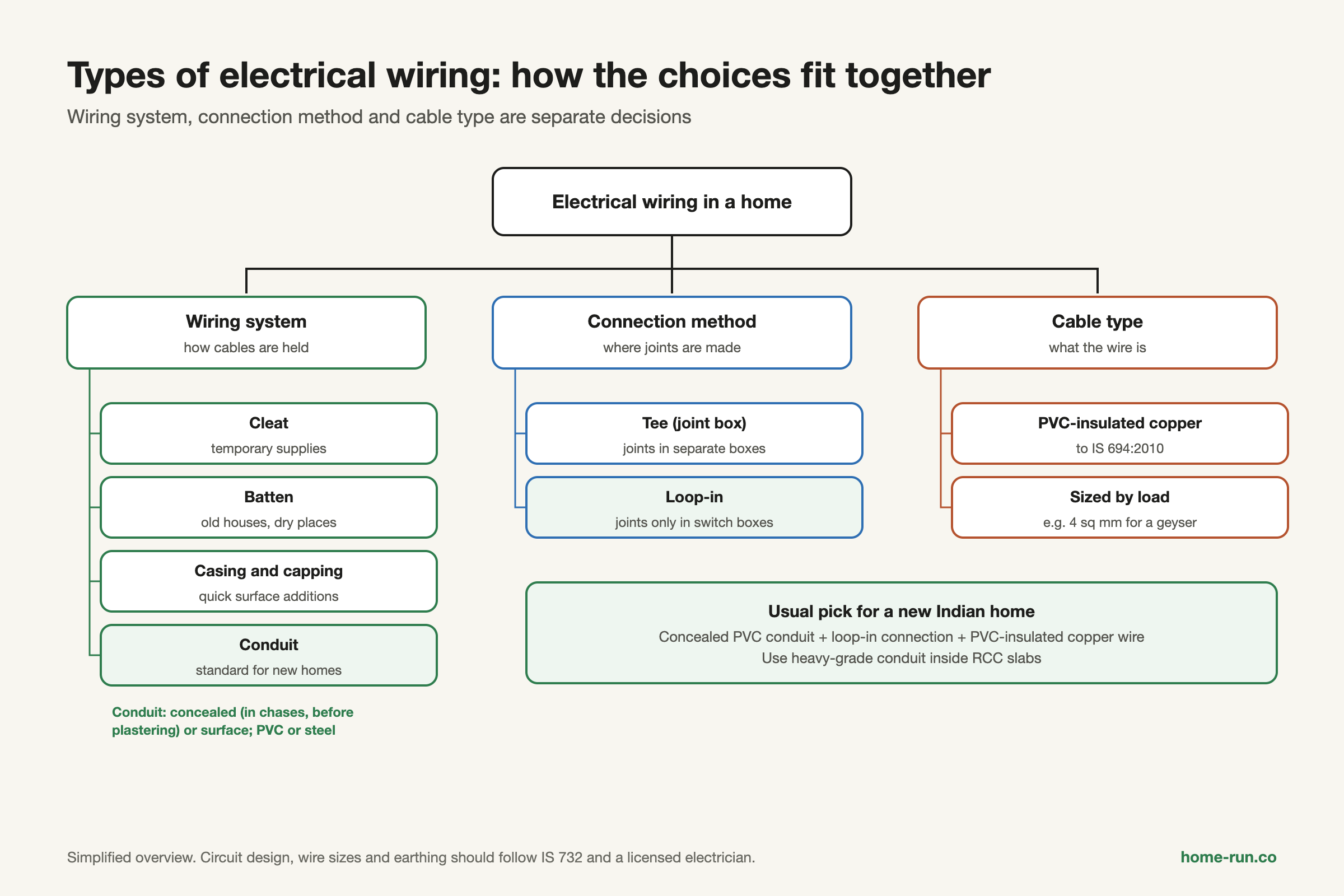
- New Indian homes mostly use concealed PVC conduit with loop-in joints.
- Plan circuits first: a light circuit carries up to 10 points or 800 W, a power circuit up to 2 outlets or 3,000 W.
- Wiring follows IS 732:2019; house wires follow IS 694:2010.
The types of electrical wiring in a house fall into two groups: the wiring system, which is how cables are fixed and protected, and the connection method, which is how circuits branch to each point.
The cable itself (PVC, FR, armoured) is a third, separate choice.
What Are the Types of Electrical Wiring Used in Indian Homes?
Indian buildings use four wiring systems: cleat, batten, casing and capping, and conduit. Each system can be connected by the tee (joint box) method or the loop-in method.
- Wiring system: how cables are held on or inside the wall.
- Connection method: where the joints between cables are made.
- Cable type: what the wire is made of and how it is insulated.
Conduit is the pipe. The copper wires pulled through it are a separate purchase with their own grade and size.
Cleat, Batten and Casing-Capping: Where Are Older Systems Still Used?
Cleat, batten and casing-capping are surface systems that now appear mainly in temporary supplies and old houses.
- Cleat wiring: insulated wires held apart on grooved porcelain or wooden clamps (cleats). It suits temporary supplies such as construction sites.
- Batten wiring: TRS (tough rubber sheathed, also called CTS, cab tyre sheathed) or PVC-sheathed cables clipped to a teak batten. Engineering course notes limit it to below 250 V and dry places.
- Casing and capping: wires laid in the grooves of a wooden or PVC channel (casing) and covered by a lid (capping). PVC versions suit quick surface additions.
Wooden battens and casings absorb damp, attract termites and give rodents an easy path. In an old house with wooden casing, plan a rewire rather than repairs.
Which Conduit Wiring Type Suits a Modern Home?
Concealed PVC conduit is the standard for new homes: pipes are laid in wall chases and slabs before plastering, then wires are pulled through.
Surface conduit, clamped on the wall face, suits retrofits and rented homes. Steel conduit resists crushing; PVC does not rust but needs a separate earth wire.
PVC conduit is graded under IS 9537 (Part 3) as light, medium or heavy mechanical stress (LMS, MMS, HMS). Use heavy grade inside RCC slabs. Our conduit wiring explainer covers fittings, sizes and installation steps.
Tee (Joint Box) System vs Loop-In System: Which Is Better?
The loop-in system is better for homes because every joint sits inside a switch box or fitting, where an electrician can see and test it.
Tee (joint box) system
Older methodBranches spliced off a main cable.
- Joints made in separate junction boxes
- Uses less cable
- Hidden joints are hard to find and inspect
- A loose joint can heat up unseen
Loop-in system
Ask for thisCable runs point to point.
- Joints only at switch and fitting terminals
- Uses more cable
- Faults are faster to trace
- Fewer hidden fire risks
Where a junction box is unavoidable, keep it accessible; see our junction box guide.
Which Cable Types Go Inside the Wiring System?
Most Indian homes use PVC-insulated copper wire to IS 694:2010, the BIS standard for PVC-insulated cables up to 1,100 V, usually in an FR or FR-LSH grade.
Cable types you will hear about
Pick the grade, then the size| Cable | What it is | Use today |
|---|---|---|
| VIR Avoid | Vulcanised India rubber insulation | Obsolete; rubber cracks with age |
| TRS / CTS | Tough rubber sheathed cable | Old batten wiring |
| PVC insulated | Copper conductor, PVC insulation | Standard house wire |
| FR / FR-LSH Default pick | Flame retardant; LSH adds low smoke and halogen | Concealed conduit in homes |
| Armoured | Steel wire or tape layer | Underground feeders, meter to DB |
Typical copper sizes are 1.0–1.5 sq mm for lights and fans, 2.5 sq mm for sockets, 4 sq mm for a geyser and 4–6 sq mm for an AC. These are indicative; your electrician confirms them to IS 732.
Fixed wiring uses red, yellow and blue for phases, black for neutral and green for earth. For sizes by load and colour codes in detail, read our house electrical wiring guide.
Which Type of Electrical Wiring Suits Which Situation?
Concealed conduit suits any new build or full rewire.
Wiring systems compared
Relative ratings, not rates| System | Cost | Safety | Looks | Rewiring | Best for |
|---|---|---|---|---|---|
| Cleat | Lowest | Low | Poor | Easy | Site supply, events |
| Batten | Low | Medium | Fair | Easy | Dry sheds, old houses |
| Casing-capping | Low | Medium | Fair | Medium | Quick add-ons (PVC) |
| Surface conduit | Medium | High | Fair | Easy | Rented homes, shops, factories |
| Concealed conduit Default pick | Highest | High | Best | Easy if pipes are sized well | New flats and houses |
If you can chase the walls, choose concealed conduit. If you cannot, choose surface PVC conduit over casing-capping.
Wiring a new home?
Wires, conduits, MCBs and switches delivered across Bengaluru with a GST invoice.
How Do You Plan Circuits and Outlets Before Wiring?
Plan circuits from the load first, then place points room by room, and fix both on a drawing before any wall is chased.
Indian trade guidance under the National Electrical Code limits a light and fan sub-circuit to 10 points or 800 W. A power sub-circuit takes up to 3,000 W and no more than 2 outlets. Every house needs at least two lighting sub-circuits.
Suggested points by dwelling size
Minimum guidance| Main dwelling area | Light points | 6 A sockets | 15/16 A sockets |
|---|---|---|---|
| 35 m² | 7 | 2 | 0 |
| 55 m² | 10 | 4 | 2 |
| 85 m² | 12 | 5 | 3 |
| 140 m² | 17 | 7 | 4 |
- List heavy loads: AC, geyser, oven, washing machine, EV charger.
- Give each heavy load a dedicated circuit and MCB.
- Group lights and fans into sub-circuits of 10 points or fewer.
- Mark switch boards at the door's opening side, about 130 cm high.
- Add sockets at bedsides, TV wall, study desk and kitchen counter.
- Add inverter, data and CCTV conduits now; chasing later costs more.
What Safety Standards Apply to House Wiring in India?
House wiring in India follows IS 732:2019, the BIS code of practice for electrical wiring installations, and the National Electrical Code of India (SP 30:2023).
The Central Electricity Authority (Measures relating to Safety and Electric Supply) Regulations, 2023 set the legal safety rules. In Bengaluru, BESCOM has asked for a wiring test-cum-completion report signed by a licensed electrical contractor before a new connection.
- ISI-marked wires to IS 694 and conduits to IS 9537
- A separate earth wire on every circuit, tied to a tested earth pit
- MCBs matched to each cable size in the distribution board (DB)
- A 30 mA RCCB on socket, bathroom and outdoor circuits
- Separate lighting and power circuits, labelled in the DB
- A licensed electrician's test report before handover
What Are the Signs of Faulty Wiring?
Frequent MCB trips, warm switch plates and a burning smell are the clearest signs that wiring needs inspection.
- MCB or RCCB trips repeatedly
- Burning smell or browned sockets
- Lights flicker when an appliance starts
- Mild shocks from taps, appliances or switch plates
- Brittle, cracked or rubber-insulated wires
- Old aluminium wiring or wooden casing
Ask a licensed electrician to test insulation and earthing, and to quote a rewire naming the system, cable grade and circuits.