On this page
- What Is the Difference Between FR, FRLS and FRLS-H Wires?
- Which IS 694 Tests Separate FR from FR-LSH Wires?
- Is FRLS-H Wire Halogen-Free?
- Why Do Smoke and Acid Gas Matter in a House Fire?
- FR vs FRLS vs FRLS-H Wires: Which Should You Use Where?
- How Do You Check the Fire Grade on a Wire Coil?
- How Should FR and FR-LSH Wires Be Installed?
- FR wire resists flame spread: oxygen index ≥ 29% and temperature index ≥ 250°C under IS 694:2010.
- FRLS and FRLS-H are trade labels for the IS 694 grade FR-LSH, which also caps halogen acid gas at 20% by weight.
- FR-LSH is still PVC. Halogen-free wire (HFFR, LS0H) is made to IS 17048:2018, with acid gas of 0.5% or less.
- For a home, choose FR-LSH or better and confirm it on the wire legend.
FR vs FRLS vs FRLS-H wires is a question about fire behaviour. All three are flame retardant. FRLS and FRLS-H wires also limit smoke and corrosive acid gas.
Makers use different names for the same grade, so this page explains each label by its Indian Standard tests.
What Is the Difference Between FR, FRLS and FRLS-H Wires?
The difference between FR, FRLS and FRLS-H wires is how much smoke and acid gas the insulation releases. FR only limits flame spread.
- FR (flame retardant): PVC insulation that stops a flame travelling along the wire once the fire source is removed.
- FRLS (flame retardant low smoke): FR wire with less smoke and acid gas.
- FRLS-H or FR-LSH (flame retardant, low smoke and halogen): the IS 694:2010 name. "Halogen" here means reduced, not zero.
IS 694:2010 defines only two fire categories: FR and FR-LSH. Most wires sold as FRLS, FRLSH or FRLS-H are tested to FR-LSH. If a coil says FRLS, check that its data sheet lists the acid-gas test.
Which IS 694 Tests Separate FR from FR-LSH Wires?
IS 694:2010, the Bureau of Indian Standards (BIS) code for PVC-insulated cables, sets the fire tests. Test methods come from the IS 10810 series. FR and FR-LSH share three tests; FR-LSH adds acid gas and smoke.
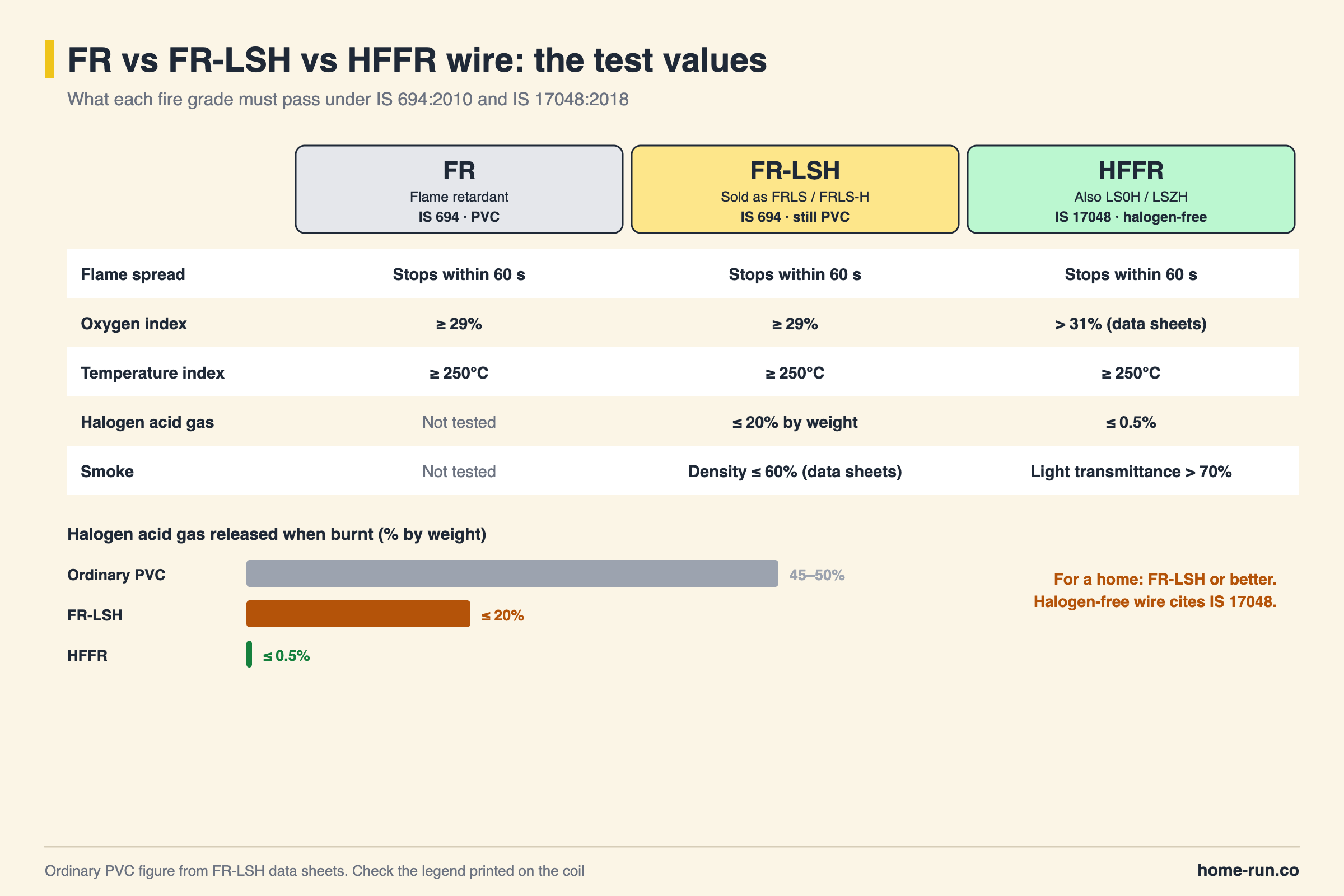
Fire tests for FR, FR-LSH and HFFR wire
IS 694:2010, IS 17048:2018 and published data sheets| Test (method) | FR | FR-LSH (FRLS, FRLS-H) | HFFR (LS0H) |
|---|---|---|---|
| Flammability (IS 10810 Part 53) | Burning stops within 60 s | Burning stops within 60 s | Required, plus Part 61 flame test |
| Oxygen index (Part 58) | ≥ 29% | ≥ 29% | > 31% on data sheets |
| Temperature index (Part 64) | ≥ 250°C | ≥ 250°C | ≥ 250°C |
| Halogen acid gas (Part 59) Key gap | Not tested | ≤ 20% by weight | ≤ 0.5% (fluorine ≤ 0.1%) |
| Smoke | Not tested | Smoke density ≤ 60% on data sheets | Light transmittance > 70% (Part 63) |
| Gas acidity | Not tested | Not tested | pH ≥ 4.3, conductivity ≤ 10 µS/mm |
Oxygen index is the lowest oxygen level at which the insulation keeps burning. Air holds about 21% oxygen, so a 29% wire stops burning in ordinary air.
Temperature index is the temperature at which the insulation keeps burning in normal air.
IS 694:2010 lists the FR-LSH smoke density test as "under preparation", with no limit. Data sheets still print a 60% maximum, citing IS 13360 (Part 6/Sec 9) or ASTM D2843. Treat it as a declared value.
Is FRLS-H Wire Halogen-Free?
No. FRLS-H wire has reduced halogen, not zero halogen. Its PVC insulation may release up to 20% halogen acid gas by weight in the IS 10810 Part 59 test.
Halogen-free wire uses a compound with no chlorine, bromine or fluorine, made to IS 17048:2018, the BIS standard for halogen-free flame retardant (HFFR) cables up to 1100 V.
Coils may say HFFR, LS0H, LSZH or ZHFR. International counterparts are IEC 60332-1-2 (flame spread), IEC 61034-2 (smoke) and IEC 60754-1 and -2 (acid gas).
IEC acid-gas limits match IS 17048: 0.5% or less, pH ≥ 4.3, conductivity ≤ 10 µS/mm. For smoke, IEC 61034 asks for over 60% light transmittance; one IS 17048 data sheet states over 70%.
If the legend or data sheet says IS 694, the wire is PVC, even if the pack says "green" or "eco". Truly halogen-free wire should cite IS 17048. Lead-free (LF) and RoHS marks cover other substances and do not make a wire halogen-free.
Why Do Smoke and Acid Gas Matter in a House Fire?
Smoke and acid gas harm people and equipment well beyond the flames. Thick smoke hides exits, and the hydrochloric acid formed from burning PVC irritates the eyes and lungs.
FR-LSH data sheets compare their insulation with ordinary PVC:
- Oxygen index: above 29% for FR-LSH, against about 23% for ordinary PVC.
- Temperature index: above 250°C, against about 150°C.
- Acid gas: below 20%, against 45% to 50%.
House wire runs inside conduits, false ceilings and shafts, where a fault can smoulder unseen. Low smoke buys time to get out, and less acid gas means less corrosion of switchgear.
FR vs FRLS vs FRLS-H Wires: Which Should You Use Where?
For most homes, FR-LSH is the sensible minimum for every circuit. Halogen-free HFFR is worth it where many people gather or exits are long.
- Independent houses and villas: FR-LSH for concealed conduit runs, the main board and sub-mains.
- Buildings 15 m or taller: FR-LSH minimum; ask whether HFFR is specified for common areas.
- Hospitals, schools, malls and offices: HFFR (LS0H), where crowds leave through long corridors.
The National Building Code of India 2016 (NBC) calls flame retardant wiring desirable and asks designers to consider FR-LSH. It defines a high-rise as 15 m or taller but does not assign a wire grade by height. Follow your project's electrical specification.
FR-LSH (FRLS, FRLS-H)
Most homes- PVC insulation to IS 694:2010
- Acid gas up to 20% by weight
- Widely stocked in common sizes
- Rated 70°C, or 85°C in HR grades
HFFR (LS0H, ZHFR)
Public buildings- Halogen-free compound to IS 17048:2018
- Acid gas 0.5% or less
- Stock varies; order ahead
- 70°C, or 90°C in XL types
Our guide to electrical wires for home: types, sizes and brands covers conductor types and sizes by circuit.
How Do You Check the Fire Grade on a Wire Coil?
Check the printed legend on the wire itself. A genuine IS 694 wire shows the size, the standard, the fire category (FR or FR-LSH) and the ISI mark with a CM/L licence number.
- "FRLS" on the box but no category printed on the wire.
- "Halogen-free" next to IS 694: halogen-free wire cites IS 17048.
- No CM/L number with the ISI mark, or a number that does not match the brand in the BIS Care app.
- No data sheet, or one without oxygen index and acid gas values.
Data sheets report these tests differently. Our Polycab vs Finolex wire spec comparison shows how to read two of them side by side.
How Should FR and FR-LSH Wires Be Installed?
All three grades install the same way. The fire grade only helps if the wire is sized, run and joined correctly.
- Size each circuit from the current rating in conduit, then pick the fire grade.
- Use one grade for the whole house, so no circuit is left on plain FR.
- Pull wires through conduit without nicking the insulation on sharp edges.
- Make joints only inside junction boxes.
- Ask for insulation resistance and earth tests before the circuits are switched on.
For circuit planning and load basics, see our guide to electrical wiring for houses.
The box label is a claim. The wire legend and the data-sheet test values are the proof.
HomeRun Team
Wiring a new home?
House wires, MCBs, conduits and switches delivered across Bengaluru.