On this page
- What Is a Side Hung Window?
- Which Materials Are Side Hung Windows Made Of?
- What Are the Advantages of Side Hinging?
- Side Hung vs Top Hung Windows: What Is the Difference?
- What Are the Installation Steps?
- How Do You Keep Hinges and Seals Working?
- What Decides Window Cost in India?
- A side hung window is a casement: the shutter pivots on hinges fixed to one vertical side of the frame.
- It opens outward or inward, so almost the whole opening lets in air.
- uPVC insulates better; aluminium gives slimmer, stronger frames.
- A top hung window is hinged at the top and suits bathrooms and rainy facades.
A side hung window is a window whose shutter is hinged on one vertical edge of the frame, so it swings open like a small door. Builders also call it a side hung casement window.
This page covers the side hung style in depth. For every window style side by side, see types of windows and doors or our guide to window designs for home.
What Is a Side Hung Window?
A side hung window is a frame with one or more shutters, each hinged on its left or right side. You open it with a handle on the opposite edge.
The shutter opens outward (most common in India) or inward. Inward shutters are easier to clean from inside.
A double side hung window has two shutters that meet in the middle, like French doors.
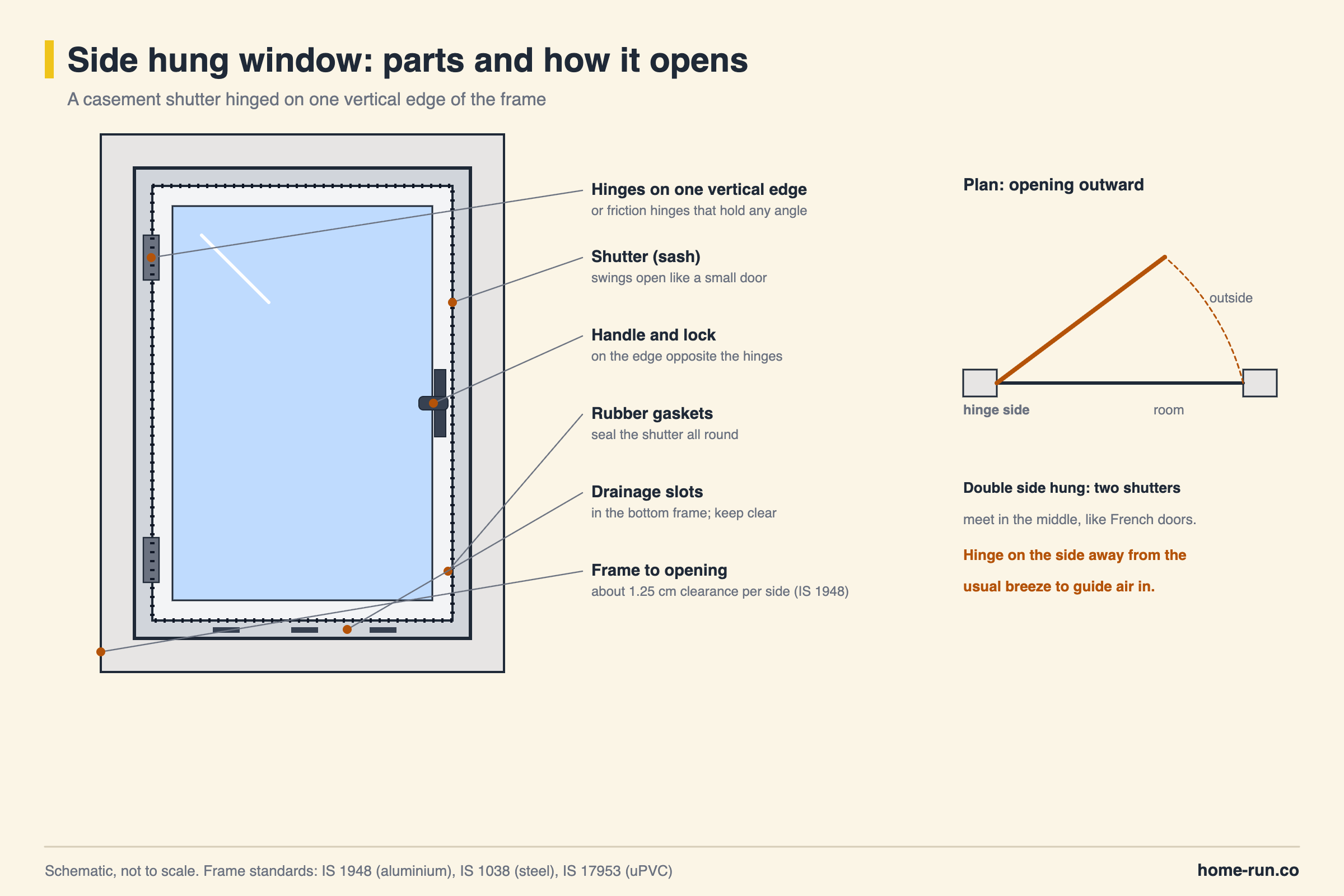
Every side hung window is a casement. Top hung and bottom hung windows are casements too, hinged on a different edge.
Which Materials Are Side Hung Windows Made Of?
Side hung windows in India are made mostly in uPVC and aluminium, with steel and wood in older or budget homes. Each has its own Indian standard.
Side hung window frame materials
Indian standards as published by BIS| Frame | Strengths | Watch for | Indian standard |
|---|---|---|---|
| uPVC Insulation | Low heat transfer, no rust, little upkeep | Bulkier frame; check profile quality | IS 17953:2023 (uPVC profiles) |
| Aluminium Slim | Light, strong, slim sections, large panes | Conducts heat unless thermally broken | IS 1948:1961 |
| Steel | Strong, low first cost | Rusts without regular painting | IS 1038:1983 |
| Wood | Warm look, insulates well | Swells and warps in monsoon damp | Depends on timber and joinery |
Aluminium conducts heat well, so a plain aluminium frame adds heat gain on a sunny wall. A thermal break, an insulating strip inside the frame, reduces this. Compare options in our page on aluminium windows.
What Are the Advantages of Side Hinging?
The main advantage of a side hung window is that almost the full shutter area opens, so it moves more air than a sliding window of the same size.
- Ventilation: an outward shutter can catch breezes that blow along the wall.
- Tight seal: the shutter closes against gaskets, which keeps out dust and driving rain better than most sliders.
- Security: multi-point locks pull the shutter into the frame at several points.
- Easy cleaning: wide-opening shutters let you reach both glass faces.
Put openable shutters on two different walls of a room for cross-ventilation. Hinge each shutter on the side away from the usual breeze, so the open shutter guides air in.
Side Hung vs Top Hung Windows: What Is the Difference?
A side hung window hinges on a vertical edge and swings sideways; a top hung window hinges on the top edge and opens outward from the bottom.
Side hung window
Living spaces- Hinged on the left or right side
- Opens wide for maximum airflow
- Needs clear space for the shutter swing
- Bedrooms, living rooms, kitchens
Top hung window
Wet areas- Hinged along the top edge
- Opens partly, like an awning
- Sheds rain while open
- Bathrooms, ventilators, high openings
Choose side hung for airflow and, without a grille, a possible escape route. Choose top hung where rain, privacy or height matter more.
What Are the Installation Steps?
A side hung window is installed by fixing a square, level frame into a prepared opening, then sealing the joint between frame and wall. Hire the fabricator's own team where possible.
- Prepare the opening. Finish the plaster and confirm the window sill height before measuring.
- Measure three times. Take width and height at three points and use the smallest. IS 1948 frames allow about 1.25 cm clearance per side.
- Pack and level the frame. Set it on non-rotting packers, check level and plumb, and match both diagonals.
- Fix the frame. One UK fabricator guide sets fixings 150–250 mm from corners and no more than 600 mm apart.
- Hang and adjust the shutter. Check it closes evenly on all gaskets and the handle locks without force.
- Seal the joint. Use a low-modulus silicone outside and inside. Back gaps wider than 6 mm with closed-cell foam first.
Fixing the frame before plastering, wedging it out of square or skipping the outer seal leads to dragging shutters and monsoon leaks.
How Do You Keep Hinges and Seals Working?
A side hung window needs a wipe-down, a hinge check and a seal check a few times a year. Bengaluru's wettest months are August to October, so check before them.
- Clean frames with mild soap and water; avoid abrasive powders and solvents
- Clear dust from the drainage slots in the bottom frame
- Oil hinges and lock points lightly with a non-gumming lubricant
- Check rubber gaskets for cracks or gaps
- Touch up paint on steel frames at the first sign of rust
Watch for these common defects:
- Shutter drops or rubs: hinges are loose or the frame is out of square.
- Light or water at the edges: gaskets are missing, shrunk or badly joined.
- Handle needs force: lock points are misaligned.
What Decides Window Cost in India?
The cost of a side hung window depends mainly on frame material, size, glass and hardware. Compare written quotes.
- Frame: uPVC and thermally broken aluminium cost more than plain steel.
- Glass: toughened or double glazing costs more.
- Hardware: multi-point locks and friction hinges cost more than peg stays.
- Installation: check if fixing and sealing are quoted.
Ask Bengaluru suppliers to list profile brand, glass, hardware and warranty in writing.
Getting window openings ready?
Order hardware, plywood and paints delivered across Bengaluru while your fabricator makes the frames.