On this page
- What Is a Sanding Machine Used For?
- Which Type of Sanding Machine Suits Which Job?
- Corded, Cordless or Pneumatic: Which Power Source Works in India?
- What Specs Should You Compare Before Buying?
- How Much Does a Sanding Machine Cost in India?
- How Do You Sand Safely and Avoid Common Mistakes?
- What Should You Check When Buying and Maintaining a Sander?
- Pick a sander by job, not brand.
- Belt and disc sanders remove material; orbital sanders finish it.
- For wall putty, use a wall sander with dust collection.
- Step through grits; never jump from 80 straight to 220.
A sanding machine (also called a sander) is a power tool that drives sandpaper, a disc or an abrasive belt to smooth, level or prepare a surface. You use one on wood, wall putty, paint, metal and floors.
What Is a Sanding Machine Used For?
A sanding machine is used to remove old finish, level high spots and leave a surface ready for paint, polish or adhesive.
- Smoothing wall putty and POP before painting
- Finishing furniture, plywood and MDF
- Removing rust and paint from metal
- Levelling wooden and parquet floors
An orbital (sheet) sander moves a square pad in small fixed circles. A random orbital sander spins a round pad while it orbits, cutting faster with fewer swirl marks. Check the pad shape: listings call both "orbital".
Which Type of Sanding Machine Suits Which Job?
Use a belt or disc sander for heavy removal, an orbital sander for finishing and a wall sander for putty.
Sanding machine types and their jobs
Default pick per task| Type | Best for | Watch out |
|---|---|---|
| Belt sander | Stripping doors, levelling rough planks | Gouges if tilted or held still |
| Disc sander | Shaping edges and end grain; rust on metal | Leaves cross-grain marks on faces |
| Orbital (sheet) sander | Final passes on flat furniture panels | Slow for heavy removal |
| Random orbital Default pick | Furniture, plywood, MDF, car body prep | Round pad misses inside corners |
| Detail sander | Corners and tight edges | Slow on large areas |
| Wall and ceiling sander Default pick | Wall putty, POP and old paint | Needs a dust bag or extractor |
| Drum or floor sander | Wooden and parquet floors | Heavy; often rented |
| Wide-belt sander Industrial | Calibrating panels in furniture factories | Often three-phase power, quote-based |
Remove with a belt or disc, finish with an orbital. Sand MDF board edges gently.
Corded, Cordless or Pneumatic: Which Power Source Works in India?
A corded sander is the best default for most Indian buyers. Choose pneumatic (compressed-air) only if you already run a compressor.
Corded electric
DefaultHomes, painters, carpenters.
- Steady power for long jobs
- Lowest price per watt
- Cable limits reach on large sites
Cordless battery
Site mobilitySites with power cuts.
- No cable on scaffolds or ladders
- Runtime limited by battery
- Batteries rarely fit other brands
What Specs Should You Compare Before Buying?
Compare motor power, orbit size, pad size, speed control and dust extraction, then match them to your task.
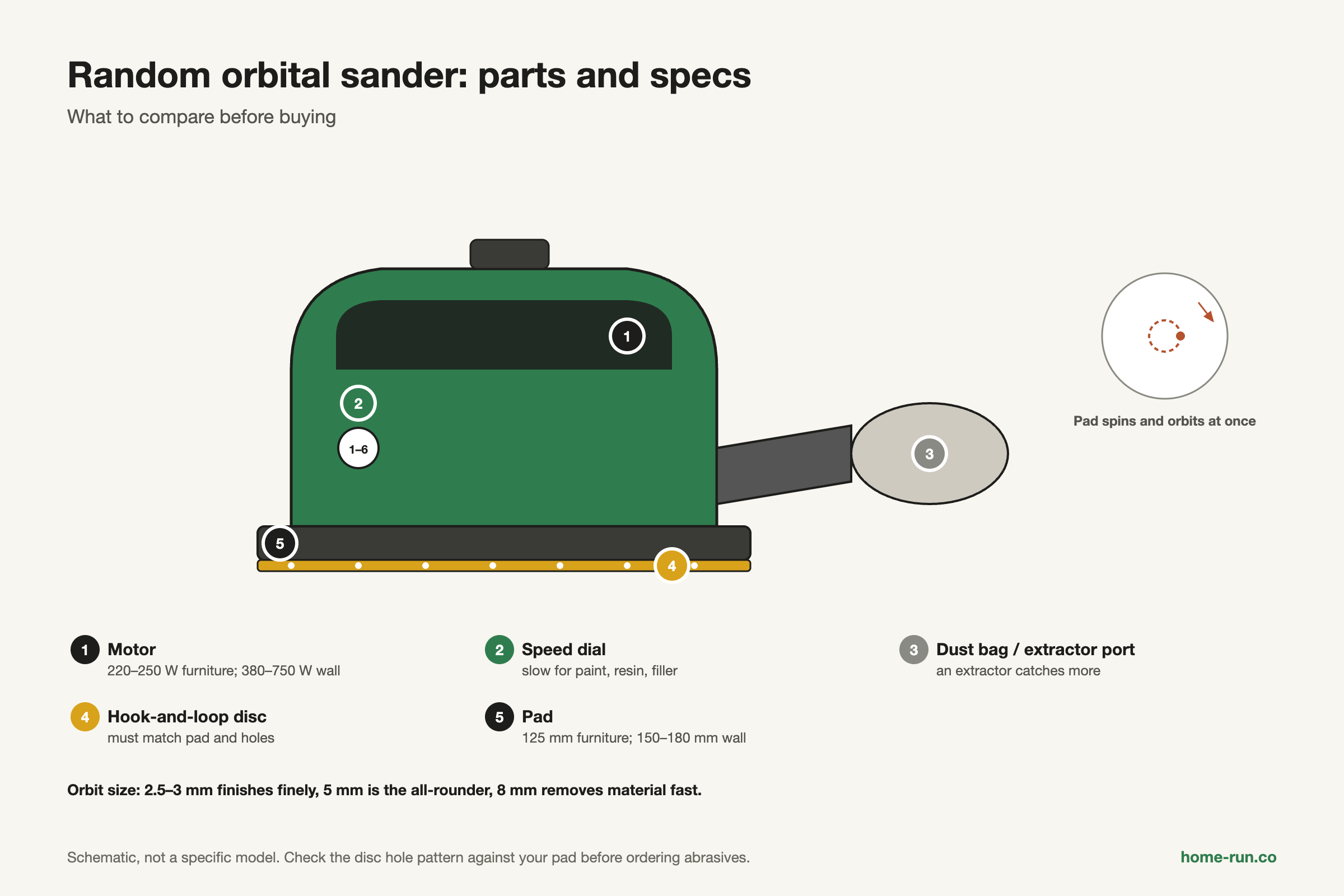
- Motor power (W): 220–250 W suits furniture; wall sanders run 380–750 W.
- Orbit size: 2.5–3 mm finishes finely; 5 mm is the all-rounder; 8 mm removes fast.
- Pad size: 125 mm is common for furniture; wall sanders use 150–180 mm.
- Variable speed: slow for paint, resin and filler that clog paper.
- Dust port: a bag catches some dust; an extractor catches more.
- Discs: hook-and-loop (Velcro) discs must match the pad and holes.
How Much Does a Sanding Machine Cost in India?
Common branded sanding machines cost about ₹3,500–8,900 in India, based on listings checked on 12 Nov 2026.
Sample sanding machine prices in India
Online listings, checked 12 Nov 2026| Model | Type | Key specs | Price (incl. GST) |
|---|---|---|---|
| Bosch GSS 140 Budget | Orbital (sheet) | 220 W, 1.5 mm orbit | ₹3,539 |
| Asian Paints Trucare W-01 | Wall sander | 380 W, 6-inch pad | ₹5,847 |
| Bosch GEX 125-1 AE | Random orbital | 250 W, 2.5 mm orbit, 125 mm pad | ₹7,439 (sale) |
| Asian Paints Trucare H-01 | Wall sander | 750 W, 180 mm pad, dust extraction | ₹8,900 |
You pay more for brushless motors, built-in extraction and longer warranty. Contractors should ask for a GST invoice.
How Do You Sand Safely and Avoid Common Mistakes?
Sand safely by working coarse to fine, keeping the pad flat and controlling dust.
- Start with the coarsest grit needed, such as 80 on rough wood.
- Keep the machine moving; never park it in one spot.
- Let the tool's weight do the work.
- Step up one grit at a time, for example 80, 120, 180, 220.
- Wipe off dust and check the surface between grits.
India's 2016 rules cap lead in household paint at 90 ppm; older coats may hold more. Wear a respirator mask and goggles when sanding old paint, wall putty, resin or MDF.
What Should You Check When Buying and Maintaining a Sander?
Buy from an authorised dealer and confirm warranty and service support in your city. For one-off floor jobs, rent a machine or ask your civil contractor.
- No GST invoice or warranty card
- No service centre or spare brushes, pads and belts nearby
- Pad holes that do not match common discs
Clean the dust port after each job and store the machine dry.
Prepping walls or woodwork?
Tools and finishing materials delivered across Bengaluru.