On this page
- What Is a Retractable Roof and How Does It Work?
- What Are the Types of Retractable Roofs?
- Which Retractable Roof Material Suits Bengaluru Homes?
- What Are the Benefits of a Retractable Roof?
- How Much Does a Retractable Roof Cost in India?
- How Is a Retractable Roof Installed?
- How Do You Maintain a Retractable Roof?
- Retractable Roof or Fixed Roof: Which Should You Choose?
- A retractable roof is a movable cover that slides, folds or rolls back to open a space to the sky.
- Homes mostly use sliding or folding systems over terraces, balconies and courtyards.
- PVC fabric is lightest and cheapest, polycarbonate lets light in, glass costs most.
- In Bengaluru, design for wind and slope the cover to drain monsoon rain.
A retractable roof is a roof system that opens and closes, so you can cover an outdoor space in rain or harsh sun and open it to the sky the rest of the time. The cover slides along tracks, folds or rolls up.
What Is a Retractable Roof and How Does It Work?
A retractable roof is a cover that moves along a track or folds to open part or all of a space.
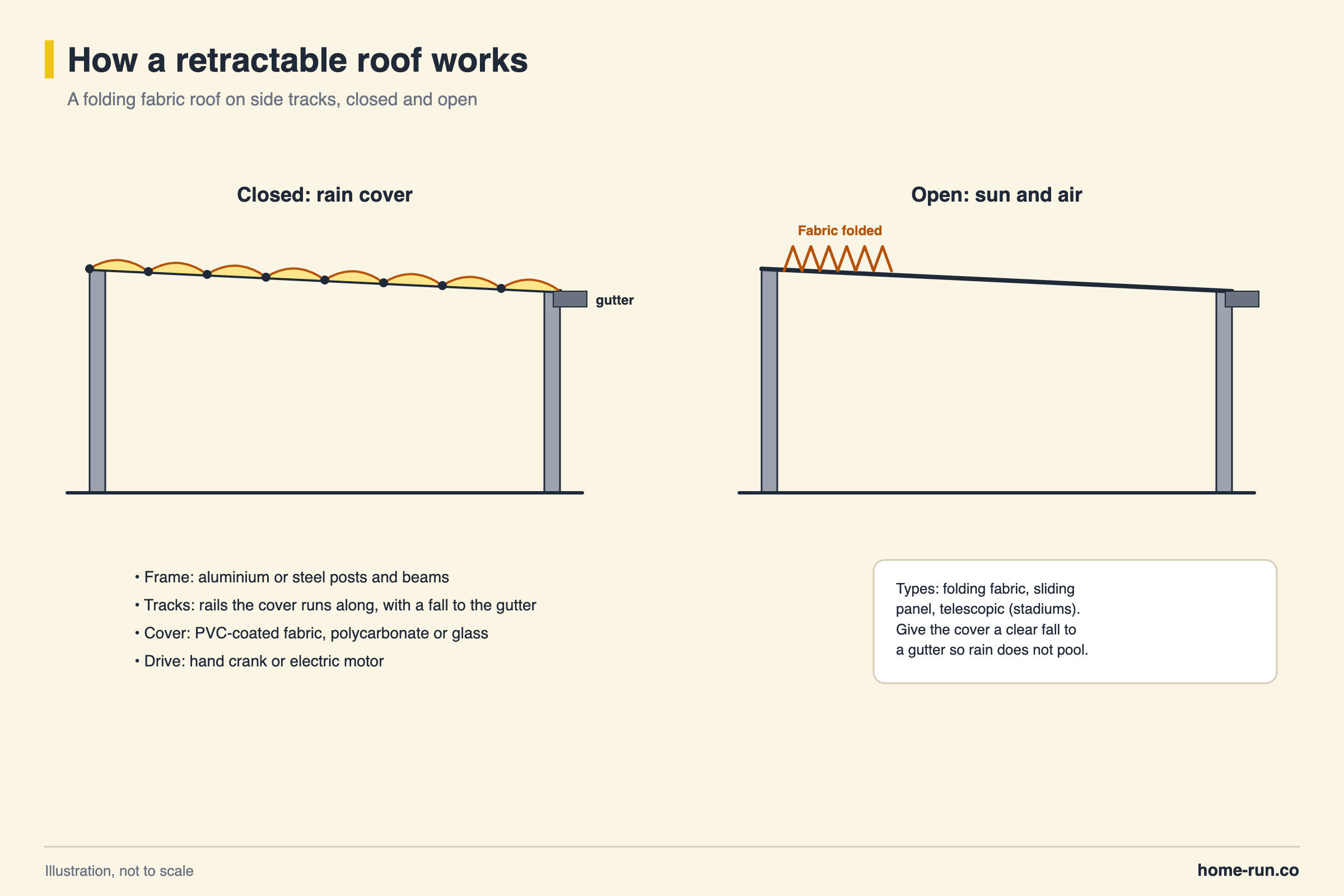
A residential retractable roof system has four parts:
- Frame: aluminium or steel posts and beams.
- Tracks: rails the cover runs along.
- Cover: PVC-coated fabric, polycarbonate sheet or glass panels.
- Drive: a hand crank or an electric motor.
A skylight is a glazed opening in a permanent roof; a pergola is an open beam frame with no cover. A retractable roof adds a movable cover, often to a pergola-style frame. See our guides to the skylight roof and pergola meaning.
What Are the Types of Retractable Roofs?
The main types of retractable roofs are sliding, folding and telescopic systems, each run manually or by motor. Homes mostly use sliding and folding designs; telescopic roofs suit stadiums, such as Pittsburgh's Civic Arena of 1961, the first retractable roof sports venue.
Retractable roof types and where they fit
By how the cover opens| Type | How it opens | Typical use |
|---|---|---|
| Folding fabric Most common at home | PVC fabric pleats up on bars along side tracks | Terraces, balconies, restaurant patios |
| Sliding panel | Rigid polycarbonate or glass panels slide over each other | Courtyards, pool decks, sit-outs |
| Telescopic | Large sections nest under one another | Stadiums, arenas, large atriums |
Manual vs motorised: a manual retractable roof uses a crank or pull cord and suits small balconies. A motorised retractable roof uses a motor and remote, and can link to wind or rain sensors.
Which Retractable Roof Material Suits Bengaluru Homes?
PVC-coated fabric on an aluminium frame suits most Bengaluru terraces and balconies, because it is light, waterproof and cheapest. Polycarbonate suits spaces that need daylight; glass suits premium courtyards.
Retractable roof materials compared
Covers and frames for homes| Material | Role | Strengths | Watch for |
|---|---|---|---|
| PVC fabric Default pick | Cover | Light, waterproof, folds tightly, lowest cost | Needs correct tension; less durable in harsh weather |
| Polycarbonate | Cover | Lets light through, tougher than acrylic, lighter than glass | Can scratch; choose UV-protected sheet |
| Glass Premium | Cover | Clear view, long-lasting surface | Heaviest and costliest; at least 6 mm thick |
| FRP (fibre-reinforced plastic) | Cover or panels | Light and strong, resists corrosion | Translucent rather than clear |
| Aluminium | Frame and tracks | Light, does not rust, easy to powder-coat | Steel is used for long spans but must be galvanised |
Give the cover a clear fall to a gutter so rain does not pool. Bengaluru gets about 87% of its yearly rain between May and November, with September the wettest month, so test drainage before June.
What Are the Benefits of a Retractable Roof?
The main benefit of a retractable roof is a space you can use in both sun and rain. Close it for a monsoon shower or afternoon sun, open it on clear evenings.
- More usable space: a terrace becomes a year-round sit-out.
- Light and air on demand: open for daylight, close for shade.
- Customisation: fabric colours, frame finishes, LED strips, side screens and remote control.
Energy savings depend on orientation and use, so treat maker claims with care.
How Much Does a Retractable Roof Cost in India?
A retractable roof in India costs roughly ₹150 to ₹2,800 per sq ft, depending mainly on the cover material and whether it is motorised. Trade portal listings quote about ₹300 to ₹2,150 per sq ft.
Indicative retractable roof cost by cover
Supply and install, per sq ft| Cover type | Low (₹/sq ft) | High (₹/sq ft) |
|---|---|---|
| Tensile / PVC fabric | 150 | 500 |
| Plastic (polycarbonate, PVC, acrylic) | 500 | 1,500 |
| Glass sliding | 1,800 | 2,800 |
Motors, sensors and structural work add to these figures.
Preparing your terrace for a new roof?
Slab, parapet and finishing materials delivered across Bengaluru.
How Is a Retractable Roof Installed?
A retractable roof is installed in stages: site survey, design and structural check, fabrication, frame fixing, cover and motor fitting, then testing.
Site survey
Measure the space, check fixing points, sun direction and drainage.
Design and structural check
Pick type, cover and drive; an engineer checks wind load and anchoring.
Fabrication
Frame, tracks and cover are made to the approved drawing.
Frame and tracks
Posts and beams are anchored and set to slope, with a gutter at the low end.
Cover and controls
Fabric or panels go on, then the motor, remote and sensors.
Testing and handover
Cycle the roof, water-test drainage and collect the maintenance schedule.
What to check before installation
- Wind design: IS 875 (Part 3), the Indian code for wind loads on buildings, gives Bangalore a basic wind speed of 33 m/s. Ask the supplier to confirm the design covers it.
- Fixing points: the slab or parapet must take the anchor loads without damaging waterproofing.
- Drainage and power: plan the gutter outlet and a weatherproof power point for motorised systems.
- Approvals: a permanent terrace structure may need permission. In Bengaluru, check with your city corporation under the Greater Bengaluru Authority (formerly BBMP) and your apartment association.
Anchor bolts through a terrace's waterproofing layer often cause new leaks. Seal every fixing, or anchor to the parapet or columns. Our guide to the permanent solution for roof leakage explains how to repair a damaged layer.
How Do You Maintain a Retractable Roof?
You maintain a retractable roof by cleaning the cover and tracks and servicing moving parts as the maker recommends. In Bengaluru, check it before the June monsoon.
- Wash fabric or polycarbonate with mild soap and water.
- Clear leaves and dust from tracks and gutters.
- Lubricate rollers and hinges only where the maker says to.
- Retract or close the roof as instructed when strong wind is forecast.
Signs of wear to fix early
- Sagging or pooling fabric: tension has dropped or the slope is too flat.
- Jerky or noisy movement: dirty tracks, worn rollers or a motor fault.
- Rust, yellowing or drips: failed coating, UV damage or failed sealant at fixings.
Retractable Roof or Fixed Roof: Which Should You Choose?
Choose a retractable roof if you want to switch between open sky and cover; choose a fixed roof or pergola if you want lower cost and less upkeep. Our explainer on types of roofs covers fixed options in detail.
Retractable roof
FlexiblePoints
- Opens or closes as weather changes
- Higher cost
- Moving parts need servicing
- Best for sit-outs and pool decks
Fixed roof or pergola
SimplerPoints
- Always covered or always open
- Lower cost
- Few or no moving parts
- Best for car parks and utility areas