On this page
- What Is the M10 Concrete Ratio, and What Does 1:3:6 Mean?
- Is M10 a Nominal Mix or a Design Mix?
- How Much Cement, Sand and Aggregate Does 1 m³ of M10 Need?
- How Much M10 Material Do Common Job Sizes Need?
- What Strength and Water-Cement Ratio Should M10 Concrete Have?
- Where Is M10 Concrete Used, and Where Must It Never Be Used?
- M10 vs M15 vs M20: Which Concrete Ratio Should You Pick?
- How Much Does M10 Concrete Cost?
- How Do You Mix M10 Concrete on Site, Step by Step?
- Ready to Buy Materials for Your M10 Pour?
- The M10 concrete ratio is 1:3:6: one part cement, three parts sand, six parts coarse aggregate, by volume.
- One cubic metre of M10 needs about 4.44 bags of cement, 0.46 m³ of sand and 0.92 m³ of aggregate.
- M10 reaches 10 N/mm² at 28 days. It is a lean mix with little cement.
- Keep the water-cement ratio at or below 0.60, about 30 litres of water per bag.
- Use M10 only for plain concrete such as PCC under footings. Reinforced work needs M20 or higher.
The M10 concrete ratio is 1:3:6, meaning one part cement, three parts sand and six parts coarse aggregate, measured by volume. M10 is a lean, unreinforced concrete used as a levelling bed under footings and floors.
What Is the M10 Concrete Ratio, and What Does 1:3:6 Mean?
M10 is a concrete grade, and 1:3:6 is the mix that usually produces it. The two numbers describe different things.
- M stands for mix.
- 10 is the characteristic compressive strength in N/mm² (megapascals) at 28 days. Labs test this on 150 mm cubes.
- 1:3:6 is the recipe: for every bucket of cement, add three of sand and six of stone chips.
Characteristic strength is the value that no more than 5% of test cubes should fall below. It is not the average strength.
The ratio is by volume because small sites measure with boxes, pans and buckets. A weigh-batched version exists too, covered below.
The 10 in M10 is a strength, not a ratio. M10 is called a lean mix because cement is only one part in ten. That low cement content keeps it cheap and also keeps it weak.
Is M10 a Nominal Mix or a Design Mix?
M10 is almost always a nominal mix. A nominal mix uses fixed proportions from a standard table, with no lab trials.
A design mix is worked out by calculation and trial batches for your actual materials. IS 10262, the Indian standard for concrete mix proportioning, gives the method.
IS 456:2000, the Indian code for plain and reinforced concrete, allows nominal mixes only for grades up to M20. M25 and above must be design mixes.
Nominal mix ratios by grade
Volume ratios as commonly used in India| Grade | Ratio (C : S : A) | Strength at 28 days (N/mm²) | Typical use |
|---|---|---|---|
| M5 | 1 : 5 : 10 | 5 | Filling, mud mats |
| M7.5 | 1 : 4 : 8 | 7.5 | Blinding, lean filling |
| M10 This guide | 1 : 3 : 6 | 10 | PCC beds, floor bases |
| M15 | 1 : 2 : 4 | 15 | PCC in moderate exposure, paths |
| M20 | 1 : 1.5 : 3 | 20 | RCC slabs, beams, columns |
A nominal mix gives roughly the right strength if batching is accurate. Loose measuring, wet sand or extra water can drop it below 10 N/mm². For every grade side by side, see our concrete mix ratio guide.
How Much Cement, Sand and Aggregate Does 1 m³ of M10 Need?
One cubic metre of M10 concrete needs about 4.44 bags of cement (222 kg), 0.46 m³ of sand and 0.92 m³ of coarse aggregate. The figures come from the dry volume method.
Dry materials take up more space than finished concrete, because water and mixing fill the gaps between grains. So you multiply the wet volume by a dry volume factor, usually 1.54.
Other sources quote slightly different numbers. Some use 1.52 or 1.57 as the dry factor, and one popular site estimate gives 7–8 bags per m³, which matches a richer mix, not 1:3:6. Trust the formula over any single quoted figure.
M10 concrete ratio by weight
IS 456 Table 9 sets nominal mixes by weight. For M10, it allows about 480 kg of total aggregate per 50 kg bag of cement, with sand to stone generally 1:2.
That works out to 50 kg cement : 160 kg sand : 320 kg coarse aggregate, or about 1 : 3.2 : 6.4 by weight. Weigh batching is more accurate than volume batching, but small sites rarely have scales.
Why your site may need more
- Bulking of sand: damp sand swells by roughly 20–40% in volume, so a box of wet sand holds less sand. Add extra sand or measure dry.
- Wastage: spillage and uneven trenches eat material. Many estimates add about 5%.
- Uneven base: a dip of 20 mm across a pit raises the volume more than you expect.
How Much M10 Material Do Common Job Sizes Need?
Multiply the per-m³ figures by your concrete volume. The table below does it for common pour sizes and two PCC bed thicknesses.
M10 concrete quantities for common volumes
Before wastage| Concrete volume | Cement (bags) | Sand (m³) | Aggregate (m³) |
|---|---|---|---|
| 0.5 m³ | 2.22 | 0.23 | 0.46 |
| 1 m³ | 4.44 | 0.46 | 0.92 |
| 2 m³ | 8.87 | 0.92 | 1.85 |
| 5 m³ | 22.2 | 2.31 | 4.62 |
| 10 m³ | 44.4 | 4.62 | 9.24 |
| 100 sq ft bed, 75 mm thick (0.70 m³) | 3.09 | 0.32 | 0.64 |
| 100 sq ft bed, 100 mm thick (0.93 m³) | 4.12 | 0.43 | 0.86 |
PCC under footings is usually 75–100 mm thick and extends 75–150 mm beyond the footing on each side. Follow your structural drawing if it says otherwise.
Batching M10 with gauge boxes
A gauge box holds the volume of one cement bag, about 35 litres. One bag batch of M10 is 1 box of cement, 3 boxes of sand and 6 boxes of aggregate, and it makes about 0.23 m³ of concrete.
M10 volume-batching cheat sheet
35-litre gauge boxes, dry sand| Concrete needed | Cement (bags) | Sand (boxes) | Aggregate (boxes) |
|---|---|---|---|
| 0.5 m³ | 2.2 | 6.7 | 13.3 |
| 1 m³ | 4.4 | 13.3 | 26.6 |
| 2 m³ | 8.9 | 26.6 | 53.2 |
What Strength and Water-Cement Ratio Should M10 Concrete Have?
M10 concrete should reach a characteristic compressive strength of 10 N/mm² at 28 days. Keep its water-cement ratio at or below 0.60.
The water-cement ratio is the weight of water divided by the weight of cement. At 0.60, each 50 kg bag gets 30 litres of water, so 1 m³ of M10 takes about 133 litres.
- IS 456 Table 5 caps plain concrete in mild exposure at a 0.60 water-cement ratio, with at least 220 kg of cement per m³.
- IS 456 Table 9 lists about 34 litres per bag for nominal M10, which is a ratio of 0.68. Treat that as an upper limit for workability, not a target.
- Published per-m³ figures vary, from about 111–133 litres to 160–180 litres. The lower range matches the 0.60 cap better.
At 1:3:6, M10 contains about 222 kg of cement per m³, barely above the 220 kg minimum in Table 5. Short-filled boxes or wet, bulked sand can push it below. Extra water then weakens it further.
Concrete gains strength over time. Ordinary Portland cement (OPC) concrete typically reaches about 65–70% of its 28-day strength in 7 days.
Place and compact
Pour soon after mixing and tamp out air pockets.
Start curing
Keep the surface wet once it has set enough to resist marking.
OPC minimum curing
About 65–70% of design strength. Blended cements need at least 10 days.
Design strength
M10 should reach 10 N/mm² characteristic strength.
Small house jobs rarely cube-test M10. On larger pours, ask for cube samples so you know the bed is sound. For load estimates, IS 456 takes plain concrete as 24 kN/m³, about 2,400 kg per m³.
Where Is M10 Concrete Used, and Where Must It Never Be Used?
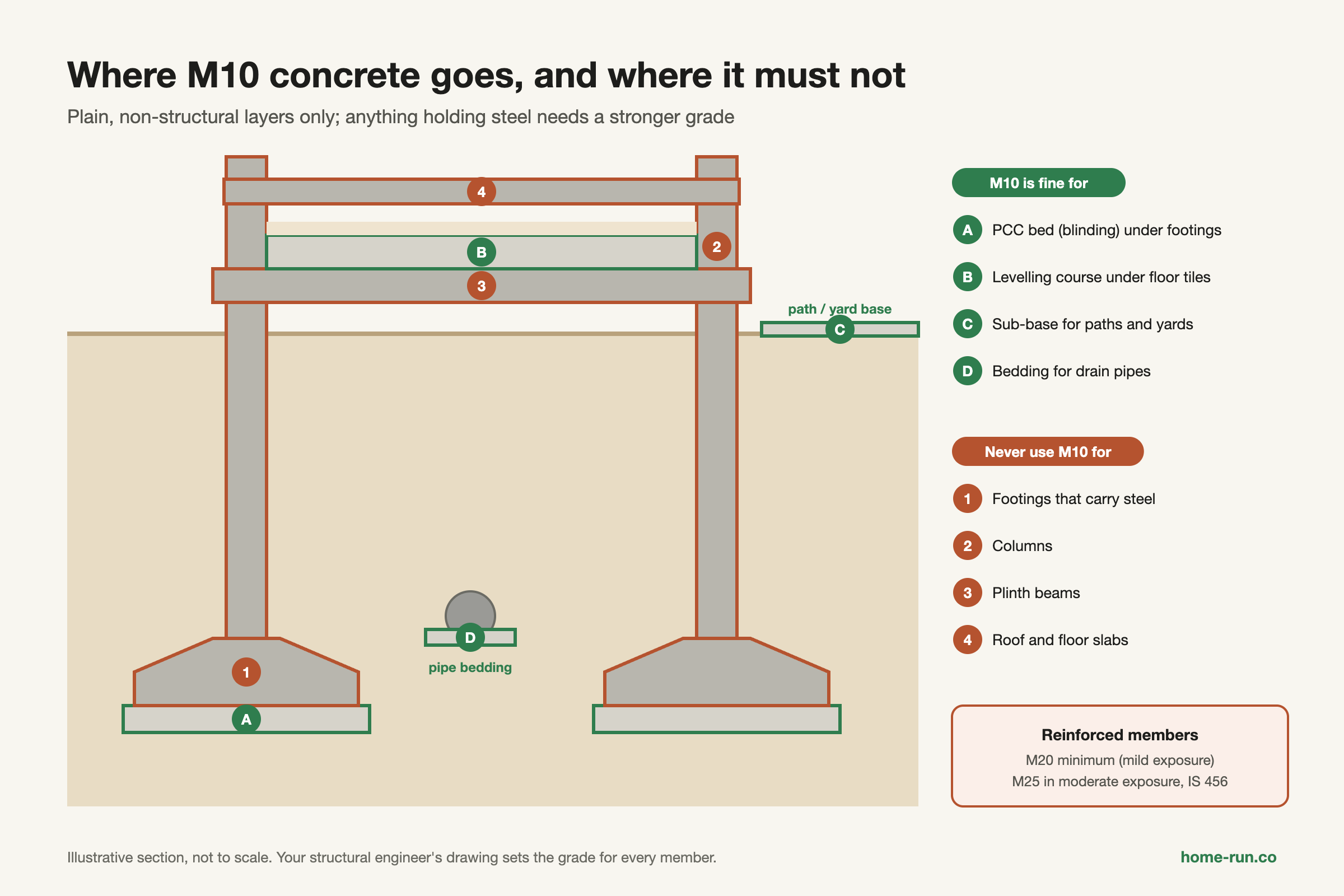
M10 concrete is used for plain, non-structural layers that sit on the ground. It must never be used for any member that holds steel or carries structural load.
- PCC bed (blinding) under footings and rafts
- Levelling course under ground-floor tiles or stone
- Sub-base for footpaths, yards and light driveways
- Bedding and haunching for drain and sewer pipes
- Filling of low spots and plinth filling over compacted soil
- Roof and floor slabs
- Beams, columns, lintels and plinth beams
- Footings, rafts and retaining walls that carry steel
- Water tanks and sumps
- Any concrete exposed to heavy rain, wet soil or sewage
Under the PCC bed, the reinforced footing, columns and slabs need a stronger grade. IS 456 Table 5 sets M20 as the minimum for reinforced concrete in mild exposure and M25 in moderate exposure. Reinforcement such as TMT bars rusts in lean, porous concrete.
IS 456 asks for at least M15 for plain concrete in moderate exposure, such as soil that stays damp or a surface exposed to rain. In that case use M15 concrete at 1:2:4 instead of M10.
M10 is a bed, not a structure. Its job is to give the steel a clean, level floor.
HomeRun Team
M10 vs M15 vs M20: Which Concrete Ratio Should You Pick?
Pick M10 for plain levelling work, M15 for plain concrete in damp or exposed spots, and M20 for anything reinforced.
M10, M15 and M20 compared
Nominal mixes, per m³| Grade | Ratio | Cement (bags/m³) | Cement (kg/m³) | Reinforced? |
|---|---|---|---|---|
| M10 Lean | 1 : 3 : 6 | 4.44 | 222 | No |
| M15 | 1 : 2 : 4 | 6.34 | 317 | No |
| M20 Default for RCC | 1 : 1.5 : 3 | 8.06 | 403 | Yes |
For reinforced slabs and beams, start with our M20 concrete ratio guide. Grades from M25 to M40 are design mixes made to a lab-tested recipe, not a fixed ratio.
How Much Does M10 Concrete Cost?
M10 concrete costs the sum of its materials at your local rates, plus labour and mixing. Because cement, sand and aggregate prices change month to month, build the cost from current rates.
Site-mixed M10
Best for small jobsMixed by hand or in a drum mixer on site.
- No minimum order
- Suits PCC beds under a few footings
- Quality depends on batching discipline
- Needs labour, space and water on site
Ready-mix M10
Bigger poursDelivered by a transit mixer truck.
- Usually sold in larger minimum loads
- Suits large floor bases and yards
- Consistent, plant-batched mix
- Needs truck access to the pour
Pouring a PCC bed?
Get cement, sand and aggregate delivered across Bengaluru with a GST invoice.
How Do You Mix M10 Concrete on Site, Step by Step?
Mix M10 by measuring in gauge boxes, dry-mixing cement and sand, adding aggregate, then adding water a little at a time.
- Soil base compacted, wetted and free of loose earth
- Level pegs or string lines set to the bed thickness
- Fresh, lump-free cement and clean, silt-free sand
- Gauge boxes, mixing platform and water ready
- Measure. Fill 1 box of cement, 3 of sand and 6 of aggregate per bag batch. Strike each box level.
- Dry-mix cement and sand. Turn them on a clean platform until the colour is even.
- Add aggregate. Spread it over the cement-sand mix and turn again.
- Add water gradually. Make a crater, pour in part of the water, and turn. Stop at about 30 litres per bag.
- Place and compact. Spread to the pegs and tamp until no air pockets remain.
- Cure. Keep the surface wet for at least 7 days with OPC, or 10 days with PPC or other blended cements.
- Lumpy or caked cement in the bag
- Sand that leaves a muddy stain on your hand
- Flaky or elongated stone chips
- A soupy mix that bleeds water on top
- Surface that dusts off after setting
Many Bengaluru sites use M-sand (manufactured sand) in place of river sand. Buy washed M-sand for M10, because excess fine dust needs more water.
Ready to Buy Materials for Your M10 Pour?
Remember three things before you order:
- The M10 concrete ratio is 1:3:6 by volume.
- M10 is lean and for plain concrete only.
- Quantities come from the dry volume formula: 4.44 bags, 0.46 m³ sand and 0.92 m³ aggregate per m³.
Measure your bed, work out the volume, add wastage, and request a quote for the cement, sand and aggregate.