On this page
- What Are Jali Bricks and Why Use Them?
- What Are the Types of Jali Bricks?
- Which Jali Brick Material Should You Choose?
- How Do You Choose a Jali Bricks Design?
- How Many Jali Bricks Do You Need?
- How Are Jali Bricks Installed?
- What Affects Jali Bricks Price?
- How Do You Maintain Jali Brick Walls?
- Where Can You Buy Jali Bricks, and What Should You Check?
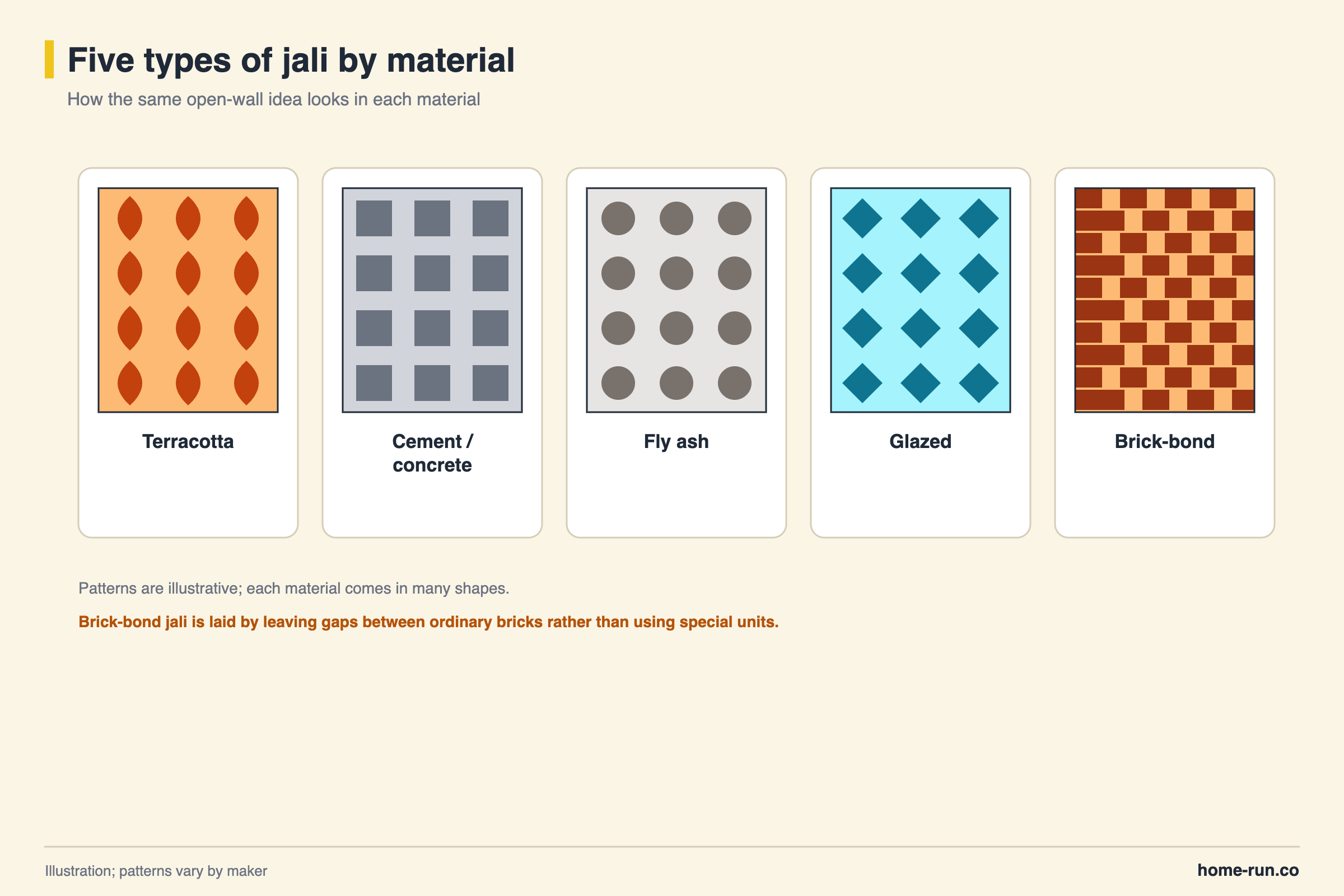
- Jali bricks come in five main types: terracotta, cement or concrete, fly ash, glazed and brick-bond jali.
- The standard block is 8 × 8 in, and you need about 2.1 blocks per sq ft of wall.
- Clay and cement blocks weigh about the same, 2.3–2.5 kg each in maker listings.
- Every jali wall is a screen, not a load-bearing wall; it needs a beam, columns or a steel frame.
- Most jali makers are in Gujarat, so Bengaluru buyers should price in freight and breakage.
Jali bricks are perforated bricks or blocks laid in courses to build an open screen wall that passes air and light but blocks direct views. They are made from terracotta, cement concrete, fly ash or glazed clay, or built from ordinary bricks with planned gaps.
This page compares the materials. For terracotta patterns in detail, see our terracotta jali brick guide.
What Are Jali Bricks and Why Use Them?
A jali brick is a building unit with open cut-outs, used to make a lattice wall. "Jali" means net or lattice in Hindi and Urdu.
Jali walls give four practical benefits:
- Ventilation: breeze passes through the openings without a window or a fan.
- Filtered light: solid parts shade the opening and cut glare.
- Privacy: people inside see out more easily than passers-by see in.
- Less material: an open wall uses fewer units and less mortar than a solid wall.
A jali block is a factory-made unit with the pattern built in. A brick-bond jali is made on site from ordinary bricks set with gaps. A jali tile is about 10 mm thick and is stuck on a wall as cladding, so it does not ventilate.
What Are the Types of Jali Bricks?
The five types of jali bricks differ by material, which sets their weight, finish, upkeep and price.
1. Terracotta (clay) jali bricks
Terracotta jali bricks are kiln-fired clay blocks, usually 8 × 8 in and about 63 mm thick. The red colour is fired in, so they need no paint. Clay is brittle, so corners chip in transit.
2. Cement and concrete jali blocks
Cement jali blocks are cast from grey or white cement concrete in the same 8 × 8 in moulds as clay jali. One Wankaner, Gujarat listing gives 2.3 kg per piece at ₹73 plus 18% GST.
Larger precast RCC (reinforced cement concrete) jali panels come in 300 × 300 mm, 600 × 600 mm and bigger sizes. GFRC (glass fibre reinforced concrete) jali is thin, about 10 mm upwards, and is sold per square foot for facades.
3. Fly ash jali
Fly ash jali usually means a brick-bond jali built from fly ash bricks. We found no maker listing a dedicated fly ash jali block in November 2026.
Fly ash bricks have sharp, even edges, which suit open bonds.
4. Glazed jali blocks
Glazed jali blocks are terracotta blocks with a glass-like coating fired onto the faces. The glaze adds colour and makes the face easier to wipe clean.
Glazed jali is rare in Indian listings, so ask for a sample and lead time.
5. Brick-bond jali with regular bricks
A brick-bond jali is a wall of ordinary bricks with some bricks left out or turned, so the wall becomes a lattice. Masons also call open patterns honeycomb or hit-and-miss bonds.
Architect Laurie Baker made brick jali a signature of his Kerala buildings. In Bengaluru, Kempegowda International Airport and several homes use brick jali facades. See our guide to brick bonds for the base patterns.
Which Jali Brick Material Should You Choose?
Choose terracotta jali for an unpainted natural finish, cement jali for a pale or painted look, and brick-bond jali when you want the screen to match exposed brickwork.
Jali brick materials compared
Typical values from Indian maker listings, Nov 2026| Material | Typical unit | Weight per piece | Finish and upkeep | Best for |
|---|---|---|---|---|
| Terracotta Default pick | 8 × 8 in, 60–76 mm thick | About 2.5 kg | Fired colour, no paint; seal against moss | Balconies, staircases, facades |
| Cement concrete | 8 × 8 in, 60–65 mm thick | About 2.3 kg | Grey or white; painted faces need repainting | Boundary walls, painted schemes |
| Precast RCC or GFRC | Panels 300 mm to 600 mm and larger | Varies by panel | Cast patterns; little upkeep | Large facades, fast installs |
| Fly ash brick-bond | Standard fly ash bricks | Brick weight | Usually plastered or painted | Compound walls, utility screens |
| Glazed Low upkeep face | Clay blocks, sizes by maker | Close to terracotta | Colour coat, wipe clean | Feature walls, courtyards |
| Brick-bond jali | Ordinary clay bricks | Brick weight | Exposed brick; repoint joints | Exposed-brick homes, parapets |
Our terracotta jali guide has a full terracotta vs cement comparison. The bigger choice is often a factory block vs a brick-bond jali:
Factory jali blocks
Most homesPoints
- Pattern is cast or fired in
- Any mason can stack them
- Many patterns from one catalogue
- Often shipped from Gujarat
Brick-bond jali
Exposed brickPoints
- Pattern is set by the mason
- Needs a skilled brick mason
- Limited to brick-sized openings
- Uses locally available bricks
How Do You Choose a Jali Bricks Design?
Choose a jali bricks design by deciding first what matters most: privacy, airflow or decoration. Small or angled openings give privacy; large round or square openings give airflow.
- West and south faces: pick a denser pattern to cut afternoon sun.
- Bedrooms and street sides: pick angled or geometric patterns that block sightlines.
- Staircases and utility areas: pick open patterns for the most air.
- Large facades: pick a simple repeating grid so the wall does not look busy.
How Many Jali Bricks Do You Need?
You need about 2.1 jali bricks per square foot of wall for a 200 × 200 mm block with a 10 mm mortar joint, plus wastage.
Show this weight to your engineer, since the beam or sill below carries it. The 5% wastage is an assumption; confirm it with your mason.
How Are Jali Bricks Installed?
Jali bricks are installed like brickwork: in mortar, course by course, inside a frame that carries the wall. The material changes a few details.
- Fix the frame first. Level the beam or sill and set RCC columns or a steel grid at the spacing your engineer gives.
- Dry-lay one row. Check how the pattern joins and where cut pieces fall.
- Lay on a string line. Keep joints thin and even, since they stay visible.
- Clean as you go. Sponge mortar off faces and openings before it sets.
- Cure the joints. Keep joints damp for about 7 days, then point and seal.
What changes by material?
- Terracotta: dampen blocks before laying so the clay does not pull water out of the mortar.
- Cement and fly ash: lay units dry or lightly damp, not soaked; wet units shrink as they dry and crack joints.
- Glazed: keep mortar off the glaze, and use mortar or tile adhesive as the maker advises.
- Brick-bond jali: make sure each brick bears on the bricks below at both ends, and keep corners solid.
No jali wall should support a slab, beam or roof. Tall or wide panels need columns, a steel frame or concrete bands sized by a structural engineer.
No Indian Standard covers decorative jali. As a benchmark, IS 3952, the Bureau of Indian Standards code for burnt clay hollow bricks for walls and partitions, asks for at least 3.5 N/mm² strength and at most 20% water absorption.
What Affects Jali Bricks Price?
Jali bricks price depends mainly on material, pattern, size, finish and freight. Most clay and cement blocks in November 2026 listings sat between ₹30 and ₹95 per piece.
Listed jali prices by type
Seller listings, Nov 2026, before freight| Type | Listed price | Unit |
|---|---|---|
| Terracotta jali, 8 × 8 in | ₹40–75 (range ₹10–110) | Per piece |
| Cement concrete jali, 200 × 200 mm | ₹30–95 | Per piece |
| Precast RCC jali | ₹50–125 | Per sq ft |
| GFRC jali | ₹300–400 | Per sq ft |
| Brick-bond or fly ash jali | Brick rate | Plus skilled labour |
Most listed jali makers are in Morbi and Wankaner (Gujarat), Ahmedabad, Jaipur and Pune. None of the concrete jali sellers we checked were in Karnataka, so add freight and breakage to every quote.
How Do You Maintain Jali Brick Walls?
You maintain a jali wall by keeping it clean, dry at the top and sound at the joints. Check it once before and once after the monsoon.
- Scrub moss off shaded terracotta and brick faces, then reseal with a clear sealer.
- Repaint cement jali when the paint chalks or peels.
- Wipe glazed faces with water and mild soap; avoid acid cleaners on joints.
- Repoint cracked or hollow joints, and fix the coping or overhang above the jali.
- Treat white salt patches (efflorescence) as a sign of water movement and find the source.
Where Can You Buy Jali Bricks, and What Should You Check?
You can buy jali bricks from tile and brick dealers, direct from makers, or through online marketplaces. Ask for a physical sample before you place a bulk order.
- Get size, thickness and weight per piece in writing.
- Ask for a compressive strength and water absorption test report.
- Order from one firing or casting batch so the colour matches.
- Confirm minimum order, packing, freight and breakage terms.
Signs of poor-quality jali bricks
- Warped faces: blocks rock on a flat floor and will not stack true.
- Uneven colour: pale or patchy clay can mean under-firing.
- Hairline cracks: cracks at the corners of openings spread after laying.
- Crumbling edges: cement blocks that dust or crumble at the edges are under-cured.
Building a jali wall?
Cement, bricks and finishing materials delivered across Bengaluru.