On this page
- When Does Wiring Happen in New Home Construction?
- How Do You Plan Circuits and Load for a New House?
- Which Wire Size Is Used for House Wiring in India?
- Which Wire Is Best for House Wiring in India?
- How Do You Choose a House Wire Brand in India?
- What Are the House Wiring Rules in India?
- How Do You Get a BESCOM Connection for a New House?
- How Much Does Wiring a New House Cost?
- Which Wiring Red Flags Should You Catch on Site?
- Plan house wiring in India at the drawing stage, before the slab and plaster.
- Buy ISI-marked copper wire to IS 694 in FR-LSH or HFFR grade.
- Fit a 30 mA RCCB and a proper earth pit to IS 3043.
- A licensed electrical contractor must do the work and sign the test report BESCOM asks for.
House wiring in India for a new home is planned with the floor plan, laid in conduits during the slab and wall work, and tested before the power connection. Getting the order right saves you from cutting finished walls later.
Below: stages, circuits, wire choice, codes and the BESCOM (Bangalore Electricity Supply Company) connection.
When Does Wiring Happen in New Home Construction?
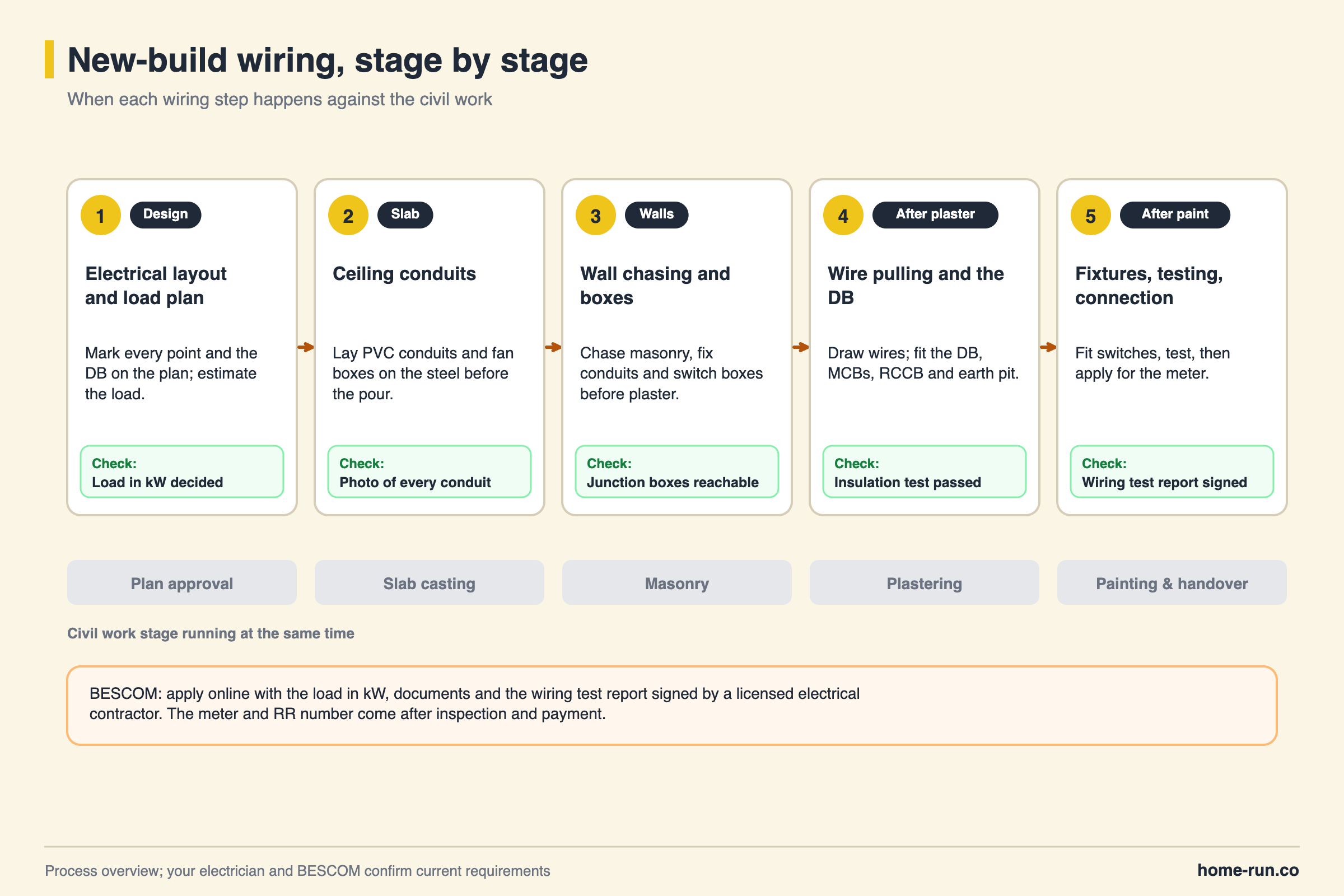
House wiring happens in five stages that track the civil work.
Electrical layout and load plan
Mark every point and the distribution board (DB) on the plan; estimate the load.
Ceiling conduits
Lay PVC conduits and fan boxes on the steel before the pour.
Wall chasing and boxes
Chase masonry, fix conduits and switch boxes before plaster.
Wire pulling and the DB
Draw wires; fit the DB, MCBs, RCCB and earth pit.
Fixtures, testing, connection
Fit switches, test, then apply for the meter.
Most new homes use concealed conduit wiring. See how concealed conduit wiring is installed.
How Do You Plan Circuits and Load for a New House?
You plan circuits by giving lighting, sockets and heavy appliances separate circuits, each with its own MCB (miniature circuit breaker).
- Lighting and fans: at least one per floor.
- General sockets: TV, fridge, chargers.
- Kitchen: separate 16 A sockets for the microwave, mixer-grinder and water purifier.
- Each AC and each geyser: a dedicated circuit, run straight from the board.
- Spare ways: empty DB slots for an EV charger or solar.
Never put two heavy appliances on one circuit. Apply for a realistic load, because changing the sanctioned load later takes effort.
Comparing loop-in and joint-box layouts? See our guide to types of electrical wiring and outlet planning.
Which Wire Size Is Used for House Wiring in India?
Indian homes typically use 1.5 sq mm copper wire for lights and fans, 2.5 sq mm for sockets and 4 sq mm for ACs and geysers. Your electrician confirms sizes from load and run length.
Wire size for house wiring in India
Copper conductor, PVC-insulated, in conduit| Circuit | Copper size (sq mm) | Notes |
|---|---|---|
| Lights and fans | 1.0–1.5 | 1.5 sq mm is the common choice for new homes |
| General sockets Most points | 2.5 | TV, fridge, chargers |
| AC and geyser | 4.0–6.0 | A 1.5-ton AC usually takes 4 sq mm on a 20 A or 25 A MCB |
For room-by-room switch and socket positions, see our house electrical wiring planning guide.
Which Wire Is Best for House Wiring in India?
The best wire for house wiring in India is ISI-marked, multi-strand copper wire in FR-LSH or HFFR grade. The grade sets how much smoke and toxic gas it gives off in a fire.
House wire grades compared
Insulation type and fire behaviour| Grade | Insulation | Standard | In a fire |
|---|---|---|---|
| FR | PVC with flame-retardant additives | IS 694 | Slows flame spread, but dense black smoke |
| FR-LSH (FRLS) Default pick | Modified PVC | IS 694 | Less smoke and acid gas than FR |
| HFFR (LS0H) Safest | Halogen-free polymer, no PVC | IS 17048 | Light smoke, no corrosive halogen gas |
FR-LSH wire still contains PVC and releases some halogen gas. Only HFFR (halogen-free flame retardant) wire avoids it.
How Do You Choose a House Wire Brand in India?
Choose a house wire brand by checking the coil marking, not the name alone. Polycab, Finolex, RR Kabel, Havells, V-Guard and Anchor by Panasonic sell ISI-marked house wire; Havells also sells Life Shield HFFR.
- ISI mark with a BIS licence number (CM/L).
- IS 694 (FR, FR-LSH) or IS 17048 (HFFR), plus size and grade, printed on the wire.
- Bright, multi-strand copper; IS 694 calls for 99.97% electrolytic-grade copper.
- Full coil length, usually 90 m.
Wiring a new home this month?
ISI-marked wires, conduits and switchgear delivered across Bengaluru.
What Are the House Wiring Rules in India?
House wiring rules in India come from Bureau of Indian Standards (BIS) codes and the Central Electricity Authority (CEA) safety regulations.
- IS 732: code of practice for electrical wiring installations, including testing.
- IS 694: PVC-insulated cables with copper or aluminium conductors.
- IS 3043: the code of practice for earthing.
- CEA (Measures relating to Safety and Electric Supply) Regulations, 2023: installation work only by a licensed electrical contractor, and no supply until insulation tests pass.
Give the house its own earth pit; never earth to water pipes. A 30 mA RCCB (residual current circuit breaker) trips on leakage that an MCB cannot sense.
Colour codes and older wiring systems are covered in our house wiring systems guide.
How Do You Get a BESCOM Connection for a New House?
You get a permanent BESCOM connection by applying online as a domestic low-tension (LT) consumer with a wiring test report signed by a licensed electrical contractor. New buildings also need an occupancy or completion certificate.
- Apply online on the BESCOM portal, stating the load in kW.
- Upload documents: ID, sale deed or khata, sanctioned plan, occupancy certificate.
- Site inspection and estimate by a BESCOM officer.
- Submit the wiring diagram and signed test report.
- Pay security deposits and service line charges.
- Meter fixed and an RR (revenue register) number issued.
The construction-stage supply does not convert on its own. Confirm current documents and fees with your BESCOM sub-division.
How Much Does Wiring a New House Cost?
House wiring cost in India is quoted per sq ft, and 2025–26 estimates vary widely: one source gives ₹20–55 per sq ft, another ₹100–250 per sq ft with labour and materials.
For 1,000 sq ft, that is about ₹20,000–55,000 or ₹1–2.5 lakh. The gap reflects what each quote includes, so ask for itemised quotes.
Licensed electrical contractor
RequiredPoints
- Legally allowed to do installation work
- Signs the test report BESCOM needs
- Tests insulation and earthing before supply
DIY or unlicensed labour
AvoidPoints
- Not allowed beyond swapping lamps, fans and switches
- No signed report, so no permanent connection
- No test gear for insulation or earth checks
Which Wiring Red Flags Should You Catch on Site?
Most red flags are visible only before the walls close, so check at the conduit and wire-pulling stages.
- Joints buried in walls: every joint belongs in an accessible junction box.
- Two ACs on one circuit: each AC and geyser needs its own wire and MCB.
- No earth wire at sockets: every socket and metal fitting needs the green earth conductor.
- No RCCB: MCBs alone do not stop shocks.