On this page
- Why Choose Granite for a Kitchen Slab?
- Which Granite Colours Work Best for a Kitchen Slab Design?
- How Do You Match Granite Colour and Pattern to Your Kitchen?
- Which Finish and Thickness Suit a Granite Kitchen Slab?
- Which Edge Profiles Suit a Granite Kitchen Slab Design?
- How Does Granite Compare with Quartz, Marble and Laminate?
- What Does a Granite Kitchen Slab Cost?
- How Is a Granite Kitchen Platform Installed?
- How Do You Spot a Poor-Quality Granite Slab?
- How Do You Maintain a Granite Kitchen Slab?
- Where Should You Buy Granite in Bengaluru?
- A granite kitchen slab design comes down to four choices: colour, finish, thickness and edge.
- Dark, dense granites such as Absolute Black and Black Galaxy resist stains best; light granites need more frequent sealing.
- Kitchen counters are usually 18–20 mm thick; a mitred edge makes the front look about 40 mm.
- Budget for the slab plus 8–12% wastage, edge work, cut-outs and 18% GST on slabs.
- Check every slab for cracks, resin-filled pits and dye before it is cut.
A granite kitchen slab design is the combination of granite variety, surface finish, thickness and edge profile used for your kitchen platform. Get these four right and the counter will handle heat, knives and daily spills for decades.
This guide covers the granite colours sold in South India, the finishes and edges masons offer, and what a typical L-shaped platform costs.
Why Choose Granite for a Kitchen Slab?
Granite is the default kitchen slab in Indian homes because it is hard, heat-tolerant and low in porosity. It also costs less than most engineered or imported surfaces.
- Durability: granite handles knives, heavy vessels and daily wear better than marble.
- Heat: a hot kadai or pressure cooker set down briefly will not scorch it, unlike resin-bound quartz or laminate.
- Low porosity: water absorption is often around 0.1–0.5%, tested under IS 1124, the Indian method for water absorption of natural building stone.
- Local supply: most kitchen granites are quarried in Karnataka, Andhra Pradesh, Telangana and Tamil Nadu.
Granite still absorbs oil and turmeric if left unsealed. The lighter and more speckled the granite, the more open its grain, so sealing matters more on white and grey stones than on solid black.
Which Granite Colours Work Best for a Kitchen Slab Design?
Black granites are the most practical kitchen slab colours, followed by browns and greys. Whites look brighter but show stains and need more care.
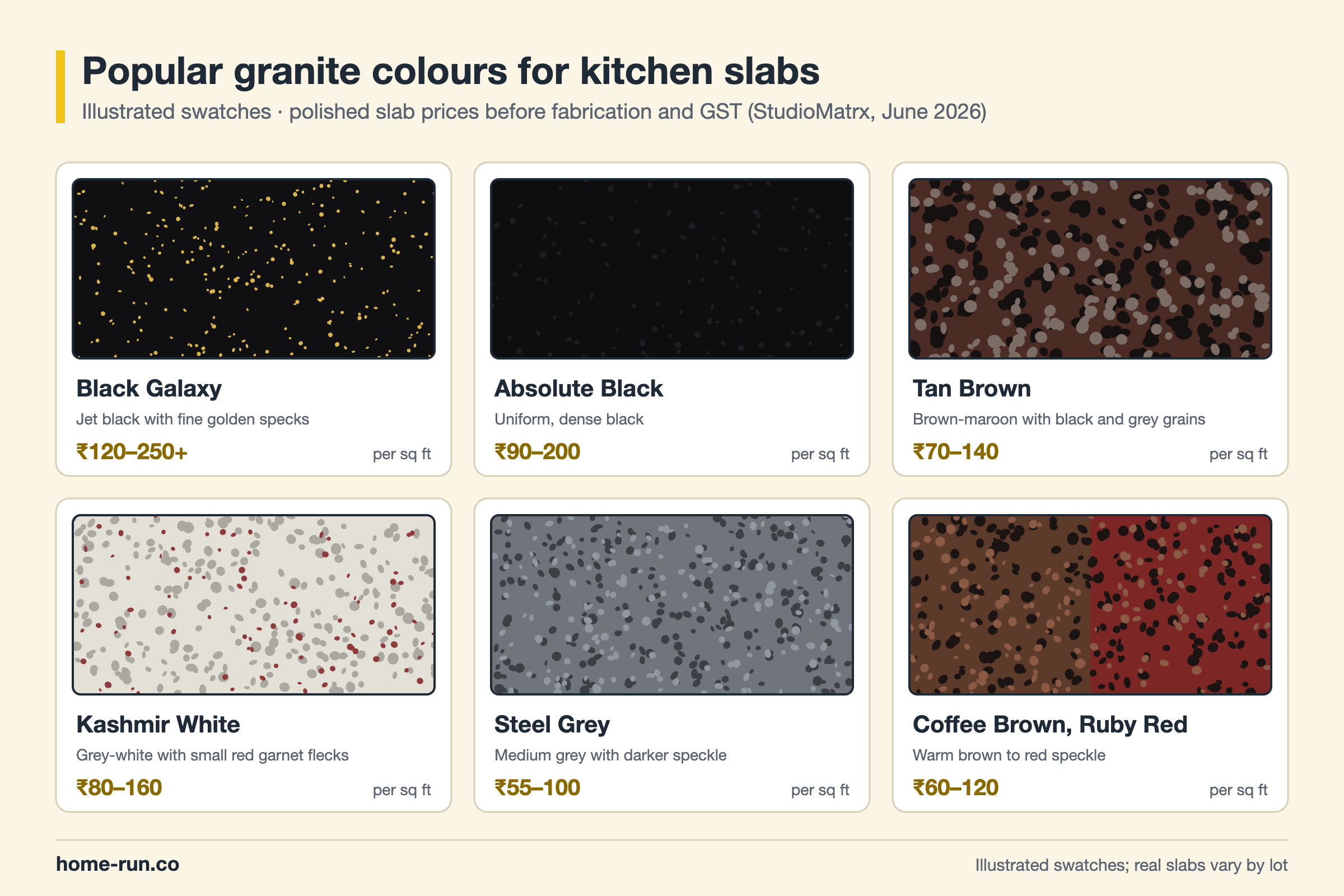
Popular kitchen granites in South India
Polished slab, ₹ per sq ft, before fabrication and GST| Granite | Look | Main source | Indicative price |
|---|---|---|---|
| Black Galaxy Classic | Jet black with fine golden specks | Ongole, Andhra Pradesh | ₹120–250+ |
| Absolute Black Low care | Uniform, dense black | Karnataka, Tamil Nadu | ₹90–200 |
| Tan Brown | Brown-maroon with black and grey grains | Salem, Tamil Nadu; Telangana | ₹70–140 |
| Kashmir White | Grey-white with small red garnet flecks | Tamil Nadu, Andhra Pradesh | ₹80–160 |
| Steel Grey Budget | Medium grey with darker speckle | Karnataka, Telangana | ₹55–100 |
| Coffee Brown, Ruby Red | Warm brown to red speckle | Karnataka, Andhra Pradesh | ₹60–120 |
Imported and exotic names such as Blue Pearl, Ubatuba Green, Alaska White, Colonial White and Viscount White are also sold in Indian yards. Expect these to cost well above the local varieties.
How Do You Match Granite Colour and Pattern to Your Kitchen?
Match the granite to your shutter colour and light: dark granite with light shutters for contrast, light granite with dark shutters to brighten a small kitchen.
- Small or dim kitchen: Kashmir White or a light grey reflects light and makes the platform feel larger.
- Modern, handle-less modular kitchen: Absolute Black or Steel Grey keeps the look plain and uniform.
- Warm wood shutters: Tan Brown or Coffee Brown picks up the wood tones.
- Busy patterns: speckled stones like Black Galaxy hide crumbs and water marks; plain stones show them.
- Backsplash: pair a busy granite with plain wall tiles, and a plain granite with a patterned tile.
Let either the granite or the backsplash carry the pattern, never both. Choose the slab first at the yard, then bring an offcut when you pick tiles.
For layout, platform height and depth, see our kitchen slab height and size planning guide.
Which Finish and Thickness Suit a Granite Kitchen Slab?
A polished finish at 18–20 mm thickness suits most granite kitchen slabs. Polishing gives the deepest colour and the most stain-resistant surface.
Granite surface finishes
For kitchen use| Finish | Look and feel | Kitchen verdict |
|---|---|---|
| Polished Default pick | Glossy, deepest colour | Best for counters; easy to wipe |
| Honed | Smooth matte, no shine | Calm look; shows oil marks, needs regular sealing |
| Leathered | Soft sheen, slightly textured | Hides fingerprints and smudges; good on black granite |
| Flamed Avoid indoors | Rough, high grip | For outdoor and wet floors, not counters |
Use 18–20 mm full slabs for kitchen counters. Floor-grade granite at 16–18 mm is too thin for overhangs, and economy 10–12 mm stone can crack under point loads. Some suppliers quote 15 mm, so confirm thickness in writing.
Which Edge Profiles Suit a Granite Kitchen Slab Design?
An eased (pencil) or half-bullnose edge suits most granite kitchen slab designs. Both edges are rounded enough to protect hips and children, and cheap to polish.
Granite edge profiles
Edge work is charged per running foot| Edge profile | Shape | Best for | Indicative cost |
|---|---|---|---|
| Eased / pencil Default pick | Square edge with slightly softened corners | Modern modular kitchens | Usually in base fabrication |
| Half-bullnose | Top corner rounded, flat bottom | Homes with children; easy to wipe | Quote per running ft |
| Bevel | Top corner cut at an angle | Crisp look, fewer chips than a sharp square edge | Quote per running ft |
| Full bullnose, ogee | Fully rounded, or an S-shaped moulding | Classic or traditional kitchens | ₹250–600 per running ft |
| Mitred (box) | Second strip glued under the front, looks about 40 mm thick | Islands and premium platforms | ₹150–400 per running ft |
Ask for a drip groove, a thin channel cut under the front edge, so spills drip to the floor instead of running onto the shutters.
How Does Granite Compare with Quartz, Marble and Laminate?
Granite offers the best balance of heat tolerance, hardness and price for an Indian kitchen. Engineered quartz looks more uniform, marble stains and etches, and laminate is cheapest but least durable.
Granite
Indian cookingPoint
- Natural stone; takes brief contact with hot vessels
- Every slab varies, so you pick the actual piece
- Needs periodic sealing, especially light colours
- Local varieties keep cost low
Engineered quartz
Uniform lookPoint
- Crushed quartz bound with resin; heat can scorch it
- Even colour and pattern across the whole run
- Non-porous, so no sealing needed
- Usually costs more than local granite
Kitchen countertop materials compared
Qualitative, for home kitchens| Material | Heat | Stains and acids | Upkeep | Cost |
|---|---|---|---|---|
| Granite Default pick | Good | Good when sealed | Seal every 1–3 years | Low to medium |
| Engineered quartz | Use trivets | Very good | Wipe only | Medium to high |
| Marble Avoid near hob | Good | Poor; lemon and tamarind etch it | Frequent sealing | Medium to high |
| Laminate | Poor | Fair | Edges swell if wet | Low |
What Does a Granite Kitchen Slab Cost?
A granite kitchen slab costs the slab rate plus wastage, edge work, cut-outs, GST and fixing labour. Local slab rates run about ₹55–250+ per sq ft (StudioMatrx, June 2026).
Sources disagree on counter-grade prices. Coohom (Nov 2025) quotes ₹120–350 per sq ft for entry slabs in Bengaluru, and ₹60–180 per sq ft for cutting, cut-outs and edges. Ask two yards for written rates on the same slab.
The ₹150 slab rate and ₹2,000 cut-out are example figures. Vanity basin cut-outs run ₹1,500–4,000 per bowl, so ask for the kitchen sink rate in your quote.
Building your kitchen platform?
Plywood, hardware and fixing materials delivered across Bengaluru.
How Is a Granite Kitchen Platform Installed?
A granite kitchen platform is installed by measuring the finished base, cutting the slab and cut-outs, fixing it level, then sealing the joints and surface.
- Finish the base first. The RCC or masonry platform, or the modular carcass, must be level and complete. Use BWR or BWP plywood (boiling-water-resistant or boiling-water-proof grades) for cabinet tops, never bare MDF.
- Template on site. The fabricator measures after the base is ready, not from drawings.
- Fix the sink and hob sizes. Give the fabricator the actual sink and hob models before any cut-out is made.
- Cut and polish edges. Edges, cut-outs and drip grooves are done at the yard or with wet cutting on site.
- Set and level. Bed the slab fully, check it with a spirit level, and keep joints away from the sink and hob.
- Seal. Fill joints with colour-matched epoxy, seal cut edges, and apply two thin coats of penetrating sealer.
For carcass and storage layout, read our modular kitchen design guide.
How Do You Spot a Poor-Quality Granite Slab?
A poor-quality granite slab shows hairline cracks, resin-filled pits, dye, uneven thickness or a dull sound when tapped. Inspect the full slab in daylight before it is cut.
- Hairline cracks or fissures: these can spread once the slab is cut and loaded.
- Dull ring when tapped: a sign of an internal crack or heavy resin filling.
- Resin-filled pits: common in cheap black and galaxy lots; look for glossy patches.
- Dye on black granite: rub a hidden spot with acetone on a white cloth; black colour on the cloth means dyed stone.
- Paler edge than face: another sign of colour enhancement.
- Uneven thickness or swirl marks: poor gangsaw cutting or polishing.
How Do You Maintain a Granite Kitchen Slab?
Maintain a granite kitchen slab by wiping it with a pH-neutral cleaner, blotting spills fast and resealing when water stops beading.
- Wipe daily with water and a mild, pH-neutral cleaner, then dry the top.
- Blot oil, turmeric, tea and lemon spills at once.
- Skip acidic descalers, lemon and vinegar; these strip the sealer and can etch some granites.
- Use a chopping board and set very hot tawas on a trivet near joints and edges.
- Do the water-drop test twice a year: if a splash darkens the stone within 10 minutes, reseal.
- Expect to reseal dense dark granite every 2–3 years, and light granite about once a year.
Where Should You Buy Granite in Bengaluru?
Buy granite from a yard where you can see and choose the actual slab. Bengaluru is South India's largest granite trading and processing hub, with stone from all four southern states.
- Pick the slab, not a sample: mark your slab and order 5–10% extra from the same lot for repairs.
- Compare yard and builder rates: builder packages can carry a margin over yard rates.
- Ask for wet cutting: granite dust is fine and harmful to breathe, so wet cutting protects workers and your home.
- Buy from licensed units: granite slurry from cutting units in Jigani, near Bengaluru, has drawn Karnataka State Pollution Control Board (KSPCB) action.
Before you visit a yard, fix your platform lengths and appliance sizes. Our guide to the standard kitchen size in feet helps you check the layout.