On this page
- What Type of Building Material Is Glass?
- How Did Glass Become a Building Material?
- What Are the Properties of Glass as a Building Material?
- What Types of Glass Are Used in Building Construction?
- How Is Glass Used in Modern Construction?
- Which Indian Standards Apply to Glass in Buildings?
- How Does Energy-Efficient Glass Cut Heat Gain in Indian Homes?
- What Drives the Cost of Glass in a Construction Project?
- What Are the Advantages and Disadvantages of Glass as a Building Material?
- What Glass Innovations Are Available in India?
- How Do You Choose Glass for Your Building Project?
- Building glass is mostly soda-lime silica float glass, about 2,500 kg/m³ in density.
- Fully tempered glass is about 4 times stronger in bending than ordinary annealed glass.
- Clear 6 mm float glass passes about 87% of visible light but also about 81% of solar heat.
- IS 16231 (Parts 1–4) guides glass selection; IS 2553 (Part 1) covers toughened and laminated safety glass.
- In Bengaluru homes, the glass's solar heat gain and shading matter more than its insulation value.
Glass as building material means sheet glass used in windows, doors, facades, partitions, railings and roofs to bring in light while keeping out weather. Almost all of it is soda-lime silica glass made by the float process, then cut, toughened, laminated or coated for the job.
This explainer covers what glass is made of, its properties, the main types in one table, where it is used, the Indian standards, and how to pick glass for an Indian home.
What Type of Building Material Is Glass?
Glass is an amorphous solid: a material that is hard like a crystal but has the disordered atomic structure of a liquid. Builders treat it as a brittle, transparent, non-combustible sheet material.
Standard building glass is made by melting three main raw materials at about 1,500–1,600 °C:
- Silica sand: the glass-forming base.
- Soda ash (sodium carbonate): lowers the melting temperature.
- Limestone or dolomite: adds lime, which makes the glass stable and water resistant.
Recycled broken glass, called cullet, is added to the batch to save energy.
Glass is the material. Glazing is the glass fitted into a frame. Fenestration is the whole opening, frame and glass together, and it is what energy codes rate.
How Did Glass Become a Building Material?
Glass became a common building material once makers could produce large, flat, cheap sheets. For most of history, window glass came in small, uneven panes made by hand.
Wikipedia's timeline of architectural glass gives these milestones:
- 1226: "broad sheet" glass first produced in Sussex, England.
- 1330: crown glass, spun into discs, produced in Rouen, France.
- 1843: Henry Bessemer tried an early float method, pouring glass onto liquid tin.
- 1959: Pilkington launched commercial float glass in the UK.
The float process floats molten glass on a bath of molten tin. The glass spreads into a flat ribbon with smooth, parallel faces, so it needs no grinding or polishing.
In India, Gujarat Guardian built the country's first float glass plant in 1993, according to Guardian Glass. Before that, most Indian window glass was drawn sheet glass, which shows more waviness.
Sources quote 500 BC, the 1st century or the 11th century for "the start" of glass. These dates refer to different things: first glass objects, glass blowing and sheet glass. For buildings, the float process of 1959 is the date that matters.
What Are the Properties of Glass as a Building Material?
The properties of glass as a building material are transparency, high compressive and surface hardness, low tensile tolerance (brittleness), moderate heat conduction, chemical resistance and non-combustibility.
The table gives typical values for soda-lime float glass, from the US National Glass Association (NGA) and an Indian maker's data sheet.
Properties of glass in construction
Typical soda-lime float glass| Property | Typical value | What it means on site |
|---|---|---|
| Density | 2,500 kg/m³ | A 6 mm pane weighs about 15 kg per m² |
| Young's modulus (stiffness) | 71.7 GPa | About as stiff as aluminium; large panes still flex under wind |
| Bending strength, annealed (mean) | 6,000 psi (≈ 41 MPa) | Breaks into large, sharp pieces |
| Bending strength, fully tempered (mean) | 24,000 psi (≈ 165 MPa) | About 4× annealed; breaks into small granules |
| Thermal expansion | 8.3 × 10⁻⁶ per °C | Needs clearance in the frame; uneven heating can crack it |
| Thermal conductivity | 0.9–1.0 W/m·K | A poor insulator on its own |
| Softening point | 715–729 °C | Does not burn, but ordinary glass cracks early in a fire |
| Refractive index | 1.5 | About 4% of light reflects off each face |
| U-value, 6 mm clear, single pane | 5.68 W/m²·K | Heat passes through easily |
| Visible light / solar factor, 6 mm clear | 86.6% / 81% | Bright, but lets in most of the sun's heat |
Five properties matter most when you choose glass for a home:
- Transparency: clear float glass passes most visible light, so rooms need less daytime lighting.
- Brittleness: glass does not bend or dent before it breaks, so impact and edge damage set its real strength.
- Heat transfer: single glass conducts heat and lets in solar radiation; coatings and air gaps change this.
- Durability: glass resists rain, most chemicals and UV, and does not rust, rot or fade.
- Fire behaviour: glass does not burn, but only tested fire-resistant glass holds back fire for a rated time.
Glass resists crushing very well, but it fails in tension from tiny surface scratches. That is why toughening, which puts the surface into compression, raises its usable strength so much.
What Types of Glass Are Used in Building Construction?
The main types of glass in construction are annealed float, toughened (tempered), heat-strengthened, laminated, insulated double-glazed units, solar control, low-E, acoustic and decorative glass. Each starts as float glass and is then processed.
Types of glass at a glance
What each type is for| Type | How it is made | How it breaks | Typical uses |
|---|---|---|---|
| Annealed float | Float glass cooled slowly to relieve stress | Large, sharp shards | Small fixed windows, cabinet fronts, mirrors |
| Toughened (tempered) Default safety pick | Heated, then cooled fast with air jets | Small blunt granules | Doors, shower screens, frameless partitions |
| Heat-strengthened | Heated, then cooled more slowly than toughened | Larger pieces that stay in the frame | Facade panels, inner layers of laminates |
| Laminated Holds together | Two or more panes bonded with a plastic interlayer | Cracks but sticks to the interlayer | Railings, skylights, overhead and street-side glazing |
| Insulated glass unit (IGU / DGU) | Two panes sealed around an air or gas gap | As per the panes used | Air-conditioned rooms, noisy roads |
| Solar control and low-E | Tinted body or metal-oxide coating | As per the base glass | West and south windows, facades |
| Acoustic | Laminated with a sound-damping interlayer, often in a DGU | Holds together | Bedrooms on main roads, studios |
| Decorative (frosted, patterned, back-painted) | Acid-etched, sand-blasted, rolled or painted | As per the base glass | Bathroom windows, wardrobes, kitchen backsplashes |
Annealed glass breaks into large, sharp pieces, so it is the wrong choice anywhere a person could fall or walk into it. Toughened glass cannot be cut or drilled after toughening, so all holes and cut-outs are made first.
How Is Glass Used in Modern Construction?
Glass is used in modern construction wherever a building needs daylight, views or a clean, open look without losing weather protection. In homes, windows and doors take the most glass.
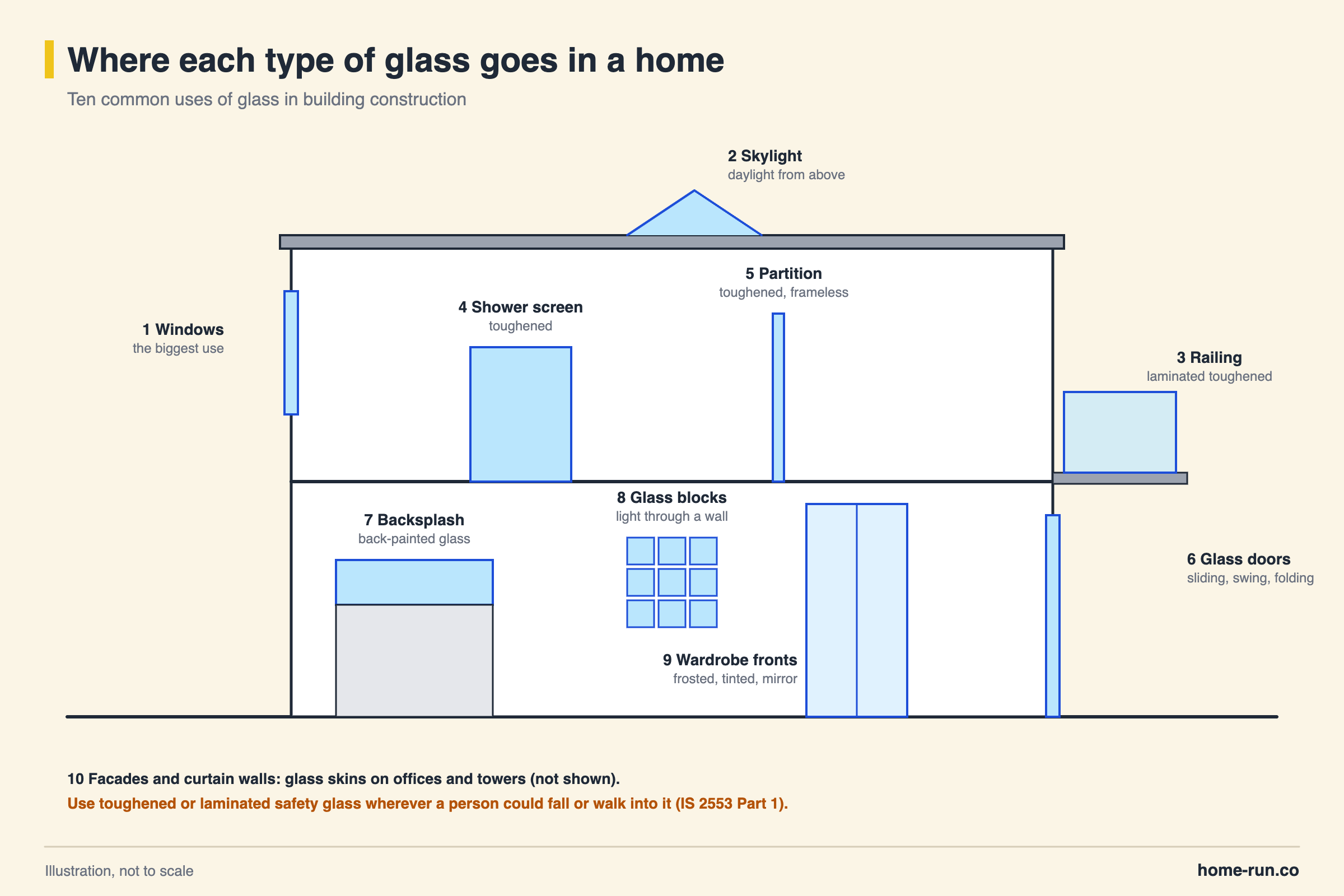
Here are 10 common uses of glass in building construction:
- Windows: the biggest use; see our guide to types of windows and doors.
- Glass doors: sliding, swing and folding doors to balconies and gardens.
- Facades and curtain walls: non-load-bearing glass skins on offices and towers.
- Skylights and roof glazing: daylight from above; see our skylight roof guide.
- Balcony and stair railings: laminated toughened glass in steel or aluminium shoes.
- Shower enclosures: toughened glass screens and doors.
- Interior partitions: glass walls in offices and open-plan homes.
- Kitchen backsplashes and shutters: back-painted or lacquered glass.
- Glass blocks: hollow blocks that pass light through a wall.
- Wardrobe and cabinet fronts: frosted, tinted or mirror glass.
Can you build a house with glass? Not as the structure. Glass walls, floors and stair treads exist, but they need engineered laminated glass on a steel or concrete frame, designed for the load.
What is chromatic glass?
Chromatic (chromogenic) glass changes its tint in response to light, heat or electricity. Photochromic glass darkens in sunlight, thermochromic glass tints as it warms, and electrochromic "smart glass" tints at the flick of a switch.
Electrochromic and switchable privacy glass is mostly used in offices and premium homes because it costs far more than coated glass.
Which Indian Standards Apply to Glass in Buildings?
Glass in Indian buildings is covered mainly by IS 16231, the Bureau of Indian Standards (BIS) code of practice for use of glass in buildings, and by product standards for float and safety glass.
Key BIS standards for building glass
Current editions listed by BIS| Standard | Title | What it covers |
|---|---|---|
| IS 16231 (Part 1): 2019 | Use of Glass in Buildings, Part 1: General Methodology for Selection | How to choose glass for a location |
| IS 16231 (Part 2): 2019 | Part 2: Energy and Light | Daylight and thermal performance |
| IS 16231 (Part 3): 2019 | Part 3: Fire and Loading | Fire behaviour and wind or other loads |
| IS 16231 (Part 4) | Part 4: Safety Related to Human Impact | Where safety glass is needed |
| IS 2553 (Part 1): 2018 | Safety Glass, Part 1: Architectural, Building and General Uses | Toughened and laminated safety glass, with tests |
| IS 14900: 2018 | Transparent Float Glass: Specification | Quality of the base float glass |
IS 2553 (Part 1) tests toughened glass by breaking it and counting the fragments in a 5 cm square. It tests laminated glass with a 38 mm steel ball dropped from 4.88 m and by boiling samples for 2 hours.
Doors, panels beside doors, low glazing near the floor, railings, shower screens and overhead glass are where people get hurt. Use toughened or laminated glass there, as IS 16231 (Part 4) sets out, and laminated glass anywhere a broken pane could fall on someone.
How Does Energy-Efficient Glass Cut Heat Gain in Indian Homes?
Energy-efficient glass cuts heat gain mainly by blocking solar radiation before it enters the room. In most of India, sun through windows adds more cooling load than heat conducted through the glass.
Two ratings on a glass data sheet tell you most of what you need:
- SHGC (solar heat gain coefficient) or solar factor: the share of the sun's heat that gets through, from 0 to 1. Lower is cooler.
- U-value: heat that flows through per m² for each 1 °C difference inside to outside, in W/m²·K. Lower insulates better.
Also check VLT (visible light transmittance), the share of daylight that gets through. Good solar control glass keeps VLT reasonably high while SHGC drops.
The 500 W/m² figure is an assumption for illustration, not a design value. Ask your consultant for a proper heat load calculation for your orientation.
Bengaluru sits in the temperate climate zone of BEE's Eco Niwas Samhita 2024, the residential energy code. Shade first with overhangs and fins, pick low-SHGC glass for west and south faces, and pay for double glazing only for air-conditioned rooms or noise.
Eco Niwas Samhita 2024 links glass area to daylight. It asks for a minimum VLT of 0.27 when glass is up to 30% of the wall area, falling to 0.11 at 61–70%. It also sets an openable window area of 12.5% of floor area for temperate climates.
Shading counts as well. The code's "equivalent SHGC" multiplies the glass SHGC by an external shading factor, so a deep overhang can make ordinary glass perform like coated glass.
What Drives the Cost of Glass in a Construction Project?
The cost of glass in a project depends on the glass type, thickness, size, processing, frame and installation, more than on the raw sheet price. Each processing step adds cost to the base float glass.
- Type and layers: toughening, laminating, coating and double glazing each add a step.
- Thickness: wind load, pane size and height set the thickness your fabricator specifies.
- Size and cut-outs: large or shaped panes and holes for hinges cost more and raise breakage risk.
- Frame: uPVC, aluminium, steel or timber frames often cost as much as the glass. Compare frames in our aluminium windows guide.
- Hardware and sealants: patch fittings, spider fittings and structural silicone for frameless glass.
- Running costs: AC energy, cleaning, and replacement of broken or fogged units.
One quote may price 5 mm clear annealed glass and another 6 mm toughened glass with a coating. Ask every supplier to state type, thickness, make, coating and SHGC for each opening before you compare totals.
The cheapest glass can cost more over the life of the house. On a large west-facing window in an air-conditioned room, solar control glass can save cooling energy every summer.
What Are the Advantages and Disadvantages of Glass as a Building Material?
The main advantages of glass as a building material are daylight, views, durability and easy cleaning. The main disadvantages are heat gain, glare, breakage risk, low insulation and cost.
Advantages of glass
Why builders use itPoints
- Brings daylight deep into rooms
- Keeps views while blocking rain and dust
- Does not rust, rot, swell or fade
- Easy to clean and hygienic
- Does not burn
- Recyclable as cullet
Disadvantages of glass
What to plan forPoints
- Lets in solar heat unless coated or shaded
- Causes glare on low sun angles
- Annealed glass breaks into sharp shards
- Single glass insulates poorly
- Processed and coated glass costs more
- Needs regular cleaning to stay clear
Why do skyscrapers use so much glass? Curtain-wall glass is light, quick to install from prefabricated panels and gives offices daylight and views. In hot climates, those towers rely on coated glass and heavy air conditioning to handle the heat.
For homes in Bengaluru, a balanced approach works best. Use generous glass on the north and east, smaller or well-shaded glass on the west, and safety glass wherever people move close to it.
What Glass Innovations Are Available in India?
Glass sold in India now goes well beyond clear float. Large float glass makers with plants in India, such as Asahi India Glass (AIS), Guardian and Saint-Gobain, publish data sheets for coated and processed products.
- Low-E and solar control coatings: metal-oxide layers that reflect heat but pass light.
- Double and triple glazed units: single glazing is about 4.8–5.8 W/m²·K, double glazing about 1.2–3.7, and triple glazing can go below 1.
- Switchable privacy glass: laminated glass that turns from frosted to clear with an electric current.
- Fire-resistant glass: tested assemblies that hold back fire for a rated time.
- Self-cleaning and anti-reflective coatings: for skylights and display windows.
How Do You Choose Glass for Your Building Project?
Choose glass opening by opening: first decide what each opening must do for safety, heat, light, privacy and noise, then pick the type and thickness that meets it.
- Map the risk. Mark doors, low glazing, railings, showers and overhead glass as safety-glass locations.
- Check the orientation. West and south faces need low SHGC or external shading.
- Set privacy needs. Use frosted, patterned or switchable glass for bathrooms and street-facing rooms.
- Consider noise. Rooms on main roads benefit from laminated acoustic glass or a DGU.
- Ask for thickness by calculation. Your fabricator or engineer should size glass for pane area and wind load.
- Match the window style. See our window designs for home for layouts that suit each room.
- Specification lists type, thickness, coating and SHGC for each opening.
- Safety glass carries a permanent mark naming the maker and the standard.
- Test certificate to IS 2553 (Part 1) for toughened and laminated glass.
- All holes and cut-outs made before toughening.
- Warranty on DGU seals against fogging inside the unit.
- Installation includes setting blocks, edge clearance and weather sealant.
Red flags when buying architectural glass
- No mark on "toughened" glass: you cannot confirm it was toughened.
- Chipped or rough edges: edge damage is where most glass cracks start.
- Distortion or waves: a sign of poor base glass or poor toughening.
- Mist between panes: a failed DGU seal.
- No data sheet for coated glass: you cannot check the SHGC claim.
Fitting windows and doors?
Hardware, sealants and fixing materials delivered across Bengaluru.