On this page
- What Is a Flue in Chimney and How Does It Work?
- Where Do Indian Homes Use a Flue?
- What Are the Types of Flue in Chimney Systems?
- What Are Common Chimney Flue Problems in Indian Homes?
- Why Do Gas Geysers Need a Flue, and Where Should They Go?
- Why Does Flue Sizing and Installation Matter?
- How Do You Maintain a Flue in Chimney Systems?
- How Do You Choose the Right Professional for Flue Work?
- How Do You Check Your Chimney Flue Is Ready for Use?
- A flue in chimney is the inner duct that carries smoke, heat and combustion gases out of the house.
- Common flue types are clay tile liners, stainless steel liners and metal flue pipes.
- In Indian homes, the flue question comes up most with gas geysers, fireplaces and wood stoves; a kitchen chimney uses an exhaust duct instead.
- NFPA 211 asks for a chimney and flue inspection at least once a year.
- A flueless gas geyser in a closed bathroom can cause carbon monoxide poisoning; Indian doctors have documented cases.
A flue in chimney is the inner passage that carries smoke, hot gases and fumes from a fire or fuel-burning appliance to the open air. The chimney is the whole structure; the flue is the duct inside it.
This page covers flues for fireplaces, stoves and gas geysers. For kitchen hoods, suction and duct routing, see our home chimney guide.
What Is a Flue in Chimney and How Does It Work?
A flue works by draught: hot gases are lighter than the cooler outside air, so they rise up the flue and pull fresh air into the fire behind them. This natural-draft venting needs no fan.
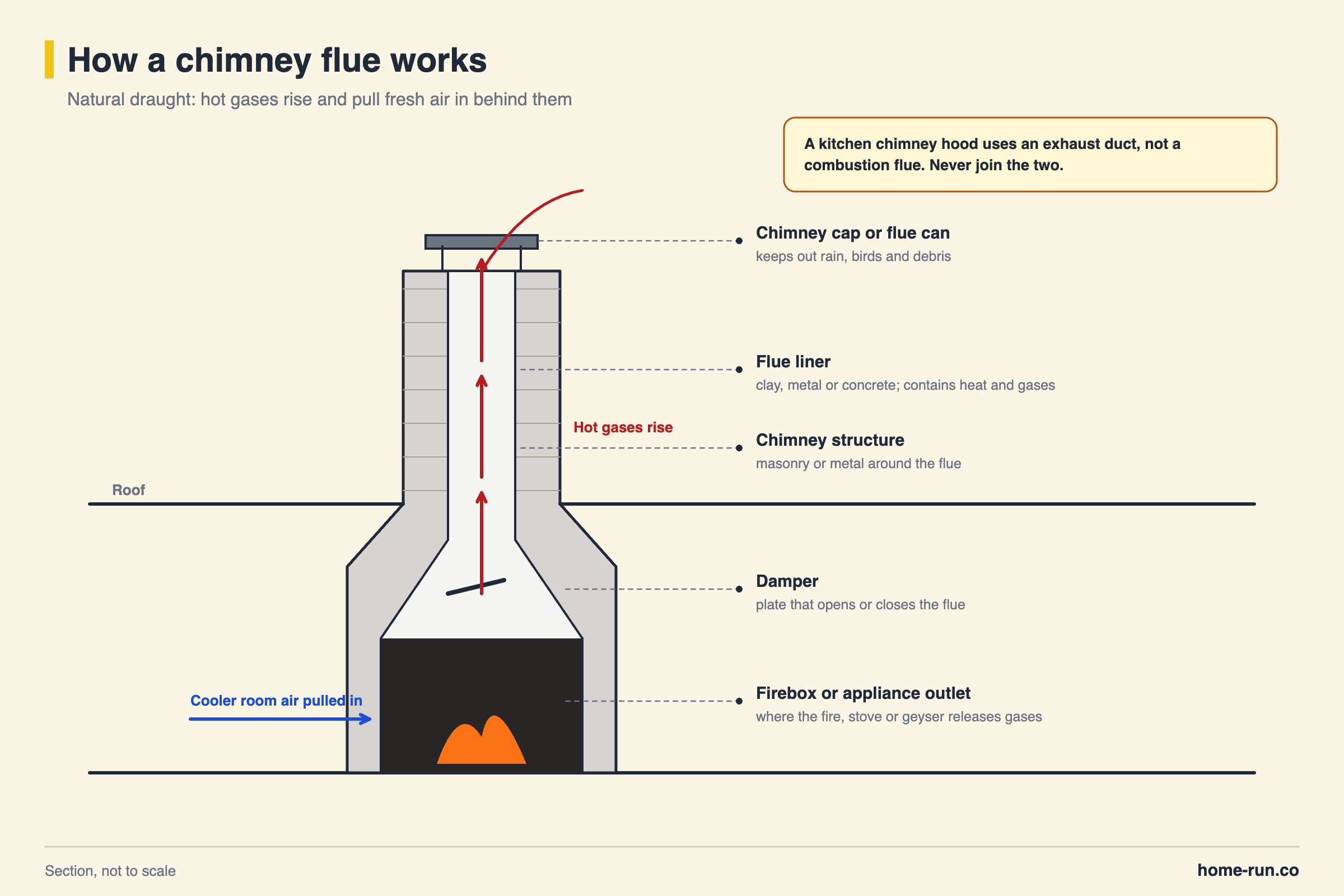
The flue in chimney meaning is simple. "Flue" names the gas passage; "chimney" names the masonry or metal structure around it. One chimney can hold more than one flue.
A basic flue system has these parts:
- Firebox or appliance outlet: where the fire, stove or geyser releases its gases.
- Damper: a plate that opens or closes the flue on fireplaces.
- Flue liner: the clay, metal or concrete lining that contains the heat and gases.
- Flue pipe or connector: the pipe that links a stove or geyser to the flue.
- Chimney cap or flue can: the cover or pot on top that keeps out rain, birds and debris.
A flue carries combustion gases from burning fuel. A kitchen chimney in India is an electric hood that pulls cooking smoke and grease out through an exhaust duct. That duct is not a combustion flue, and the two should never be joined.
Where Do Indian Homes Use a Flue?
Most Indian city homes have no fireplace, so a flue usually serves one of these appliances:
- Gas geysers: LPG or piped natural gas (PNG) instant water heaters burn gas and release combustion gases that must go outdoors.
- Fireplaces and wood-burning stoves: found in hill-station homes, farmhouses and some villas.
- Traditional chulhas and tandoors: wood or charcoal cooking fires that need a smoke outlet.
- Boilers and generators: in larger buildings, handled by engineers.
The Bureau of Indian Standards (BIS) has a dedicated code for this: IS 1649:1962, the code of practice for design and construction of flues and chimneys for domestic heating appliances. It dates from 1962, so ask your architect which current rules apply to your building.
What Are the Types of Flue in Chimney Systems?
The main flue types are clay tile liners, stainless steel liners, metal flue pipes and cast-in-place liners. Each suits a different chimney and appliance.
Chimney flue types compared
General guidance; follow the appliance maker's flue specification| Flue type | What it is | Suits | Watch for |
|---|---|---|---|
| Clay tile liner Masonry default | Fired clay sections stacked inside a brick chimney | Open fireplaces in masonry chimneys | Tiles crack in a chimney fire or with rapid heating |
| Stainless steel liner Relining pick | Metal tube slid down an existing chimney | Wood-burning stoves, gas appliances, relining old flues | Grade and size must match the fuel |
| Metal flue pipe | Single-wall or twin-wall pipe run from the appliance | Stoves and gas geysers without a masonry chimney | Clearance from wood, ceilings and wiring |
| Cast-in-place liner | Insulating concrete mix poured around a former inside the chimney | Repairing old or uneven masonry flues | Specialist work; hard to reverse |
| Unlined brick flue Avoid | Bare brick passage with no liner | Old buildings only | Gas and heat leak through mortar joints |
Clay tiles and stainless steel liners differ most in how they age:
Traditional masonry flue
Clay tilePoints
- Built with the chimney
- Long life if never overheated
- Cracked tiles are hard to reach
- Best for open wood fires
Modern metal flue
Most retrofitsPoints
- Fitted inside or outside the wall
- Smooth bore, easier to sweep
- A damaged section can be replaced
- Suits stoves and gas appliances
Heat-resistant refractory bricks line the firebox below the flue, where the fire burns hottest.
What Are Common Chimney Flue Problems in Indian Homes?
The most common flue problems are blockages, creosote buildup and cracked or holed flue liners. All three can push smoke or carbon monoxide (CO) back into the room.
- Blockages: bird nests, leaves, fallen bricks or debris stop the gases from rising. Unused flues fill up during long idle periods.
- Creosote buildup: creosote is a black or brown tar-like residue from wood smoke. It forms when smoke condenses on a cool flue wall and it burns easily.
- Cracked flue tiles: a chimney fire runs at about 2,000°F (around 1,090°C), hot enough to crack tiles and loosen mortar.
- Hole in chimney flue: rust in metal flue pipes or missing mortar lets gases leak into rooms or the roof space.
- Damp and moss: rain entering an uncapped flue soaks the masonry and weakens joints over each monsoon.
Flue gas temperature in chimney matters too. When the flue runs cool, smoke condenses and leaves more creosote. CSIA lists unseasoned wood, a half-closed damper and overloaded stoves as common causes.
Smoke stains around the chimney breast, smoke leaking through mortar joints and a strong smell when the fire is out all point to a flue fault. Stop using the fire and get the flue inspected.
Why Do Gas Geysers Need a Flue, and Where Should They Go?
Gas geysers need a flue or open-air location because burning LPG or PNG makes carbon monoxide when air runs short. CO is a colourless, odourless gas, according to the US Centers for Disease Control and Prevention (CDC).
A 2013 study in the Annals of Indian Academy of Neurology reported 26 people who collapsed, had seizures or showed CO poisoning while bathing in ill-ventilated bathrooms with a flueless gas geyser. The authors called this "gas geyser syndrome" and said it is entirely preventable.
Follow these gas geyser rules:
- Buy a BIS-licensed geyser made to IS 15558, the Indian Standard for domestic gas instantaneous water heaters.
- Install the geyser outside the bathroom in a ventilated spot, as one city gas distributor's installation guidelines require.
- If the model has a flue outlet, run the flue pipe to open air, never into a closed shaft or false ceiling.
- Keep the bathroom ventilator or exhaust fan open and running while the geyser is on.
- Fit a battery CO detector near the bathroom and bedrooms, as the CDC advises for homes with gas appliances.
CO symptoms include headache, dizziness, weakness, nausea, vomiting, chest pain and confusion, says the CDC. If anyone feels unwell in the shower, turn off the geyser, get them into fresh air and seek medical help.
Why Does Flue Sizing and Installation Matter?
A flue that is too small cannot carry all the smoke, so smoke spills into the room. A flue that is too large lets gases cool and slow down, which leaves more creosote.
For a wood fireplace, the US IRC sets the flue's net area at 1/12 of the fireplace opening for round flues, 1/10 for square flues and 1/8 for long rectangular flues (2:1 or more). For stoves and gas geysers, use the flue size the appliance maker specifies.
Height matters as much as size. The IRC asks for a chimney at least 3 ft (914 mm) above the point where it leaves the roof and 2 ft (610 mm) higher than any part of the building within 10 ft (3,048 mm).
The IRC also asks for clay liners to run up vertically, never more than 30° off vertical, and to be laid in refractory mortar.
How Do You Maintain a Flue in Chimney Systems?
You maintain a flue by inspecting it at least once a year and sweeping it whenever deposits build up. NFPA 211, the US standard for chimneys, fireplaces, vents and solid fuel-burning appliances, says chimneys "shall be inspected at least once a year".
- Get the flue inspected before the first fire of the cool season and after any chimney fire.
- Sweep a masonry fireplace flue at 1/8 inch (about 3 mm) of sooty buildup, or sooner if glazed creosote appears, as CSIA advises.
- Check the chimney cap or flue can after each monsoon for rust, gaps and nests.
- Look for cracked tiles, gaps in mortar joints and rusted pipe joints.
- Burn only dry, seasoned wood, and open the damper fully before lighting.
- Service gas geysers once a year, as the CDC advises for fuel-burning appliances.
Kitchen chimneys need different care: filter and duct cleaning, covered in our home chimney maintenance section.
How Do You Choose the Right Professional for Flue Work?
Choose a professional who has installed flues for your exact appliance type: wood stove, fireplace or gas geyser. India has no widely used chimney-sweep certification, so experience and references count most.
- Gas geysers: use the brand's authorised installer or your city gas distributor's approved technician.
- Fireplaces and stoves: ask for photos of past flue jobs and the liner or pipe they plan to use.
- Structural changes: involve your architect or structural engineer before cutting a slab or roof.
- Reviews and references: call one or two past clients and ask how the flue has performed.
For whole-house air movement beyond the flue, see our guide to types of ventilation systems.
How Do You Check Your Chimney Flue Is Ready for Use?
Check your chimney flue in four steps before you light a fire or run a gas appliance:
- Look up the flue. With a torch, check for light at the top and for nests or debris.
- Check the outside. Look for a cap, sound mortar and a chimney top clear of the roof.
- Test the draught. A small flame or smoke held near the opening should lean into the flue.
- Book an inspection. If you see cracks, stains or smoke spillage, call a professional before use.
Repairing a chimney or fireplace?
Cement, bricks and hardware delivered across Bengaluru.