On this page
- What Does a Home Chimney Do in an Indian Kitchen?
- What Are the Main Parts of a Home Chimney?
- Auto-Clean, Baffle or Filterless: Which Home Chimney Type Suits Indian Cooking?
- Which Home Chimney Mounting Types Are There?
- What Size Home Chimney Do You Need: 60 cm, 75 cm or 90 cm?
- How Much Suction Does a Home Chimney Need?
- Ducted or Ductless: Which Home Chimney Works in an Indian Flat?
- What Are the Key Home Chimney Installation Points?
- How Much Does a Home Chimney Cost in India?
- How Do You Clean and Maintain a Home Chimney?
- A home chimney has five working parts: hood, filter, motor, oil collector and duct.
- Pick a chimney at least as wide as your hob; go wider for island or heavy cooking.
- For daily frying and tadka, brands suggest 1,000–1,200 m³/hr or more of rated suction.
- A short, straight 6-inch duct matters more than an extra 200 m³/hr on the box.
- Range hoods sold in India must meet IS 302 (Part 2/Sec 31) and carry the BIS mark.
A home chimney is an electric kitchen hood fixed above the hob. It sucks in smoke, oil droplets and cooking smells, then vents them outside through a duct or filters them and returns the air to the room.
In India, "home chimney" almost always means this kitchen appliance. A fireplace or boiler flue is a different thing.
What Does a Home Chimney Do in an Indian Kitchen?
A home chimney captures cooking fumes at the source, before they spread. Indian frying, tadka and masala cooking throw up oil mist that settles as a sticky film on cabinets, tiles and ceilings.
An exhaust fan on the wall only moves room air. A chimney sits directly over the pan, so it catches the rising plume first and traps much of the grease in its filter.
A ducted chimney removes smoke, heat and moisture from the kitchen. A ductless one traps grease and some smell, but returns warm air to the room. Results depend on matching size, suction and duct to how you cook.
What Are the Main Parts of a Home Chimney?
A home chimney has a hood, a filter or oil-separating system, a motor and blower, an oil collector, a duct or carbon filter, and controls with lights.
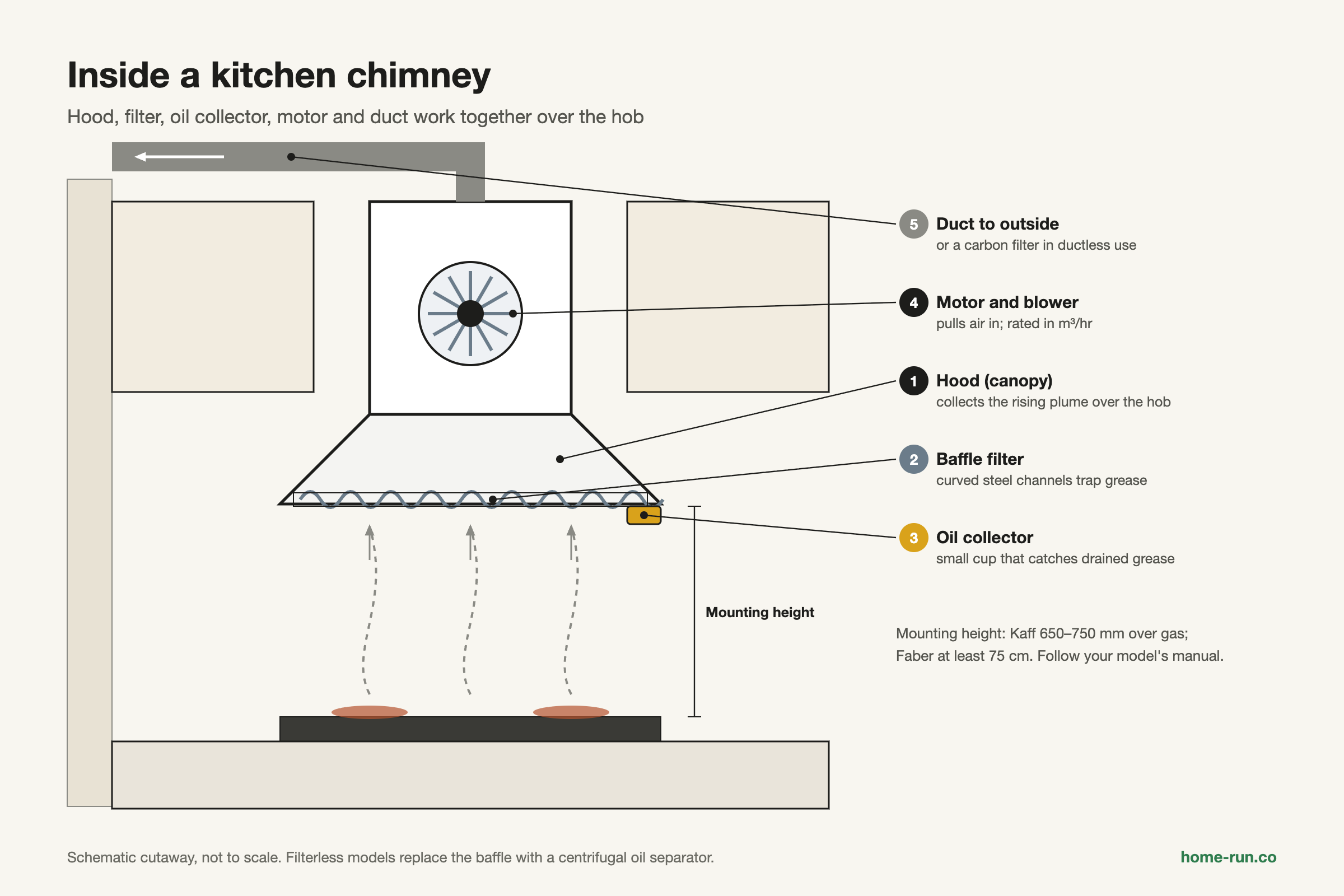
Parts of a kitchen chimney and what each one does
Names you will see on spec sheets| Part | What it does | What to check |
|---|---|---|
| Hood (canopy) | Collects the rising plume over the hob | Width and depth cover the front burners |
| Filter | Traps grease: baffle (curved steel channels) or mesh (layered metal net) | Removable and dishwasher-safe, or filterless |
| Motor and blower | Pulls air in; rated in m³/hr | Suction, noise in dB, BLDC or standard motor |
| Oil collector | Small cup or tray that catches drained grease | Easy to reach and empty |
| Duct or carbon filter | Duct vents air outside; carbon filter absorbs smell in ductless use | Duct size and route, or carbon filter cost |
| Controls and lights | Touch, push-button, motion-sensor or voice; LED lamps over the hob | Works with oily or wet hands |
Auto-Clean, Baffle or Filterless: Which Home Chimney Type Suits Indian Cooking?
All three types handle Indian cooking. The difference is how the grease is caught and how much cleaning you do.
- Baffle filter chimney: smoky air turns through curved steel channels, and oil sticks to the walls. You remove and degrease the filters.
- Filterless chimney: a fast blower flings oil outward into a collector. There is no filter to wash, but the collector and inside still need cleaning.
- Heat auto-clean chimney: a heating element warms the inside so trapped oil melts and drains into the collector. Most auto-clean models in India are also filterless.
Chimney filter and cleaning types compared
Qualitative; check each model's manual| Type | Your cleaning effort | Heavy frying | Watch out for |
|---|---|---|---|
| Baffle filter Budget | Medium to high: wash filters regularly | Good if cleaned | Suction drops fast with clogged filters |
| Mesh filter Avoid for frying | High: clogs quickly | Weak | Oil blocks the fine mesh |
| Filterless | Low to medium | Good | Collector and interior still need wiping |
| Heat auto-clean Common pick | Low: run the cycle, empty the tray | Good | Not zero maintenance; periodic deep clean |
Which Home Chimney Mounting Types Are There?
A home chimney is wall-mounted, island (ceiling-hung) or built-in. The shape of the glass is a separate, mostly visual choice.
- Wall-mounted: fixed to the wall behind the hob. This is the usual choice in Indian flats.
- Island: hangs from the ceiling over a central hob in an open kitchen. It needs a ceiling duct route and costs more to fit.
- Built-in: hidden inside the overhead cabinet of a modular kitchen.
- Styles: curved glass, flat, slant (T-shape) and pyramid describe looks and how easily you can wipe them.
Planning cabinets now? Fix the chimney position and duct route before tiling, as covered in our modular kitchen design guide.
What Size Home Chimney Do You Need: 60 cm, 75 cm or 90 cm?
Choose a chimney at least as wide as your hob, never narrower. The number in cm is the hood width, not its power.
Chimney width vs hob size
Measure your own hob; widths vary by brand| Chimney width | Typical hob | Good for |
|---|---|---|
| 60 cm Most common | 2-burner and most 3-burner hobs | Compact flat kitchens |
| 75 cm | 3-burner hobs up to about 75 cm wide | A little extra capture on each side |
| 90 cm | 3-, 4- and 5-burner hobs | Large hobs, heavy cooking, island setups |
If your overhead cabinet allows it, one size wider than the hob catches more smoke. Check the cabinet cut-out before you order.
Unsure of your counter length? See standard kitchen sizes in feet.
How Much Suction Does a Home Chimney Need?
Most Indian kitchens with regular cooking need a chimney rated above 1,000 m³/hr, and about 1,200 m³/hr or more for daily deep frying (Kaff and Glen buying guides). Suction capacity, also written CMH, is the air the motor moves per hour in test conditions.
Every extra metre of duct, every bend and a narrow 4-inch pipe cut real airflow and raise noise. More suction also means more sound, so compare dB figures; Glen suggests looking for models below 58 dB.
Ducted or Ductless: Which Home Chimney Works in an Indian Flat?
A ducted chimney works better wherever you can run a duct to an outside wall or shaft. A ductless chimney suits rented flats where you cannot cut the wall.
Ducted
Better extractionOwned homes with an outside wall.
- Sends smoke, heat and moisture outside
- Needs a 6-inch hole in the wall
- Duct ideally under 12 ft, 2 bends or fewer
- No carbon filters to buy
Ductless (recirculating)
No wall cuttingRented flats and inner kitchens.
- Filters air and returns it to the room
- Does not remove heat or steam
- Carbon filter every 3 to 6 months
- Easier to remove when you move
What Are the Key Home Chimney Installation Points?
Install a home chimney at the height in its manual, close to a dedicated socket, with the shortest straight duct you can manage. Plan these before buying, in this order:
- Mounting height: Kaff gives 650–750 mm above a gas hob and about 550–650 mm for induction. Faber asks for at least 75 cm over gas and 65 cm over electric or induction. Follow your model's manual.
- Wall strength: fix brackets into brick or concrete. Hollow block or board walls need suitable anchors.
- Power point: place a switched socket above the hood line, not behind the hob. Plan it with your house electrical wiring layout.
- Duct hole: a 6-inch core cut through the outside wall, about 7 ft above the floor or above the window lintel.
- Duct route: keep it short and straight. Seal joints with foil tape and fit a cowl on the outside.
- Who fits it: book the brand's technician after delivery so the warranty stays valid.
- Duct longer than 12 ft or with three or more bends
- Socket behind or beside the hob, within reach of flame or spills
- Hood mounted lower than the manual allows, which is a fire risk
- A 4-inch pipe on a high-suction chimney
V-Guard's chimney terms, for example, include a 6 ft aluminium flexible duct, brackets and screws in the kit. Extra duct, core cutting, electrical work and clamps are charged on the technician's quote. Ask your brand before booking.
Placing the hob and chimney together? Our kitchen slab height and size guide sets the counter level the hood height is measured from.
How Much Does a Home Chimney Cost in India?
Most wall-mounted home chimneys in India list between about ₹4,000 and ₹24,000. A basic 60 cm filterless model starts near ₹4,000, and BLDC heat auto-clean 60–90 cm models from Faber, Elica, Hindware and Havells mostly sit around ₹12,500 to ₹23,500 (Smartprix listings, checked 12 Nov 2026).
Prices rise with width, BLDC motors, motion or voice controls, glass finish and longer motor warranty. Island and built-in designs sit above these bands. Get the installation quote along with the product price.
Fitting out your kitchen?
Tiles, plywood and electrical supplies delivered across Bengaluru.
How Do You Clean and Maintain a Home Chimney?
Wipe the outside every week, empty the oil collector regularly, and give the chimney a deep clean or technician service periodically. Heavy frying shortens every interval.
Wipe and check
Wipe the glass, body and controls with mild soap. Check the oil collector level.
Filters and tray
Soak baffle filters in hot soapy water, or run the auto-clean cycle and empty the tray.
Carbon filter
Replace the carbon filter on ductless models.
Deep service
Have a technician clean the blower and check the duct, or use the brand's AMC (annual maintenance contract).
When suction feels weak, check the filters, the collector, duct joints and the outside cowl first. A rattle often means a loose duct or an oily blower.
Built-up oil in filters and ducts can catch fire from a high flame. Range hoods sold in India come under IS 302 (Part 2/Sec 31):2009, the BIS safety standard for range hoods, through a Quality Control Order. Look for the ISI mark and licence number.