On this page
- What Are Refractory Bricks?
- What Raw Materials Go Into Them, and How Are They Made?
- What Are the Main Types of Refractory Bricks?
- Which Properties Decide Heat Resistance and Strength?
- Where Are Fire Bricks Used in Industry and at Home?
- What Challenges Does India's Refractory Industry Face?
- How Do You Choose the Right Grade?
- How Are the Bricks Laid and Cured?
- Where Can You Buy Refractory Bricks in India, and at What Price?
- Refractory bricks line furnaces, kilns, boilers and ovens that run above about 1,000 °C.
- Pick the grade by chemistry: acid (silica, fireclay), neutral (high alumina) or basic (magnesia).
- IS 6:1983 fireclay bricks need at least 30% alumina and 20 MPa crushing strength (Type 1).
- Dense bricks take the flame; insulating bricks sit behind them to hold heat.
- Lay them in refractory mortar, never ordinary cement mortar, and dry them out slowly.
Refractory bricks are bricks made to keep their shape, strength and chemistry at temperatures where ordinary clay or cement bricks crack, soften or melt. Industry uses them to line steel furnaces, cement kilns, glass tanks and boilers. At home, the same bricks build pizza ovens, tandoors and fireplaces.
What Are Refractory Bricks?
A refractory brick is a fired or chemically bonded block of heat-resistant minerals. "Refractory" means a material that resists heat, slag and chemical attack without breaking down.
Common clay bricks are made for walls. Refractory bricks use purer raw materials and hotter firing, so they survive the inside of a furnace.
Dense bricks form the hot face that touches flame, metal or slag. Lighter insulating bricks sit behind them and cut heat loss.
"Fire brick" usually means a fireclay brick, the most common refractory brick. Every fire brick is a refractory brick, but high alumina, silica and magnesia bricks are refractory bricks that are not fireclay.
What Raw Materials Go Into Them, and How Are They Made?
Refractory bricks are made mainly from alumina (Al₂O₃), silica (SiO₂) and magnesia (MgO), with other oxides added for special duties.
- Fireclay: a clay rich in alumina and silica. IS 6:1983 sets at least 30% alumina and at most 65% silica.
- High alumina: bauxite, sillimanite or andalusite raise alumina above fireclay levels. ASTM C27 classes run from 50% to 99% alumina.
- Silica: quartzite bonded with lime, fired at about 1,450–1,500 °C.
- Magnesia: dead-burnt magnesite. Magnesia-carbon bricks carry 80–93% MgO plus 7–20% graphite.
- Mullite, zircon and silicon carbide (SiC): used for glass furnaces, abrasion zones and fast heat transfer.
The manufacturing process of refractory bricks follows the same order for most grades. Raw material is crushed, graded and mixed with a binder. The mix is pressed in moulds, dried, then fired in a tunnel or shuttle kiln.
Silica bricks are mostly SiO₂ and suit acid conditions. SiC bricks are silicon carbide, a much harder compound with high thermal conductivity. The two names look alike but the bricks are not interchangeable.
What Are the Main Types of Refractory Bricks?
The main types of refractory bricks are grouped by how they react with slag: acid, neutral and basic. A second split is dense versus insulating.
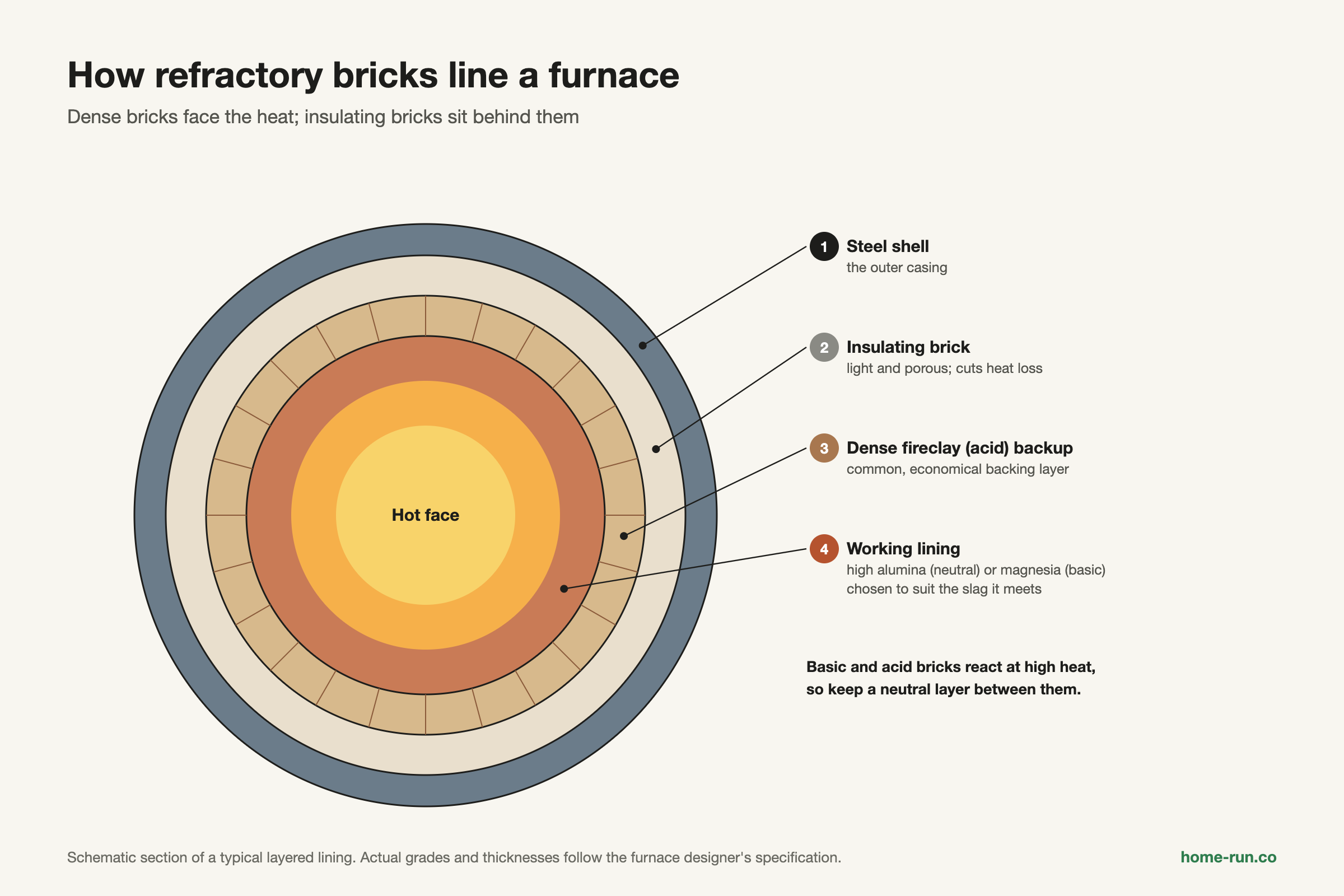
- Acid refractory bricks (silica, fireclay) resist acid slags and attack from basic slags.
- Neutral refractory bricks (high alumina, chromite, SiC) tolerate both slag types reasonably well.
- Basic refractory bricks (magnesia, magnesia-carbon, magnesia-spinel) resist lime-rich steel and cement clinker.
Refractory brick types and where they are used
ispatguru, refra.com, IS 6:1983| Type | Class | Main oxide | Typical use |
|---|---|---|---|
| Fireclay Most common | Acid | 30%+ alumina, rest silica | Boilers, ladle backups, small kilns, pizza ovens |
| High alumina | Neutral | 50–99% alumina | Blast furnaces, cement kiln coolers, hotter kiln zones |
| Silica | Acid | Mostly SiO₂ | Coke ovens, glass furnaces, hot blast stoves |
| Magnesia-carbon | Basic | 80–93% MgO, 7–20% graphite | Steel converters (BOF), arc furnaces, ladle slag lines |
| Magnesia-spinel | Basic | MgO with MgAl₂O₄ spinel | Cement kiln burning and transition zones, chrome-free |
| Insulating firebrick Backup | Mostly alumina-silica | Over 45% porosity | Backup layer behind the hot face |
Dense refractory brick
Hot faceTouches flame, metal or slag.
- High crushing strength, carries load
- Resists abrasion and slag
- Conducts more heat through the wall
Insulating refractory brick
BackupSits behind the dense layer.
- Light, with more than 45% porosity
- Weak against abrasion and load
- Cuts heat loss and shell temperature
Ceramic fibre, an alumina-silica blanket rather than a brick, is a lighter third layer.
Which Properties Decide Heat Resistance and Strength?
Refractory brick properties come down to how hot the brick can run, how much load it carries when hot, and how it handles thermal shock and slag.
Key refractory brick properties
Tested under the IS 1528 series| Property | What it tells you | IS 6:1983 Type 1 limit |
|---|---|---|
| Refractoriness (PCE) | Temperature at which a cone of the material bends | ASTM cone 30 min |
| Refractoriness under load (RUL) | Softening point while carrying weight | 1,300 min |
| Alumina content | Higher usually means hotter service | 30% min |
| Apparent porosity | Open pores that let slag in | 25% max |
| Cold crushing strength | Strength for handling and load | 20 MPa min |
| Permanent linear change | Shrinkage or growth after reheating at 1,350 °C | 1.0% max |
Thermal conductivity and thermal shock resistance matter too. Silica bricks, for example, are nearly free of spalling above about 593 °C but crack easily below it.
Refractory bricks with lower porosity have higher strength and better slag resistance, but they also conduct more heat. Use dense, low-porosity bricks where slag or wear hits, and porous bricks only behind them.
The main disadvantages of refractory bricks are weight, brittleness under sudden temperature swings, and slower laying than castables (pourable refractory concrete).
Where Are Fire Bricks Used in Industry and at Home?
Refractory bricks are used for any lining that holds fire, molten metal, glass or hot gas for long periods.
- Steel: blast furnaces, converters, arc furnaces and ladles. IS 8953:2006 covers 62% alumina bricks for blast furnaces.
- Cement: rotary kilns use alkali-resistant fireclay in the preheater, magnesia-spinel in the burning zone and high alumina in the cooler.
- Glass: silica and zircon-mullite bricks (IS 10551:1983) line melting tanks.
- Coke ovens: silica bricks are the most used refractory in a coke oven battery.
- Boilers, foundries and forges: fireclay and high alumina bricks. IS 14406:1996 gives recommendations for forge and heat treatment furnaces.
- Homes and restaurants: pizza ovens, tandoors, barbecue pits and fireplaces, usually with fireclay bricks.
What Challenges Does India's Refractory Industry Face?
India's refractory industry depends on steel and on imported raw materials. IMARC values the market at USD 2.58 billion in 2025, with iron and steel taking a 70% share.
- Imported inputs: fused alumina, zirconia and high-purity magnesite come largely from China, Europe and other countries, which exposes makers to price and currency swings.
- Skilled installers: IMARC also flags a shortage of trained installers for specialty linings.
- Waste and emissions: spent linings are heavy, bulky waste from every relining.
Recycling is the clearest innovation. In June 2026, RHI Magnesita (51%) and Khemka Refractories (49%) announced a venture to recover and reuse spent refractories in Odisha, close to steel clusters.
Online B2B listings show makers in Gujarat, Rajasthan, Jharkhand and Tamil Nadu, plus a Bengaluru seller of 70% alumina bricks.
How Do You Choose the Right Grade?
Choose a refractory brick by working temperature first, then chemistry, load and thermal cycling.
- Maximum working temperature, with a margin below the brick's rating
- Slag or gas chemistry: acid, neutral or basic
- Load on the brick when hot (roof, arch or wall)
- Heating and cooling cycles per day (thermal shock)
- Abrasion from charge, ash or tools
- Whether an insulating backup layer is needed
- Size and shape: straights, arches, wedges or splits
- Matching refractory mortar from the same supplier
For a home pizza oven or tandoor, a dense fireclay brick to IS 6 is usually enough. Industrial kilns need a lining design from the furnace maker or a refractory engineer.
- No IS grade or test certificate offered
- Uneven colour, black cores or a dull ring when two bricks are tapped
- "Fire bricks" that are really ordinary red bricks
- Used refractory bricks for sale with slag glaze or deep cracks
How Are the Bricks Laid and Cured?
Refractory bricks are laid with thin joints of refractory mortar, then dried out slowly before full firing.
- Lay a level, dry base that can carry the weight of the lining.
- Dry-lay one course to plan joints, cuts and expansion gaps.
- Butter each brick with refractory mortar, keep joints thin and stagger vertical joints, as in normal masonry.
- Cut bricks with a masonry saw, not a chisel, to avoid hidden cracks.
- Leave expansion joints where the supplier specifies them.
- Let the work air-dry, then heat it in stages.
Ordinary cement mortar breaks down in sustained heat, so use refractory mortar. A big first fire turns trapped water into steam and cracks the lining.
A typical small wood-fired oven schedule, from oven maker Forno Bravo, looks like this.
Finish the brickwork
Complete the dome or walls and joints.
Rest and air-dry
Leave the oven for one week before any fire.
First curing fire
Hold about 150 °C (300 °F) for the day.
Step the heat up
Raise the target by about 28 °C (50 °F) each day.
Final curing fire
Hold about 260 °C (500 °F). Normal cooking fires can follow.
Industrial linings follow the supplier's heat-up curve instead. Silica linings, for example, need a slow rise to about 800 °C.
Where Can You Buy Refractory Bricks in India, and at What Price?
Refractory bricks in India are sold by manufacturers, regional traders and B2B marketplaces. Standard 30–50% alumina bricks in the 230 × 115 × 75 mm size list at about ₹15–45 per piece on IndiaMART; 70% alumina bricks list at about ₹105–125 (checked 15 Nov 2026).
Prices vary with alumina content, quantity, freight and minimum order, so get a written quote with the grade and size.
For a house wall rather than a heat lining, ordinary red bricks or blocks are the right and cheaper choice.
Building a fireplace, oven or boundary wall?
Bricks, cement and masonry tools delivered across Bengaluru.