On this page
- What Is False Flooring and Why Is It Used?
- What Are the Types of False Flooring?
- Where Are Raised Access Floors Used?
- Why Choose a Raised Floor Over a Solid Floor?
- How Do You Choose the Right Panel Material?
- How Is False Flooring Installed?
- How Much Does a Server Room Raised Floor Cost?
- How Do You Maintain a Raised Floor in Indian Weather?
- How Do You Pick a Supplier in Bengaluru?
- False flooring is a raised floor of loose panels on adjustable pedestals.
- The void below carries cables and cool air, and any panel lifts out for access.
- Steel cement-filled panels are the common pick; calcium sulphate suits heavy, quiet floors.
- Server rooms need anti-static (ESD) panels bonded to an earth grid.
False flooring is a raised floor built from removable panels that sit on adjustable pedestals above the concrete slab. The gap underneath holds power cables, data lines and air ducts, so you can reach them by lifting a single panel.
What Is False Flooring and Why Is It Used?
A false floor, also called a raised access floor, is a second walking surface lifted above the structural slab. It creates a service void (plenum) for wiring and air.
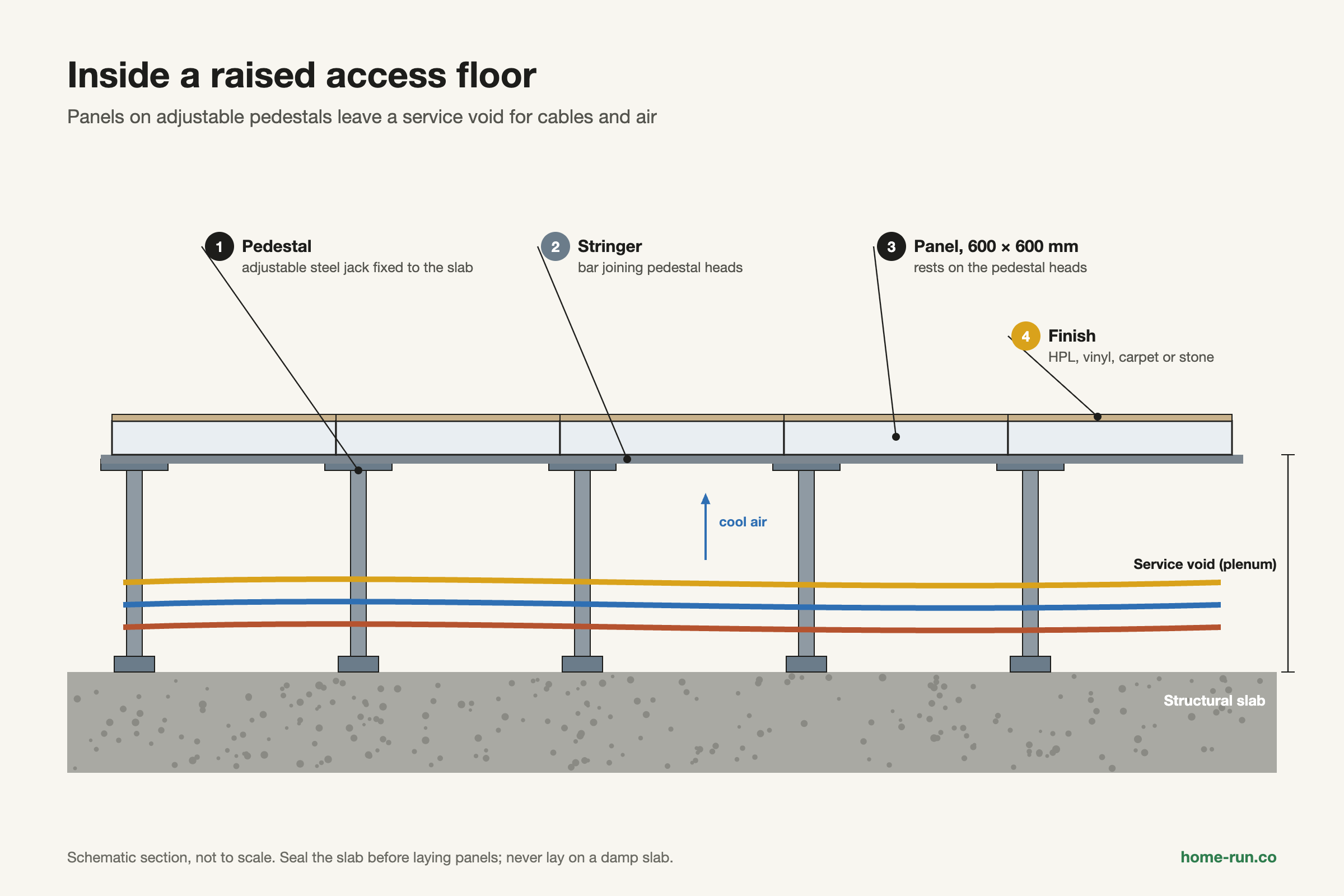
- Pedestals: adjustable steel jacks fixed to the slab, which set the floor level.
- Stringers: bars that join pedestal heads and steady deeper floors.
- Panels: 600 × 600 mm tiles that rest on the pedestal heads.
- Finish: HPL (high-pressure laminate), vinyl, carpet tiles or stone on top.
A false ceiling hides services overhead. A false floor puts them underfoot, where you reach them without a ladder and can send cool air straight up to equipment.
What Are the Types of False Flooring?
False flooring types differ mainly by panel core, which sets load capacity and price. Indian makers such as Unitile, based in Gujarat, offer most of these.
Common false flooring panel types
Indicative 2026 ranges| Panel type | Build | Best for | Indicative ₹/sq ft |
|---|---|---|---|
| Woodcore Budget | Chipboard core, steel-encapsulated or bare | Dry offices, low heights | 150–280 |
| Steel cementitious Default pick | Welded steel shell filled with cement | Offices, server rooms | 280–450 |
| Calcium sulphate Heavy duty | Dense mineral board, fire resistant | Data centres, quiet floors | 400–600+ |
| Aluminium / all-steel | Cast or pressed metal panel | Clean rooms, light loads | Varies by maker |
Anti-static false flooring is a finish, not a separate core. A conductive HPL or vinyl top drains static to an earth grid, which protects servers and electronics.
Where Are Raised Access Floors Used?
False flooring is used wherever cables or cooling change often:
- Server rooms and data centres, where perforated panels feed cold air to racks
- Open-plan offices and IT parks, with floor boxes for power and data
- Control rooms, labs and computer classrooms in schools and colleges
- Bank branches, trading floors and studios
Why Choose a Raised Floor Over a Solid Floor?
The main advantage of false flooring is access: you lift a panel instead of breaking a floor.
- Easy maintenance: add or reroute cables in minutes.
- Layout freedom: move desks and floor boxes without civil work.
- Cooling: the void works as an air supply plenum in server rooms.
- Level surface: pedestals absorb an uneven slab.
- Reuse: panels and pedestals can move to a new site.
Trade-offs: higher cost, a ramp at the door and less room height.
How Do You Choose the Right Panel Material?
Choose false flooring by the heaviest load it must carry, then by moisture and finish. A concentrated load is the weight on a small spot, such as a rack foot.
One Tate steel-cement panel, for example, is rated at 4.5 kN (about 459 kg) concentrated load under CISCA test methods (Ceilings & Interior Systems Construction Association).
Steel cementitious
Humid Indian sitesMost offices and server rooms.
- Steel shell resists moisture swelling
- Mid price, wide supply in India
- Heavier to lift than woodcore
Woodcore
BudgetDry, air-conditioned offices.
- Lighter and cheaper
- Core can swell if wetted
- Lower load ratings
Ask for the concentrated, rolling and ultimate load ratings in writing. Match them to your heaviest rack or UPS, plus a margin, before you compare prices.
How Is False Flooring Installed?
False flooring installation takes six steps, done by a trained crew after wet trades finish.
- Clean, dry and seal the slab so dust does not rise into the plenum.
- Mark a 600 mm grid from a fixed reference line with a laser level.
- Glue the pedestal base plates to the slab and set each head to the finished floor height.
- Fix stringers where the floor is tall or carries heavy loads.
- Lay panels from the centre outwards, then cut perimeter panels to fit.
- Fit ramps, perforated panels and floor boxes, then bond the earth grid.
Never lay panels on a damp or unsealed slab. Avoid cutting many panels in one row. Without earthing, an anti-static finish does not work.
How Much Does a Server Room Raised Floor Cost?
A false flooring cost estimate is the floor area times the rate per sq ft, plus add-ons.
How Do You Maintain a Raised Floor in Indian Weather?
Maintain false flooring by keeping dust and moisture out of the void. Clean the top with a damp mop and a neutral cleaner, and vacuum the plenum once or twice a year.
Monsoon humidity is the main risk in India. ASHRAE (American Society of Heating, Refrigerating and Air-Conditioning Engineers) recommends a dew point of −9 to 15 °C and no more than 70% relative humidity for data centres.
How Do You Pick a Supplier in Bengaluru?
Ask two or three false flooring suppliers in Bengaluru for itemised quotes with the same panel type, height and load rating.
- No written load ratings or test reports
- Panels that rock or click when you step on them
- Rusty pedestals or bent panel edges at delivery
- A quote that hides ramps, trims and earthing
Compare raised panels with other options in our guides to epoxy flooring and types of floor tiles.
Preparing the slab for a false floor?
Materials for slab repair and sealing delivered across Bengaluru.