On this page
- Which Bathroom Building Materials Does a Typical Bathroom Need?
- What Factors Matter Most When Choosing Bathroom Materials?
- What Are the Best Bathroom Wall Materials?
- Which Bathroom Flooring Materials Are Safest?
- Which Countertop Bathroom Building Materials Last Longest?
- What Eco-Friendly Bathroom Materials Are Available in India?
- Which Materials Are Best for Bathroom Fixtures and Fittings?
- How Do Bathroom Building Materials Compare Side by Side?
- How Do You Maintain Different Bathroom Materials?
- How Should You Plan and Buy Bathroom Building Materials?
- Good bathroom building materials share three traits: low water absorption, slip resistance and easy cleaning.
- For floors, choose matt vitrified or anti-skid ceramic tiles rated R10 or R11; keep polished marble out of the wet zone.
- For walls, glazed ceramic tiles over a waterproofed base remain the default; lime finishes and panels suit dry zones.
- Bengaluru water is often hard, so pick brass or stainless steel fittings and anti-stain sanitaryware.
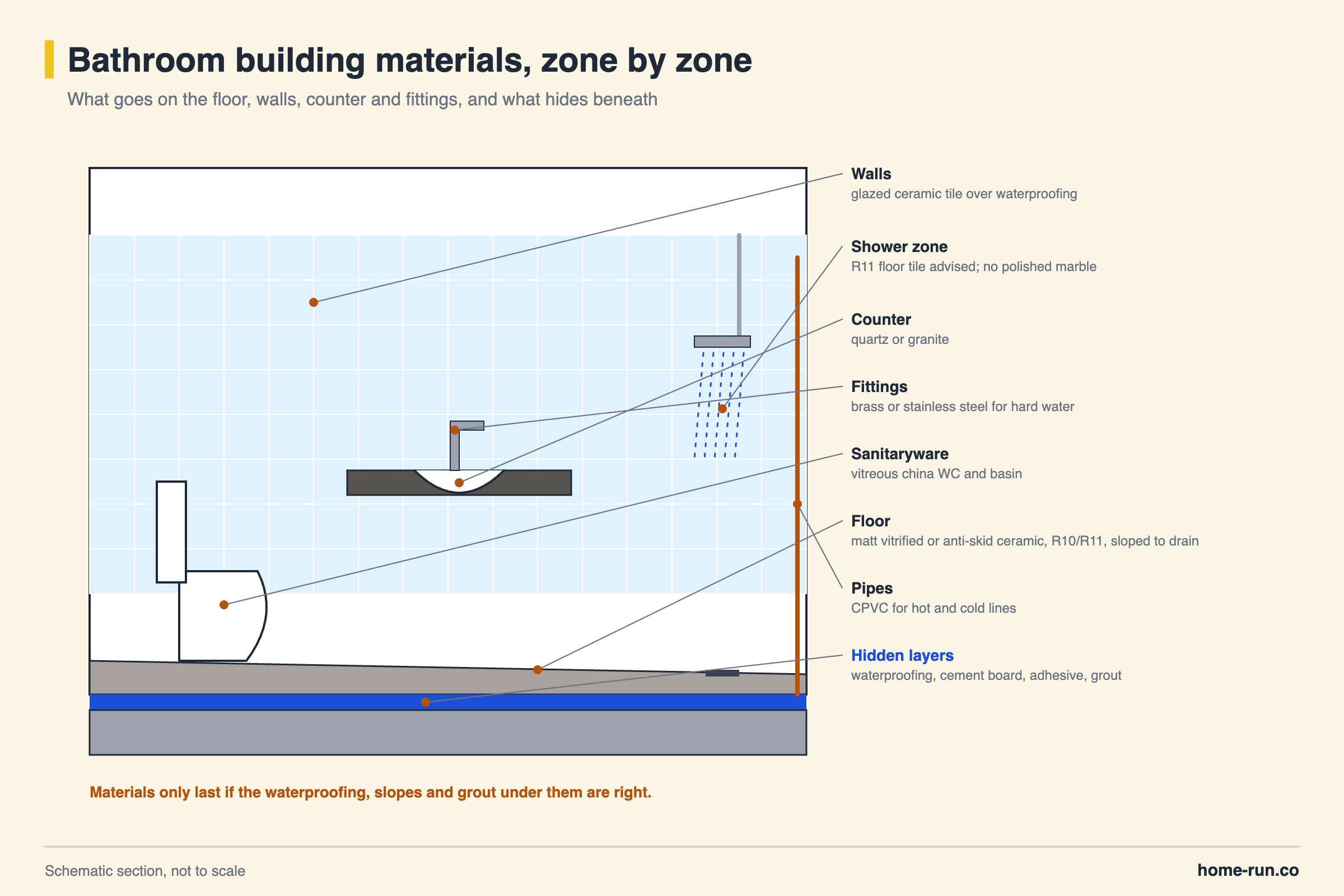
- Materials only last if the waterproofing, slopes and grout under them are right.
Bathroom building materials are the tiles, stones, boards, plasters, sanitaryware and fittings that make up a bathroom's floor, walls, counters and fixtures. The right ones resist water, stay safe underfoot and clean easily. In India's humid, hard-water conditions, those three tests matter more than looks.
This list covers each zone of the bathroom and points you to our deeper guides where a topic needs more space.
Which Bathroom Building Materials Does a Typical Bathroom Need?
A typical bathroom needs materials for six zones: the floor, the walls, the counter, the sanitaryware, the fittings and the hidden layers below. Each zone faces a different mix of water, wear and cleaning.
Here is the bathroom building materials list by zone:
- Floor: anti-skid ceramic tiles, vitrified tiles, natural stone, vinyl.
- Walls: glazed ceramic tiles, large-format vitrified slabs, tadelakt or lime plaster, PVC or laminate panels.
- Counter: quartz, granite, marble, solid surface.
- Sanitaryware: vitreous china WCs (water closets) and basins.
- Fittings: brass, stainless steel, zinc alloy or plastic taps and showers.
- Hidden layers: waterproofing, cement board, CPVC pipes, tile adhesive and grout.
Engineered stone is crushed stone bound with resin. Quartz slabs are more than 90% solid aggregate and 7–10% resin, so they do not soak up water. Marble, limestone and travertine are natural stones with open pores that need sealing.
What Factors Matter Most When Choosing Bathroom Materials?
The factors that matter most are water absorption, slip resistance, stain and chemical resistance, hard-water tolerance, and how easily you can repair or replace the material. Budget and style come after these.
- Water absorption: lower is better. IS 15622, the Indian standard for glazed, vitrified and unglazed ceramic tiles, puts vitrified tiles at 0.5% or less.
- Slip resistance: check the R rating or barefoot rating on the box before you buy floor tiles.
- Stain resistance: soaps, hair dye and acidic cleaners mark porous stone quickly.
- Hard water: limescale dulls chrome, blocks shower nozzles and jams cheap cartridges.
- Space and ventilation: the National Building Code of India (NBC 2016) sets a minimum bathroom area of 1.8 m² with a 1.2 m width; small, damp rooms need the hardest-wearing finishes.
- Certification: look for the BIS (Bureau of Indian Standards) mark on tiles and sanitaryware. ISO 9001 and ISO 14001 certify a maker's quality and environmental systems, not the product itself.
What Are the Best Bathroom Wall Materials?
The best bathroom wall material for wet zones is glazed ceramic or vitrified tile fixed over a waterproofed surface. Dry zones, away from the shower, can take lime plaster finishes, PVC panels or moisture-resistant paint.
1. Glazed ceramic wall tiles
Ceramic tiles are clay tiles hardened in a kiln and coated with a glaze. The glaze, not the body, keeps water out. Wall tiles are light, cheap to cut and come in every finish. Grout lines are the weak point, which our bathroom tile and grout guide covers in detail.
2. Large-format vitrified slabs
Vitrified slabs absorb almost no water and leave fewer grout joints to clean. They are heavy, so they need a good adhesive and a skilled fixer.
3. Tadelakt and lime plaster
Tadelakt is a Moroccan lime plaster polished with stone and sealed with soap to make a jointless, water-repellent wall. It looks striking but needs a specialist applicator, and few Indian contractors offer it.
4. PVC and laminate panels
PVC panels and high-pressure laminate sheets go up fast and cost little. Laminate is paper or fabric layers fused with resin, and water at the edges can make it swell. Keep both out of direct shower spray.
Ceramic or vitrified tiles
Wet zones- Very low water absorption when glazed or vitrified
- Lasts decades if grout is maintained
- Wide range of sizes, colours and finishes
- Needs waterproofing and a sound base behind it
Tadelakt or panels
Dry zones- Tadelakt gives a jointless wall; panels install fast
- Tadelakt needs re-soaping; panel edges can swell
- Limited specialist labour for tadelakt in India
- Best used away from direct shower spray
Behind tiles, a cement board wall works well for dry partitions and ledges because it does not rot like plywood or gypsum.
Which Bathroom Flooring Materials Are Safest?
The safest bathroom flooring materials are matt or textured vitrified tiles and anti-skid ceramic tiles with an R10 or R11 slip rating. Polished marble and glossy tiles are the most slippery choices when wet.
DIN 51130, the German test for shod slip resistance, grades tiles R9 (lowest) to R13 (highest). Villeroy & Boch advises R10 or R11 for private bathrooms, and B or C under DIN 51097, the barefoot wet-area test. Some Indian guides name R10 and others R11, so treat R11 as the safer pick for the shower area.
5. Anti-skid ceramic and matt vitrified tiles
These tiles have a textured or matt surface that grips wet feet. Vitrified tiles in Group BIa absorb 0.5% water or less, so they resist stains and do not swell. Smaller floor tiles also help, because more grout lines give more grip and follow the slope to the drain more easily.
6. Marble and other natural stone
Marble, limestone and travertine look rich but are porous and soft. Acidic cleaners etch them, and a honed or leathered finish is needed to reduce slipping. Granite is harder and less porous, which makes it the better natural stone for a bathroom floor.
7. Vinyl flooring
Vinyl is a waterproof plastic sheet or plank that is warm and soft underfoot. It suits quick renovations over existing floors. Water can still get under poorly sealed edges, so vinyl is a weaker choice for an open shower floor.
Bengaluru's monsoon months keep bathrooms damp for long periods. Floors that dry fast and do not hold water in their pores stay cleaner and safer in that climate.
Which Countertop Bathroom Building Materials Last Longest?
Quartz and granite last longest as bathroom counters. Quartz is non-porous and needs no sealing, while granite is a hard natural stone that costs less and is widely quarried in South India.
8. Quartz
Quartz resists stains from soap, toothpaste and cosmetics. Its resin can be damaged by strong, direct heat, so keep hot styling tools on a mat.
9. Granite
Granite is the cost-effective stone in most Indian cities and handles daily wear well. A penetrating sealer once in a while keeps lighter shades from staining.
10. Marble and solid surface
Marble gives a classic look but stains and etches. Solid surface, an acrylic-based sheet, allows a jointless counter and basin in one piece and can be sanded to remove scratches.
A granite counter with a ceramic under-counter or table-top basin is the most common value pairing in Indian homes. Spend the savings on a better faucet, which you touch every day.
What Eco-Friendly Bathroom Materials Are Available in India?
Eco-friendly bathroom materials in India include recycled-content tiles, recycled glass mosaics, treated bamboo accessories, low-VOC adhesives and sealants, and water-efficient fixtures. Locally made materials also cut transport emissions.
- Recycled glass: mosaic tiles and counters made from crushed glass.
- Bamboo: fast-growing, but only for shelves, stools and dry-zone accessories, and only when sealed.
- Low-VOC products: adhesives, sealants and paints that release fewer volatile organic compounds indoors.
- Water-saving fittings: aerated taps, low-flow showers and dual-flush WCs. Our water-efficient fixtures guide lists flow rates.
LEED, the US-based green building programme, and IGBC, the Indian Green Building Council, rate whole buildings. They reward these choices through credits but do not certify single products.
Which Materials Are Best for Bathroom Fixtures and Fittings?
The best fitting materials are forged brass and stainless steel, while vitreous china is the standard for WCs and basins. Zinc alloy and plastic fittings cost less but wear out faster, especially in hard water.
11. Brass and stainless steel fittings
Asian Paints' hard-water guide reports that zinc alloy taps can fail within 18 to 24 months, while forged brass bodies with ceramic disc cartridges last much longer. The same guide rates stainless steel as the most scale-resistant finish. For tap styles, see our guide to types of faucets.
12. Vitreous china sanitaryware
Vitreous china is a dense, glazed ceramic used for WCs and basins. Choose BIS-marked pieces and an anti-stain glaze. Rimless WCs avoid the hidden rim where stains build up.
13. Plastic and copper
ABS plastic suits budget taps and accessories in low-use bathrooms. Copper appears mostly in decorative fittings; supply pipes today are usually CPVC, covered in our bathroom plumbing guide.
Fixture and fitting checklist
- Faucet body is brass or stainless steel, not zinc alloy.
- Cartridge is ceramic disc, not rubber washer.
- WC and basin carry the BIS mark and an anti-stain glaze.
- Finish matches across taps, shower and accessories.
- Spare parts are available locally for the brand you choose.
How Do Bathroom Building Materials Compare Side by Side?
Vitrified tiles, quartz and brass score best across water resistance, durability and upkeep. The table ranks each material on the factors that matter in a bathroom.
Bathroom building materials compared
Relative ratings for home bathrooms| Material | Best zone | Water resistance | Durability | Upkeep |
|---|---|---|---|---|
| Matt vitrified tile Default pick | Floor, walls | Very high | High | Low |
| Glazed ceramic tile Budget | Walls | High (glaze) | Medium | Low |
| Granite | Counter, floor | High | High | Low to medium |
| Quartz | Counter | Very high | High | Low |
| Marble, travertine | Counter, dry walls | Low to medium | Medium | High (sealing) |
| Vinyl | Floor, dry area | High (surface) | Medium | Low |
| Tadelakt | Feature walls | Medium | Medium | Medium |
| PVC or laminate panel Avoid in shower | Dry walls, ceiling | Medium | Low to medium | Low |
| Forged brass fittings | Taps, showers | Very high | High | Low |
| Zinc alloy fittings Hard water risk | Low-use taps | Medium | Low | Medium |
How Do You Maintain Different Bathroom Materials?
You maintain bathroom materials by cleaning with mild, pH-neutral products, drying wet areas, and fixing leaks early. Harsh acids are the fastest way to ruin stone, grout and chrome.
- Tiles and grout: wipe weekly; reseal cement grout when it darkens.
- Stone: use stone-safe cleaner and reseal marble and light granite as the maker advises.
- Fittings: wipe dry after use and descale aerators and shower heads with a mild vinegar soak.
- Ventilation: run the exhaust fan or open the window after every shower.
Warning signs to act on
- Dark, crumbling grout or hollow-sounding tiles.
- Damp patches or peeling paint on the wall behind the bathroom.
- White crust on taps that returns within days.
- Water pooling instead of flowing to the floor trap.
- Etched dull spots on marble after cleaning.
Damp walls next to a bathroom usually point to failed waterproofing or a pipe joint, not the tile. Our bathroom waterproofing guide explains how to test and fix it before you retile.
How Should You Plan and Buy Bathroom Building Materials?
Plan bathroom building materials in order: fix the layout and plumbing, measure areas, choose materials by zone, then buy with a wastage margin. Visit a showroom to see tiles wet and dry before you decide.
Layout and plumbing
Fix WC, basin and shower positions, pipe routes and floor-trap location.
Measure and list
Measure floor and wall areas and list every material by zone.
Select and sample
Check slip rating, water absorption and BIS marks; see samples in person.
Waterproof and test
Apply waterproofing and run a water-ponding test before tiling.
Tile and grout
Lay floor to slope, fix wall tiles, grout and seal joints.
Fit and finish
Install sanitaryware, fittings and accessories, then check for leaks.
Worked example: tile quantity for a 1.5 m × 2.4 m bathroom
Multiply each area by your supplier's current rate per square metre to get the tile budget.
Building or redoing a bathroom?
Tiles, waterproofing, plumbing and sanitaryware delivered across Bengaluru.