On this page
- Who Makes Polycab and Finolex Wires?
- Are Polycab and Finolex Wires ISI Certified?
- What Insulation Types Do the Two Brands Offer?
- How Does Copper Purity Compare in Polycab vs Finolex Wires?
- Polycab vs Finolex Wires: Which Specs Differ?
- Which Wire Size Do You Need?
- How Do You Check That a Polycab or Finolex Coil Is Genuine?
- Polycab or Finolex: Which Should You Choose?
- Polycab and Finolex house wires are both certified to IS 694:2010 and marked 1100 V.
- Both use electrolytic-grade copper: Polycab states 99.97% for Maxima+, Finolex states 99.96% in its FR leaflet.
- Current ratings on the two data sheets are within 1–2 A of each other for common sizes.
- Pick the insulation grade (FR, FR-LSH, HR) and the right size first; the brand choice comes after.
- Neither brand's data sheet states a warranty term, so ask the dealer in writing.
Polycab vs Finolex wires is a close comparison: both brands sell single-core copper house wire certified to IS 694:2010, in the same sizes and the same 90 m coils. The differences sit in product grades, stated copper purity and a few rating figures.
This page compares only what each brand documents on its own data sheets. Costs are left out, since they change often and vary by dealer.
Who Makes Polycab and Finolex Wires?
Polycab India and Finolex Cables are two of India's longest-running wire and cable makers. Both sell house wire across the country, including in Bengaluru.
- Polycab: traces its roots to 1964, was incorporated in Mumbai in 1996 and has its registered office in Halol, Gujarat. The company listed on the BSE and NSE in 2019.
- Finolex: began in 1956 as a small-scale unit in Pune making PVC-insulated cables, became a limited company in 1972 and runs plants in Pune, Goa and Roorkee.
Each brand sells several house-wire grades. A Polycab FR wire and a Finolex FR wire are closer to each other than a Polycab FR wire is to a Polycab HR FR-LSH wire. Match the grade first.
Havells, RR Kabel and KEI also sell house wire, but this page covers only Polycab and Finolex.
Are Polycab and Finolex Wires ISI Certified?
Yes. Both brands certify their house wires to IS 694:2010, the Bureau of Indian Standards (BIS) code for PVC-insulated household wiring cable, and print the ISI mark on the wire.
- Polycab FR-LSH data sheet: lists IS 694:2010, IS 8130:2013 (conductors) and IS 5831:1984 (PVC insulation).
- Finolex FR leaflet: lists IS 694:2010 category FR, IS 3961 (Part V) for current ratings, and BIS licence numbers CM/L 7306463, CM/L 7525273 and CM/L 8944096.
- Eco marks: both brands state RoHS and REACH compliance on the products checked.
The ISI mark on a wire carries a CM/L licence number. Enter it in the BIS Care app under "Verify Licence Details" to see which company holds that licence.
What Insulation Types Do the Two Brands Offer?
Both brands sell house wire in the main IS 694 fire grades, with PVC insulation in each case.
- FR (flame retardant): the insulation resists spreading a flame.
- FRLS or FR-LSH (flame retardant, low smoke and halogen): also limits smoke and corrosive halogen gas in a fire.
- HR (heat resistant): a PVC grade rated for a higher conductor temperature.
- LF (lead free): PVC made without lead stabilisers.
- HF (halogen free): uses a non-PVC compound with no halogens; check availability with each brand.
Finolex's FR leaflet gives an oxygen index of at least 29% and a temperature index of at least 250°C. Higher values mean the insulation needs more oxygen or heat before it keeps burning.
Polycab's Maxima+ Green wire is an HR FR-LSH LF grade with an 85°C heat rating. Its standard FR-LSH wire is rated for a 70°C maximum conductor temperature.
How Does Copper Purity Compare in Polycab vs Finolex Wires?
Copper purity is almost identical: Polycab states 99.97% for Maxima+ Green wire and Finolex states 99.96% for its FR house wire. Both describe the copper as electrolytic grade and annealed.
A 0.01 percentage-point gap does not show up in practice. Conductor resistance is the figure that matters, and both data sheets list the same maximum for class 5 wire: 7.98 Ω/km at 20°C for 2.5 sq mm.
Class 5 means fine, flexible strands. Polycab also offers some sizes in class 2, with fewer, thicker strands and a slightly lower resistance (7.41 Ω/km at 2.5 sq mm).
Polycab vs Finolex Wires: Which Specs Differ?
Polycab vs Finolex wires differ mainly in stated heat rating, insulation thickness and how each data sheet reports fire tests. The table puts the documented figures side by side.
Documented specs, Polycab vs Finolex house wire
From manufacturer data sheets and product pages, Nov 2026| Spec | Polycab | Finolex |
|---|---|---|
| Product checked | FR-LSH data sheet; Maxima+ Green (HR FR-LSH LF) | FR and FR-LSH (Flamegard) leaflets |
| Standard | IS 694:2010 | IS 694:2010 |
| Voltage marking | 1100 V AC | 1100 V |
| Conductor | Electrolytic copper, class 2 or 5 | Electrolytic copper, class 5 |
| Stated copper purity | 99.97% (Maxima+ Green) | 99.96% (FR leaflet) |
| Max conductor temperature | 70°C (FR-LSH); 85°C (HR grade) | Not stated in leaflet |
| Oxygen / temperature index | Tests listed, values not printed | ≥ 29% / ≥ 250°C |
| Insulation, 2.5 sq mm | 0.7 mm (class 5) | 0.7 mm (FR-LSH); 0.8 mm (FR) |
| Coil length | 90 m (also 180 m packs) | 90 m |
| Warranty on data sheet | Not stated | Not stated |
Which Wire Size Do You Need?
Wire size, in square millimetres (sq mm), sets how much current a wire can carry safely. A bigger cross-section carries more current with less heating.
Current rating in conduit, 2 wires single phase
Class 5 FR-LSH wire, manufacturer data sheets| Size | Polycab (A) | Finolex (A) |
|---|---|---|
| 1 sq mm | 11 | 11 |
| 1.5 sq mm | 14 | 13 |
| 2.5 sq mm Common | 19 | 18 |
| 4 sq mm | 26 | 24 |
| 6 sq mm | 31 | 31 |
Size the wire for the circuit's load and breaker first. A one-size step up matters far more than the 1–2 A gap between the two brands.
For how circuits and cable sizes fit together, see our guide to house wiring systems and cable selection and the electrical wiring and load basics for houses.
How Do You Check That a Polycab or Finolex Coil Is Genuine?
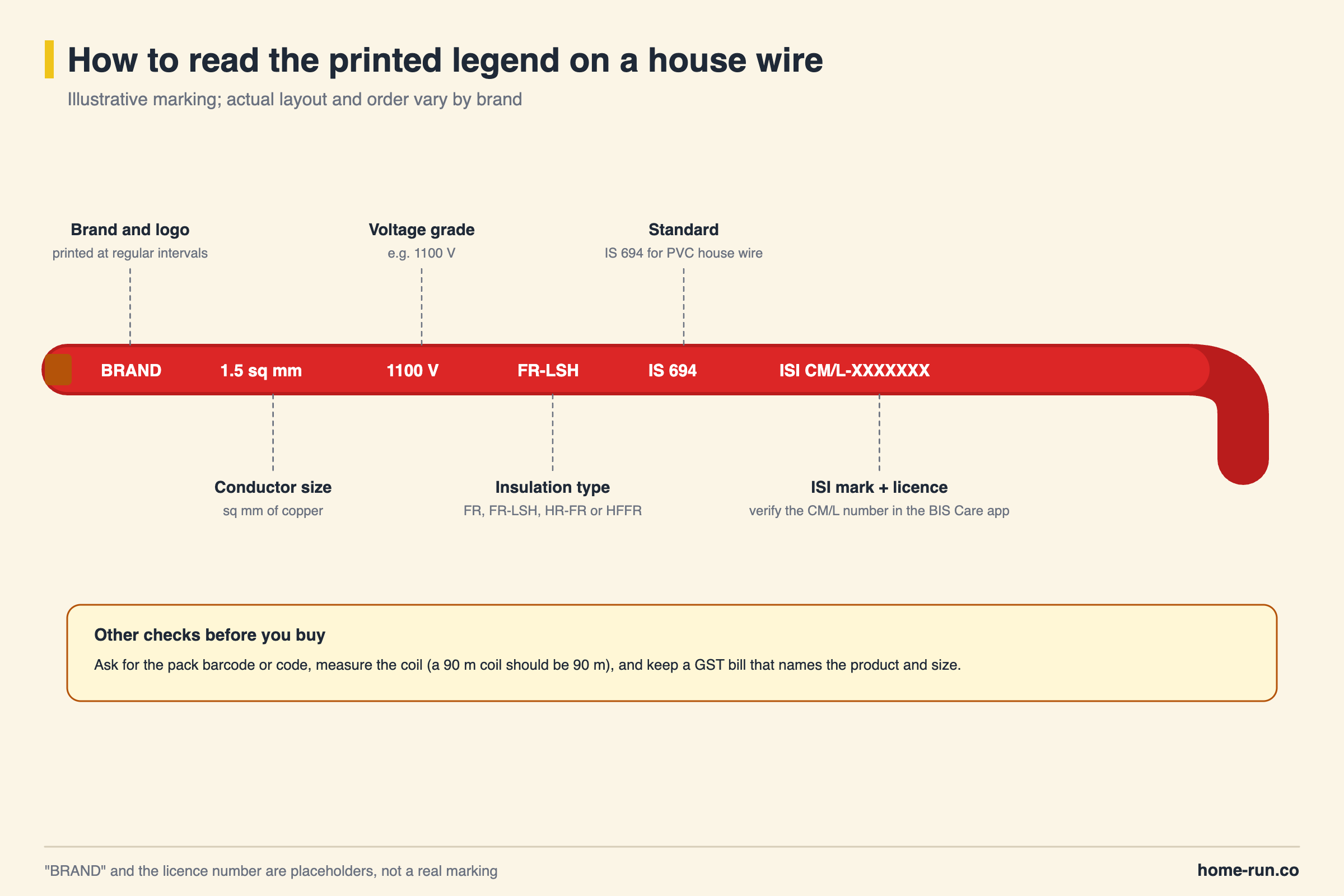
A genuine coil carries the brand's printed legend along the wire, a valid ISI mark with a CM/L licence number, and a bill from an authorised dealer.
- Printed legend: Finolex prints brand, logo, size, voltage grade, FR type, ISI mark and licence number at regular intervals on the wire.
- Licence check: verify the CM/L number in the BIS Care app.
- Pack code: Polycab added a unique barcode to consumer packs in 2017 for checks at purchase; ask the dealer how to scan it today.
- Coil length: a 90 m coil should measure 90 m.
- Bill: keep a GST invoice that names the product and size.
Finolex also verifies doubtful coils: send the cash memo, coil number and a 1 m sample to the company.
- No legend or a smudged legend on the wire itself.
- ISI mark without a CM/L number, or a number that does not match the brand in BIS Care.
- Insulation that peels or cracks when you bend a short length.
- Thin or few strands compared with the strand count on the data sheet.
- A loose coil with no label or a pack with spelling errors.
Polycab or Finolex: Which Should You Choose?
Either brand suits Bengaluru home wiring when you buy the right grade and size from an authorised dealer. On documented specs, the two are close.
Polycab house wire
Wide grade rangePoints
- 99.97% copper stated for Maxima+ Green
- HR grade rated to 85°C
- Class 2 and class 5 options
- 90 m and 180 m packs
Finolex house wire
Published fire valuesPoints
- 99.96% copper stated in FR leaflet
- Oxygen index ≥ 29% printed
- BIS licence numbers printed
- Factory check of doubtful coils
If your walls use concealed conduit, read how conduit wiring works before you buy the wire.
Wiring a new home?
House wires, switches, MCBs and conduits delivered across Bengaluru.