On this page
- What Are the Types of Electrical Wires for Home Use?
- Which Wire Size Is Right for Each Home Circuit?
- What Do FR, FR-LSH, HR-FR and HFFR Insulation Mean?
- Which Electrical Wire Brands Are Available in India?
- How Do You Check the Quality of House Wire Before Buying?
- How Should You Buy and Install House Wiring Cables?
- Most electrical wires for home use are single-core copper, 1100 V house wires made to IS 694.
- Size each circuit by load: 1.5 sq mm for lights, 2.5 sq mm for 16 A sockets, 4 sq mm for AC and geyser circuits.
- Match the MCB to the wire: the breaker rating must not exceed the wire's current rating in conduit.
- Choose FR-LSH or HFFR insulation for lower smoke in a fire; plain FR is the minimum.
- Buy only coils with the ISI mark and a CM/L licence number you can check on the BIS Care app.
Electrical wires for home wiring in India are mostly single-core, multi-strand copper conductors with flame-retardant PVC insulation, rated 1100 V and made to IS 694. The main types differ by conductor, core count and insulation. The main brands include Polycab, Havells, Finolex, RR Kabel, KEI, V-Guard, Anchor by Panasonic and Syska.
This explainer covers wire types, sizes by circuit, insulation and a brand overview. For how a full house circuit is planned, see our house electrical wiring guide.
What Are the Types of Electrical Wires for Home Use?
House wire is the insulated copper conductor that runs inside conduits from the distribution board to every switch, light and socket. Homes use four main types.
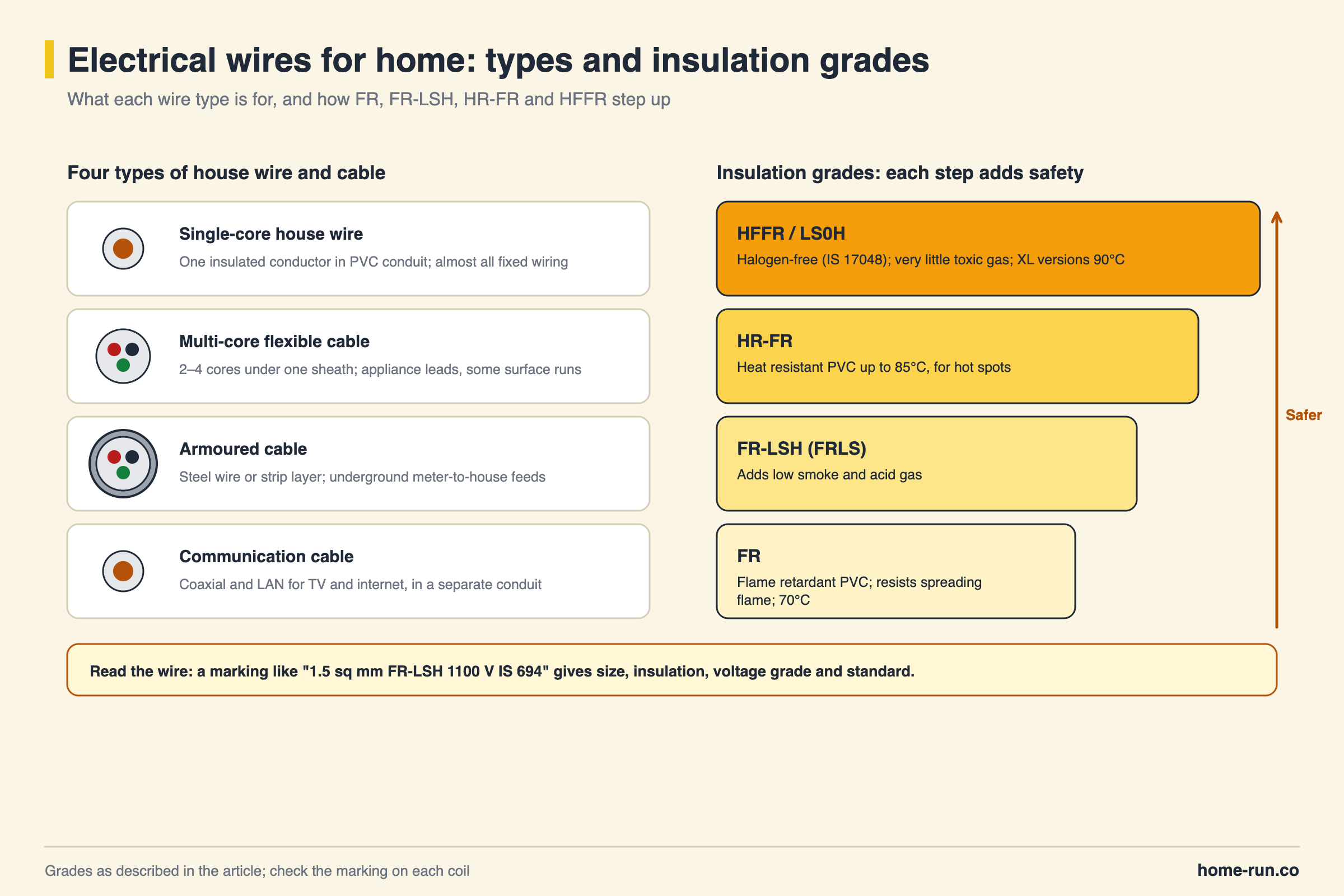
- Single-core house wire: one insulated conductor, pulled through PVC conduit. Used for almost all fixed wiring.
- Multi-core flexible cable: two to four insulated cores under one outer sheath. Used for appliance leads and some surface runs.
- Armoured cable: multi-core cable with a steel wire or strip layer. Used for underground runs, such as a meter-to-house feed.
- Communication cable: coaxial and LAN cable for TV and internet, run in a separate conduit.
House wire also comes in two conductor builds under IS 8130, the Indian Standard for conductors in insulated cables. Class 2 uses a few thicker strands. Class 5 uses many fine strands and bends more easily through conduit bends.
Every genuine coil carries its size, voltage grade, insulation type and standard on the insulation. A marking such as "1.5 sq mm FR-LSH 1100 V IS 694" tells you most of what you need before you read a brochure.
Copper vs aluminium: which conductor suits house wiring?
Copper is the standard conductor for electrical wires for home use. Aluminium conducts about 61% as well as annealed copper, so it needs a larger size for the same current.
Copper
House wiringPoints
- Electrolytic-grade copper, rated around 100% IACS
- Smaller size for the same current
- Flexible and easy to pull through conduit
- Firm, low-resistance joints at switches and MCBs
Aluminium
Service mainsPoints
- About 61% of copper's conductivity
- Needs a larger cross-section for the same load
- Stiffer and more prone to breakage when bent
- Terminals need care to avoid loose, hot joints
RR Kabel rates its electrolytic tough pitch (ETP) copper at 101% IACS, the International Annealed Copper Standard. Higher conductivity means lower resistance and less heating for a given size.
Which Wire Size Is Right for Each Home Circuit?
The right wire size for each circuit is the smallest size whose current rating in conduit is at least the MCB rating protecting it. In practice that means 1.5 sq mm for lighting, 2.5 sq mm for 16 A sockets and 4 sq mm for air-conditioner and geyser circuits.
Sub-circuit limits come from BIS wiring practice, which the National Electrical Code of India 2023 (NEC 2023) and IS 732, the code for electrical wiring installations, follow:
- Light and fan sub-circuit: not more than 10 points (lights, fans and 6 A sockets) and not more than 800 W.
- Power sub-circuit: not more than 2 outlets (16 A sockets), with the load normally kept within 3,000 W.
Current rating of copper house wire in conduit, by size
Two single-core wires, one circuit| Size (sq mm) | Polycab FR-LSH, Class 5 (A) | Finolex FR-LSH (A) | Max resistance at 20°C (Ω/km) |
|---|---|---|---|
| 1.0 | 11 | 11 | 19.5 |
| 1.5 | 14 | 13 | 13.3 |
| 2.5 | 19 | 18 | 7.98 |
| 4.0 | 26 | 24 | 4.95 |
| 6.0 | 31 | 31 | 3.30 |
| 10 | 42 | Not listed | See data sheet |
The two brands' figures differ by 1 to 2 A because they use different reference tables. Use the rating printed in the data sheet of the wire you actually buy.
Wire size by circuit for a typical home
Single-phase, copper, wires in PVC conduit| Circuit | Typical load | Wire size | MCB |
|---|---|---|---|
| Lights and fans Most points | Up to 800 W, 10 points | 1.5 sq mm | 6 A or 10 A |
| 6 A plug points | Phone chargers, TV, laptop | 1.5 sq mm | 10 A |
| 16 A power sockets | Up to 3,000 W, 2 outlets | 2.5 sq mm | 16 A |
| AC, geyser, oven | One appliance per circuit | 4 sq mm | 20 A |
| Sub-main to a floor board | Whole floor | 6 sq mm | Up to 25 A |
| Sub-main, higher load | Whole floor or flat | 10 sq mm | 32 A or 40 A |
Both data sheets rate 6 sq mm at 31 A in conduit, which is below a 32 A MCB. Ratings also fall when several circuits share one conduit or the roof space runs hot. In those cases, step up one size.
A worked check: a 2,000 W geyser draws 2,000 ÷ 230 = 8.7 A. A 2.5 sq mm wire could carry that, but a 4 sq mm wire on a 20 A MCB leaves headroom for a larger heater later.
Conduit choice also affects how many wires fit in a run. Our conduit wiring guide explains the options.
What Do FR, FR-LSH, HR-FR and HFFR Insulation Mean?
FR, FR-LSH, HR-FR and HFFR are insulation grades that control how a house wire behaves in heat and fire. All four are sold as electrical wires for home use, and each step adds a safety property.
- FR (flame retardant): PVC compound that resists spreading flame. Rated for a 70°C conductor.
- FR-LSH (flame retardant, low smoke and halogen): often sold as FRLS. Gives off less smoke and acid gas than plain FR.
- HR-FR (heat resistant, flame retardant): PVC rated up to 85°C, for hot spots such as near lights or kitchens.
- HFFR or LS0H (halogen-free, flame retardant): made to IS 17048. Contains no halogen, so it releases very little toxic gas. Cross-linked versions run at 90°C.
Finolex's Flamegard FR-LSH leaflet shows the gap against ordinary PVC: oxygen index above 29% vs 23%, temperature index above 250°C vs 150°C and acid gas under 20% vs 45 to 50%.
Smoke and acid gas cut visibility and make escape harder in a fire. FR-LSH or HFFR insulation is the sensible default for bedrooms, stairwells and apartments.
For a side-by-side of how house wiring systems are laid out, see our explainer on house wiring types and cable selection.
Which Electrical Wire Brands Are Available in India?
The main brands of electrical wires for home use in India are Polycab, Havells, Finolex, RR Kabel, KEI Industries, V-Guard, Anchor by Panasonic and Syska. All of them sell ISI-marked copper house wire in the common sizes.
Differences sit mainly in the insulation grades each range offers. The table lists what each brand publishes for its house-wire range.
House-wire ranges by brand
From each brand's own product pages and data sheets| Brand | Examples of house-wire lines | Insulation grades listed |
|---|---|---|
| Polycab | FR-LSH, Etira, HR-FR-LSH-LF Green Wire, HFFR | FR, FR-LSH, HR-FR-LSH, HFFR (IS 17048) |
| Havells | Lifeline, Life Line Plus S3, Life Guard, Life Shield | FR, HRFR, FR-LSH, HFFR |
| Finolex | FR Gold, FR Silver, Flamegard FR-LSH | FR, FR-LSH |
| Anchor by Panasonic | Advance FR, Copapro FR, Fireguard FR-LSH | FR, FR-LSH |
| KEI Industries | Homecab FR | FR and others; check current range |
| RR Kabel | See brand site | FR, HR-FR, LS0H types in its guidance |
| V-Guard, Syska | See brand site | Check data sheet per product |
For house wiring, compare brands on documented specs rather than on name. A detailed Polycab vs Finolex comparison is planned as a separate HomeRun guide.
Two coils from different brands with the same size, insulation grade and IS 694 marking should do the same job. The data sheet, not the logo, is what to compare.
HomeRun Team
How Do You Check the Quality of House Wire Before Buying?
Check the ISI mark, the printed markings and the conductor before you buy any electrical wire for home use. A genuine coil passes all three checks.
- The ISI mark with IS 694 (or IS 17048 for HFFR) and a CM/L licence number is printed on the coil or wire.
- The CM/L number shows the maker's details in the BIS Care app under "Verify Licence Details".
- The insulation repeats brand, size, voltage grade (1100 V) and insulation type along the length.
- The copper is bright and evenly coloured, and the strand count matches the data sheet.
- The coil length is as labelled, usually 90 m; some ranges also come in 180 m.
- The insulation is even in thickness, with no thin spots, bubbles or cracks.
Red flags when buying electrical wires
- No ISI mark, or a CM/L number that does not return a licence in the BIS Care app.
- Markings that rub off with a thumb or skip sections of the wire.
- Dull, blackened strands, or copper-coated aluminium sold as copper, under the insulation.
- A coil that feels much lighter than another of the same size and length.
- Insulation that cracks when bent sharply.
Lab checks also exist. IS 8130 sets a maximum conductor resistance, for example 13.3 Ω/km at 20°C for 1.5 sq mm. Under-sized copper fails this test.
How Should You Buy and Install House Wiring Cables?
Buy electrical wires for home use from an authorised dealer and have a licensed electrician install them. Follow this order.
- List every circuit and its MCB rating with your electrician.
- Choose the size for each circuit from the in-conduit rating table.
- Pick one insulation grade for the whole house, FR-LSH or better.
- Buy sealed, ISI-marked coils and keep the invoice for the warranty claim.
- Use separate colours for phase, neutral and earth, and keep them the same through the house.
- Ask for insulation resistance and earth tests before the circuits are switched on and handed over.
Warranty terms vary by brand and range. Read them on the coil pack or the brand website.
Wiring a new home or renovating?
House wires, MCBs and conduits delivered across Bengaluru.