On this page
- What Is Dr. Fixit Pidicrete URP SBR Latex?
- What Are the Benefits of Pidicrete URP?
- How Does Pidicrete URP SBR Latex Work?
- What Is the Dr. Fixit 301 Mixing Ratio for Each Use?
- How to Use Dr. Fixit Pidicrete URP SBR Latex, Step by Step
- How Should You Cure Pidicrete URP Work?
- What Is the Coverage of Dr. Fixit 301 URP?
- What Safety Precautions Apply to Pidicrete URP?
- Where Can You Buy Pidicrete URP and Learn More?
- Pidicrete URP is a ready-to-use SBR latex that you mix with OPC cement, never apply on its own.
- Use 1:1 by volume with cement as a bond coat and 1:1.5 by volume as a two-coat waterproofing slurry.
- In repair mortar and floor screed, add 6–7.5 kg URP per 50 kg cement along with about 10 litres of water.
- Expect about 2–2.2 m² per kg in two waterproofing coats and 4.2–4.5 m² per kg per bond coat.
- Prepare a clean, sound, damp surface and place new mortar while the bond coat is still tacky.
Dr. Fixit Pidicrete URP SBR latex usage comes down to three jobs: a bond coat between old and new concrete, a brush-on waterproofing coat, and an additive for repair mortar. Each job has its own mix with OPC (Ordinary Portland Cement).
Figures below come from the Pidilite technical data sheet (TDS) for Dr. Fixit 301. For other methods, see our guide to types of waterproofing in construction.
What Is Dr. Fixit Pidicrete URP SBR Latex?
Dr. Fixit Pidicrete URP is a modified styrene butadiene latex, sold by Pidilite as a ready-to-use liquid bonding agent. Its product code is 301, so you will also see it sold as Dr. Fixit 301.
SBR (styrene butadiene rubber) latex is an emulsion of synthetic rubber in water. Mixed with cement, it turns ordinary mortar into polymer-modified mortar.
The latex is a milky white liquid with about 38% solids. Sealed packs keep for 18 months.
Pidilite lists concrete repair and waterproofing of small terraces, toilets, bathrooms, chajjas, lift pits and balconies.
What Are the Benefits of Pidicrete URP?
The main benefit of Pidicrete URP is a stronger bond between new cement mortar and an old surface. The TDS also lists:
- Bonding: grips concrete, masonry, stone and plaster.
- Less shrinkage: lowers drying and ageing shrinkage, so fewer cracks.
- Flexural strength: mortar bends more before it cracks.
- Harder surface: better abrasion resistance and less dusting on floors.
- Durability: better resistance to erosion and corrosion.
Pidicrete URP improves a good cement job. It cannot rescue a dusty, loose or oily surface.
HomeRun Team
How Does Pidicrete URP SBR Latex Work?
Pidicrete URP works by forming a thin rubbery polymer film inside the cement paste as the mix dries. The film coats cement grains and bridges tiny pores.
- Bonding: the latex locks the new layer to the old surface.
- Waterproofing: the polymer film blocks capillary pores, so less water passes through.
- Crack control: the rubber phase adds flexibility and reduces shrinkage.
What Is the Dr. Fixit 301 Mixing Ratio for Each Use?
The Dr. Fixit 301 mixing ratio depends on the job: 1:1 by volume with cement for a bond coat, 1:1.5 by volume for waterproofing, and 6–7.5 kg per 50 kg cement in mortar.
Pidicrete URP mix ratios by application
Per Pidilite TDS 301, 50 kg OPC basis| Application | Cement | Sand / aggregate | URP | Water | Thickness |
|---|---|---|---|---|---|
| Bond coat (primer) Most used | 1 part | None | 1 part by volume | None | 1 brush coat |
| Waterproofing coat | 50 kg (1.5 parts) | None | 20–22 kg (1 part) | None | 2 brush coats |
| Patch repair mortar | 50 kg | 150 kg washed sand | 6–7.5 kg | 10 L | 5–25 mm |
| Floor screed / PCC | 50 kg | 75 kg sand + 75 kg 6 mm aggregate | 6–7.5 kg | 10 L | 10–40 mm |
| Slurry for pinholes, grouting Thin mix | 50 kg | None | 5 kg | 5 L | Slurry |
How to Use Dr. Fixit Pidicrete URP SBR Latex, Step by Step
To use Dr. Fixit Pidicrete URP, clean and dampen the surface, mix URP with cement to the ratio for your job, and brush or trowel it on in thin layers.
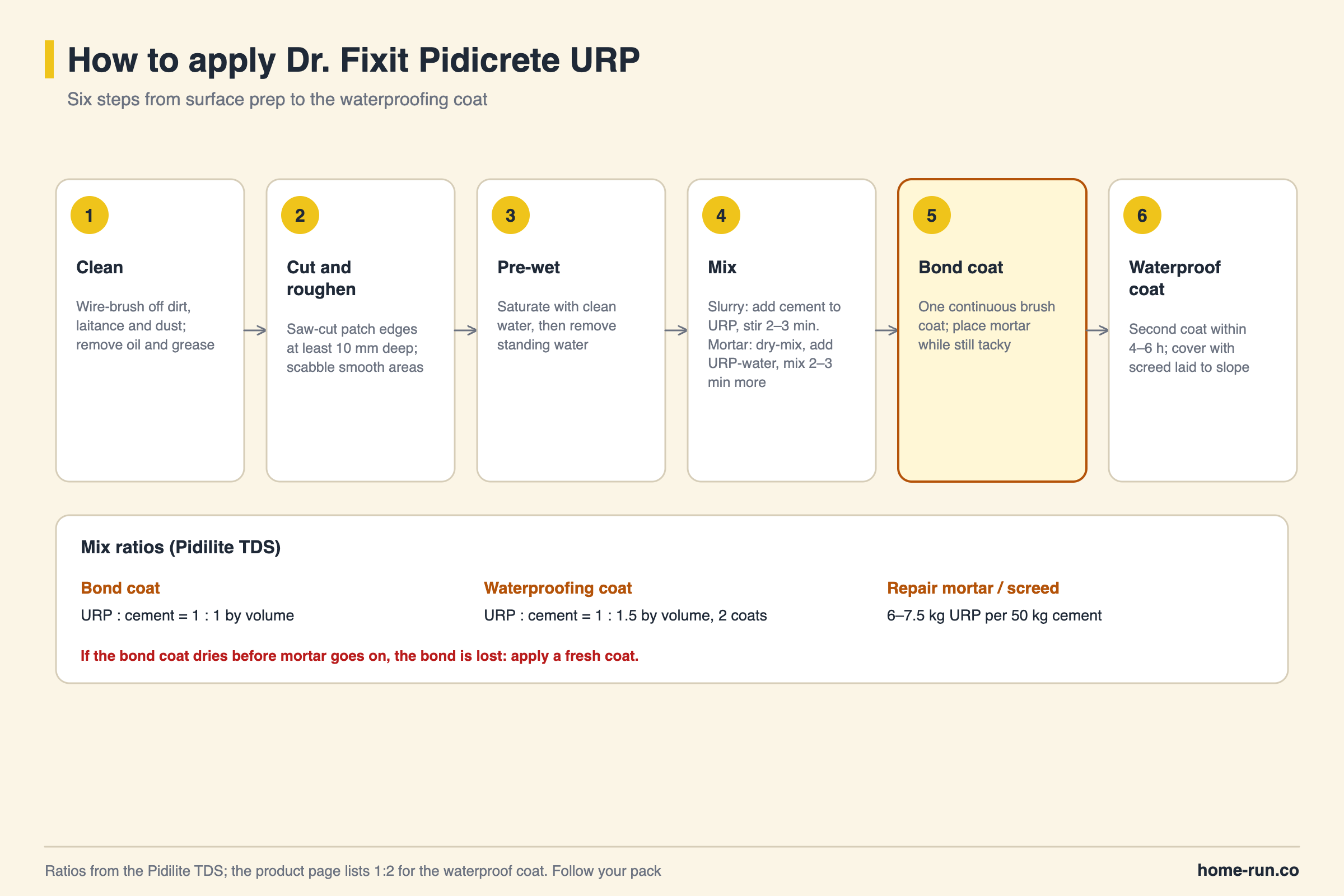
- Clean the surface: wire-brush or scrub off dirt, loose particles, laitance (the weak cement film on concrete) and dust. Remove oil and grease with a suitable solvent.
- Cut and roughen: saw-cut patch edges at least 10 mm deep to avoid thin, weak edges. Lightly scabble smooth areas.
- Pre-wet: saturate the surface with clean water, then remove standing water.
- Mix: for slurries, add cement slowly to the URP and stir for 2–3 minutes. For mortar, dry-mix sand and cement for 1–2 minutes, add the URP-water mix and mix for 2–3 minutes more.
- Apply the bond coat: brush one continuous coat and place the repair mortar while the coat is still tacky.
- Apply the waterproofing coat: brush the first coat, then the second within 4–6 hours. Cover it with a protective screed laid to slope.
Use a pan mixer or a drill with a spiral paddle at 400–500 rpm. Hand-mix only batches of 25 kg or less.
If the bond coat dries before the new mortar goes on, the bond is lost. Work in small areas. If the coat has dried, apply a fresh coat before placing mortar.
How Should You Cure Pidicrete URP Work?
Pidicrete URP work needs protection from fast drying, but the Pidilite TDS gives no curing period. Use the cement layer's normal curing as your baseline.
- First hours: shield fresh work from sun and wind. In hot weather, the TDS allows extra mix water for evaporation.
- Repair mortar and renders: keep moist under polythene or damp hessian. SBR latex guidance from Sika India advises at least 3–5 days, with no ponding before day 5.
- Protective screed and concrete: IS 456:2000, the Indian code for plain and reinforced concrete, calls for at least 7 days of moist curing with OPC.
What Is the Coverage of Dr. Fixit 301 URP?
The coverage of Dr. Fixit 301 URP is about 2–2.2 m² per kg in two waterproofing coats, and 4.2–4.5 m² per kg for one bond coat, per Pidilite.
- Waterproofing, 2 coats: 2–2.2 m²/kg, about 21.5–23.7 sq ft per kg.
- Bond coat, 1 coat: 4.2–4.5 m²/kg, about 45–48 sq ft per kg.
Plan on 1 kg of URP for every 20 sq ft of two-coat waterproofing. Rough or porous surfaces use more, so check the figures on your pack.
For leaks at walls and joints, see our guide to water seepage in walls.
What Safety Precautions Apply to Pidicrete URP?
Pidicrete URP mixes release alkali when wet, so protect your skin, eyes and lungs during mixing and application.
- Wear gloves, protective clothing and eye protection.
- Use a dust mask and keep small bathrooms ventilated.
- Rinse skin with clean water, then wash with soap and water.
- Flush eyes with plenty of clean water and get medical advice.
Common mistakes to avoid:
- Using URP alone: the latex needs cement to form a coating or bond.
- Painting a dusty slab: laitance and dust break the bond.
- Waiting too long: a dried bond coat no longer bonds.
- Skipping the screed: a bare waterproof coat wears out under foot traffic.
- Large terraces: Pidilite lists URP for small terraces only.
For roof slabs with active leaks, see our guide to leaking roof repair first.
Where Can You Buy Pidicrete URP and Learn More?
You can buy Dr. Fixit Pidicrete URP from hardware stores, Dr. Fixit dealers and online stores across India, in packs from 200 g to 50 kg.
- Check the pack: confirm it says 301 Pidicrete URP, not another Dr. Fixit latex.
- Read the TDS: Dr. Fixit publishes the 301 technical data sheet on its website.
Planning a repair or wet-area job?
Waterproofing chemicals, cement and sand delivered across Bengaluru.