On this page
- What Are Emulsion Paints for Interior and Exterior Walls?
- How Do Interior and Exterior Emulsion Paints Differ?
- What Does IS 15489 Say About Emulsion Paints?
- What Are the Types of Interior Wall Paint Finishes?
- How Do You Choose the Right Emulsion Paint for Your Walls?
- Which Emulsion Paint Brands Are Sold in India?
- Should You Paint Walls Yourself or Hire Professionals?
- How Do You Apply Emulsion Paint on Interior and Exterior Walls?
- How Do You Maintain and Refresh Emulsion-Painted Walls?
- Are Emulsion Paints Safe for the Environment?
- What Are the Signs of Poor-Quality Emulsion Paint?
- Emulsion paint is a water-based plastic paint for plastered walls and ceilings.
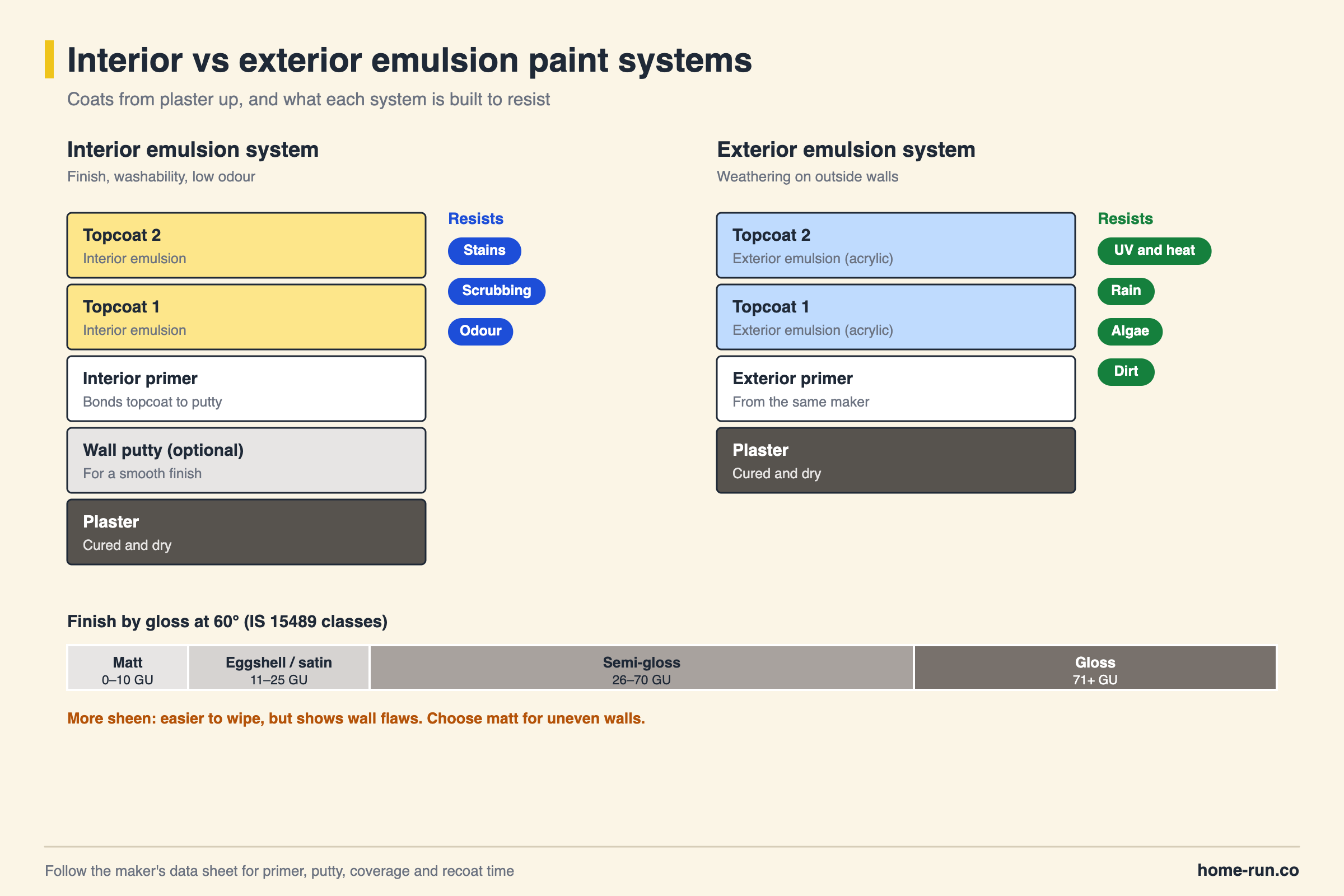
- Exterior emulsions add UV, rain, algae and dirt resistance. Interior emulsions focus on finish, washability and low odour.
- India's code is IS 15489, Paint, plastic emulsion. The 2024 revision replaced IS 15489:2013 from 3 March 2025.
- Finish is graded by gloss at 60°: matt 0–10, eggshell/satin 11–25, semi-gloss 26–70, gloss 71+.
Emulsion paints for interior and exterior walls are water-based paints that use a plastic binder, usually acrylic, to form a tough, breathable film on plaster. Interior emulsions are made for a smooth look and easy cleaning. Exterior emulsions are made to survive sun, rain and algae.
For the other common water-based wall paint, see our guide to distemper paint types and benefits.
What Are Emulsion Paints for Interior and Exterior Walls?
Emulsion paints are paints in which tiny drops of binder and pigment are dispersed in water. As the water evaporates, the binder particles fuse into a continuous film.
The binder is usually acrylic or vinyl-acrylic. Emulsions thin with water, dry in minutes and go over a primer, with putty where you want a smooth finish.
Distemper is a basic water-based paint with lower washability. Enamel is a solvent-based paint for wood and metal. Emulsion sits between them for walls: water-based, but with a film that can be wiped and, in exterior grades, weathered.
How Do Interior and Exterior Emulsion Paints Differ?
Interior and exterior emulsion paints differ in what the film must resist: stains and cleaning indoors, UV, rain, heat and algae outdoors.
Interior emulsion
Inside walls and ceilings- Smooth, even finish over putty
- Washable or stain-resistant grades
- Low odour, water clean-up
- Not made for rain or direct sun
Exterior emulsion
Outside walls- Often 100% acrylic binder
- UV-stable pigments to limit fading
- Anti-algal and dirt pick-up resistance
- Needs an exterior primer first
Interior vs exterior emulsion: two data sheets compared
Maker's figures, brush on primed masonry| Property | Tractor Emulsion (interior) | Apex Ultima (exterior) |
|---|---|---|
| Binder | Water-based emulsion | 100% acrylic, PU-modified |
| Coverage, 2 coats Check per product | 10–12 sq m/L (about 108–129 sq ft/L) | About 55–65 sq ft/L |
| Surface dry | 10–15 min | About 30 min |
| Recoat | About 4–8 h | 4–6 h |
| Sheen at 60° | 0–4 gloss units | 12–20 sheen units |
What Does IS 15489 Say About Emulsion Paints?
IS 15489 is the Bureau of Indian Standards (BIS) specification for plastic emulsion paint, covering interior and exterior emulsions for building surfaces after preparation and priming.
IS 15489:2024, the second revision, replaced the 2013 version for licensees from 3 March 2025. The table uses the 2004 edition plus the published changes.
Key IS 15489 requirements for plastic emulsion paint
Confirm against the current BIS text| Requirement | What the standard sets |
|---|---|
| Types Key point | Type 1 interior, Type 2 exterior (2004 edition) |
| Finish classes | Matt, eggshell/satin, semi-glossy, glossy |
| Hard dry, max | 4 h or 8 h, by class (2004) |
| Scrub resistance | Wet abrasion test, 4,000 oscillations, no film failure (2004) |
| Exterior durability | No film breakdown in under 12 months outdoors (2004) |
| Lead Revised | Cut from 300 ppm to 90 ppm in the second revision |
| VOC | Limits added in the second revision |
What Are the Types of Interior Wall Paint Finishes?
The types of interior wall paint finishes are matt, eggshell or satin, semi-gloss and gloss. IS 15489 separates them by how much light the dry film reflects at a 60° angle, measured in gloss units (GU).
Emulsion paint finishes by gloss level
Gloss at 60°, IS 15489 classes| Finish | Gloss units | Look | Good for |
|---|---|---|---|
| Matt Hides flaws | 0–10 | Flat, no shine | Living rooms, bedrooms, ceilings |
| Eggshell / satin | 11–25 | Soft, low sheen | Kids' rooms, passages |
| Semi-gloss | 26–70 | Clear shine | Kitchens, utility walls |
| Gloss | 71 and above | High shine | Trims and accent areas |
More sheen means easier cleaning but more visible wall flaws. Choose matt where walls are uneven, and satin or semi-gloss where walls get touched or splashed.
How Do You Choose the Right Emulsion Paint for Your Walls?
Choose an emulsion paint by matching type, finish and specs to the wall and its wear.
- Type and finish: interior or exterior grade, then matt, satin or gloss.
- Washability: look for a stated scrub or stain-resistance claim on the data sheet.
- Coverage and coats: read sq ft per litre for 2 coats on the product sheet.
- Primer and putty: buy the system the maker names, interior or exterior.
- Warranty: read the written terms and registration rules.
Bengaluru gets rain from both the southwest and northeast monsoons, so anti-algal exterior grades are worth checking for shaded walls.
Which Emulsion Paint Brands Are Sold in India?
Emulsion paint brands sold widely in India include Asian Paints, Berger, Birla Opus, Kansai Nerolac, Indigo and Dulux, each with interior and exterior ranges. Compare products on data sheets, not brand name.
Examples of emulsion ranges and what their sheets state
Listed alphabetically, not ranked| Brand | Example product | Use | Stated on maker's sheet |
|---|---|---|---|
| Asian Paints | Tractor Emulsion | Interior | 10–12 sq m/L for 2 coats, 0–4 GU sheen |
| Asian Paints | Apex Ultima | Exterior | 100% acrylic, anti-algal, 8-year performance warranty |
| Berger | WeatherCoat Anti Dustt | Exterior | 100% acrylic, dust and algae resistance, 8-year warranty |
| Birla Opus | Interior and exterior ranges | Both | Launched by Grasim Industries in February 2024 |
Most brands sell economy to luxury emulsions, such as Asian Paints Tractor Emulsion and Royale. Compare any two on finish, coverage, washability and warranty.
Should You Paint Walls Yourself or Hire Professionals?
DIY suits small repaints on sound walls. Professionals suit fresh plaster, exteriors, high walls and putty work.
DIY vs professional emulsion painting
Neither is right for every job| Factor | DIY | Professional |
|---|---|---|
| Spend | Materials and tools only | Materials plus labour |
| Surface prep | Hard to get putty and sanding even | Trained in putty, sanding and primer |
| Finish quality | Roller marks and patchy edges are common | More even coats and clean cutting-in |
| Exterior and height Risk | Ladders above one storey are unsafe | Scaffolding and safety gear |
How Do You Apply Emulsion Paint on Interior and Exterior Walls?
You apply emulsion paint in a fixed order: prepare the wall, putty if needed, prime, then apply two topcoats with the recoat gap the data sheet gives.
Cure and check the wall
Cure new plaster 28 days. Fix damp and cracks, scrape loose paint.
Putty (interior)
Thin coats of wall putty, sanded smooth.
Primer
One coat of the matching interior or exterior primer.
First topcoat
Thin as the data sheet says; brush or roll.
Second topcoat
Apply after the recoat gap on the sheet, often 4–6 hours. Add a third coat where the maker advises.
Primer choice matters for adhesion. Our guide to latex primer benefits and application explains where a water-based primer fits.
How Do You Maintain and Refresh Emulsion-Painted Walls?
Maintain emulsion-painted walls by cleaning gently, fixing damp early and repainting once the film fades or chalks.
- Wipe stains with a damp sponge and mild soap. Test a hidden spot first.
- Clean matt walls more gently than satin or gloss.
- Hold off wet cleaning until the paint has fully cured, as the data sheet states.
- Wash exterior walls before repainting to remove dust and algae.
- Repaint when exterior paint turns powdery, a problem covered in our guide to paint chalking causes and repair.
An emulsion is only as good as the wall under it. Fix damp and prep the surface before you pick a shade.
HomeRun Team
Are Emulsion Paints Safe for the Environment?
Emulsion paints are lower-impact than solvent paints because they thin with water, but they still contain some volatile organic compounds (VOCs), chemicals that evaporate as paint dries.
The 2004 edition of IS 15489 had an optional eco-mark limit of 5% VOC by mass. The second revision adds VOC limits and cuts the lead limit to 90 ppm.
Ventilate rooms until the smell clears. Seal leftovers for touch-ups and let empty cans dry before disposal.
What Are the Signs of Poor-Quality Emulsion Paint?
The main signs of poor-quality emulsion paint are missing marks, no data sheet and early film failure.
- No ISI mark or IS 15489 number on the pack.
- No data sheet with coverage, drying time and coats.
- Watery paint that needs many coats to hide.
- Colour rubbing off on a damp cloth weeks after painting.
- Interior paint sold for exterior walls.
Planning a repaint?
Emulsions, primers and putty delivered across Bengaluru.